MRC-Versus Arthritis Centre for Musculoskeletal Ageing Research, Royal Derby Hospital Centre, University of Nottingham, Derby, UK.
Department of Surgery & Anaesthetics, Royal Derby Hospital, Derby, UK.
J Cachexia Sarcopenia Muscle. 2021 Aug;12(4):866-879. doi: 10.1002/jcsm.12724. Epub 2021 May 31.
Declines in cardiorespiratory fitness (CRF) and fat-free mass (FFM) with age are linked to mortality, morbidity and poor quality of life. High-intensity interval training (HIIT) has been shown to improve CRF and FFM in many groups, but its efficacy in the very old, in whom comorbidities are present is undefined. We aimed to assess the efficacy of and physiological/metabolic responses to HIIT, in a cohort of octogenarians with comorbidities (e.g. hypertension and osteoarthritis).
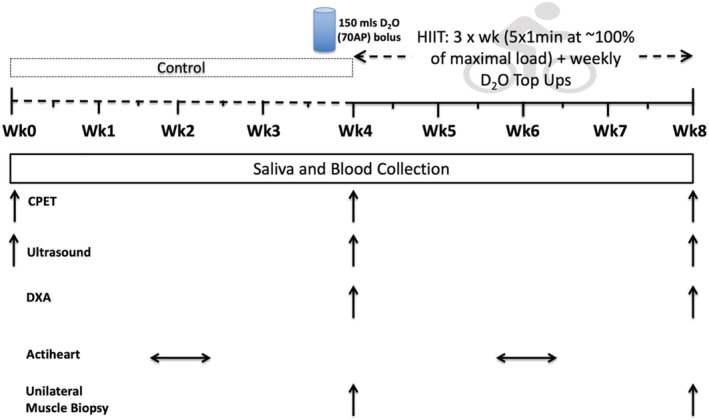
Twenty-eight volunteers (18 men, 10 women, 81.2 ± 0.6 years, 27.1 ± 0.6 kg·m ) with American Society of Anaesthesiology (ASA) Grade 2-3 status each completed 4 weeks (12 sessions) HIIT after a control period of equal duration. Before and after each 4 week period, subjects underwent body composition assessments and cardiopulmonary exercise testing. Quadriceps muscle biopsies (m. vastus lateralis) were taken to quantify anabolic signalling, mitochondrial oxidative phosphorylation, and cumulative muscle protein synthesis (MPS) over 4-weeks.
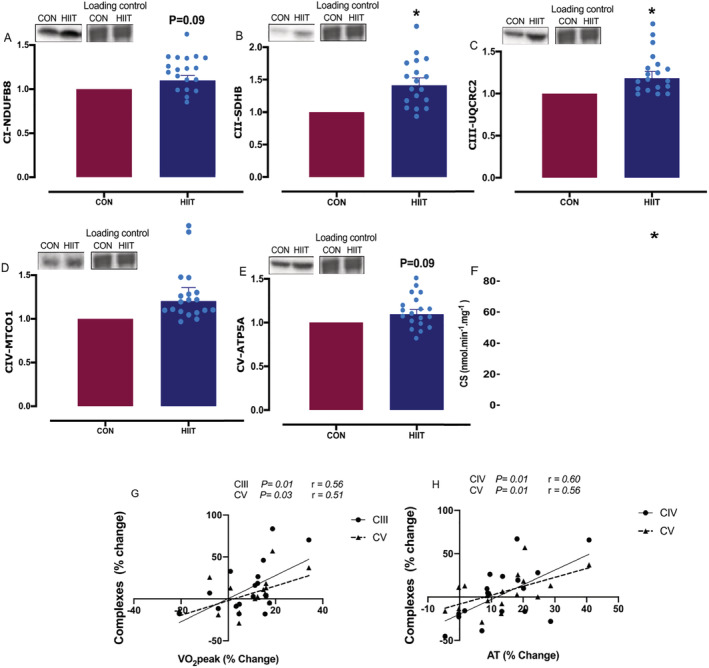
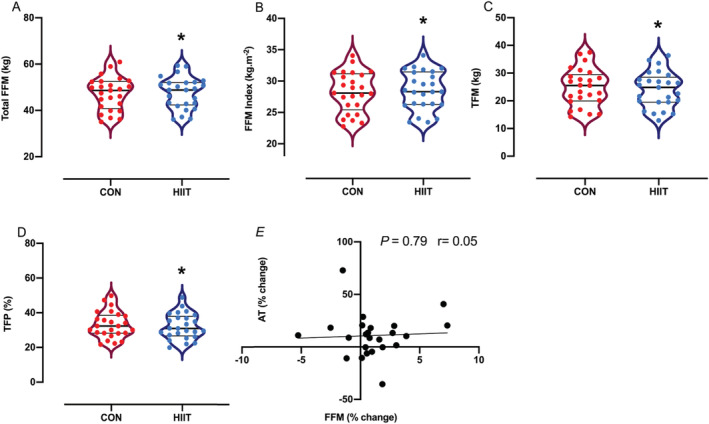
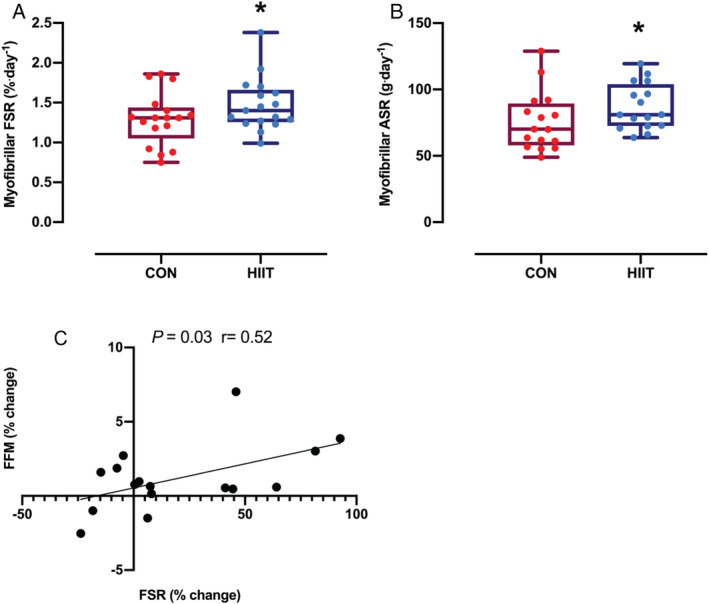
In comorbid octogenarians, HIIT elicited improvements in CRF (anaerobic threshold: +1.2 ± 0.4 ml·kg ·min , P = 0.001). HIIT also augmented total FFM (47.2 ± 1.4 to 47.6 ± 1.3 kg, P = 0.04), while decreasing total fat mass (24.8 ± 1.3 to 24 ± 1.2 kg, P = 0.0002) and body fat percentage (33.1 ± 1.5 to 32.1 ± 1.4%, P = 0.0008). Mechanistically, mitochondrial oxidative phosphorylation capacity increased after HIIT (i.e. citrate synthase activity: 52.4 ± 4 to 67.9 ± 5.1 nmol·min ·mg , P = 0.005; membrane protein complexes (C): C-II, 1.4-fold increase, P = 0.002; C-III, 1.2-fold increase, P = 0.03), as did rates of MPS (1.3 ± 0.1 to 1.5 ± 0.1%·day , P = 0.03). The increase in MPS was supported by up-regulated phosphorylation of anabolic signalling proteins (e.g. AKT, p70S6K, and 4E-BP1; all P < 0.05). There were no changes in any of these parameters during the control period. No adverse events were reported throughout the study.
The HIIT enhances skeletal muscle mass and CRF in octogenarians with disease, with up-regulation of MPS and mitochondrial capacity likely underlying these improvements. HIIT can be safely delivered to octogenarians with disease and is an effective, time-efficient intervention to improve muscle mass and physical function in a short time frame.
心肺功能(CRF)和去脂体重(FFM)随年龄增长而下降与死亡率、发病率和生活质量差有关。高强度间歇训练(HIIT)已被证明可改善许多人群的 CRF 和 FFM,但在存在合并症的非常高龄人群中,其效果尚未确定。我们旨在评估 HIIT 在患有合并症(例如高血压和骨关节炎)的 80 岁以上人群中的疗效和生理/代谢反应。
28 名志愿者(18 名男性,10 名女性,81.2±0.6 岁,27.1±0.6 kg·m ),美国麻醉师协会(ASA)分级 2-3 级,在相同持续时间的对照期后各完成 4 周(12 次)的 HIIT。在每个 4 周期间前后,受试者接受身体成分评估和心肺运动测试。股外侧肌(m. vastus lateralis)活检用于量化 4 周内的合成代谢信号、线粒体氧化磷酸化和累积肌肉蛋白质合成(MPS)。
在患有合并症的 80 岁以上人群中,HIIT 可提高 CRF(无氧阈:+1.2±0.4 ml·kg·min ,P=0.001)。HIIT 还增加了总 FFM(47.2±1.4 至 47.6±1.3 kg,P=0.04),同时减少了总脂肪量(24.8±1.3 至 24.0±1.2 kg,P=0.0002)和体脂百分比(33.1±1.5 至 32.1±1.4%,P=0.0008)。从机制上讲,HIIT 后线粒体氧化磷酸化能力增加(即柠檬酸合酶活性:52.4±4 至 67.9±5.1 nmol·min·mg ,P=0.005;膜蛋白复合物(C):C-II 增加 1.4 倍,P=0.002;C-III 增加 1.2 倍,P=0.03),MPS 率也增加(1.3±0.1 至 1.5±0.1%·天 ,P=0.03)。MPS 的增加得到了合成代谢信号蛋白(如 AKT、p70S6K 和 4E-BP1)磷酸化的上调的支持(均 P<0.05)。在对照期内,这些参数均无变化。整个研究过程中均未报告任何不良事件。
HIIT 可增强患有疾病的 80 岁以上人群的骨骼肌质量和 CRF,MPS 和线粒体能力的上调可能是这些改善的基础。HIIT 可安全地用于患有疾病的 80 岁以上人群,是一种有效的、时间效率高的干预措施,可在短时间内改善肌肉质量和身体功能。