State Key Laboratory of Urban and Regional Ecology, Research Center for Eco-Environmental Sciences, Chinese Academy of Sciences, Beijing, China.
University of Chinese Academy of Sciences, Beijing, China.
mBio. 2021 Jun 29;12(3):e0075121. doi: 10.1128/mBio.00751-21. Epub 2021 Jun 1.
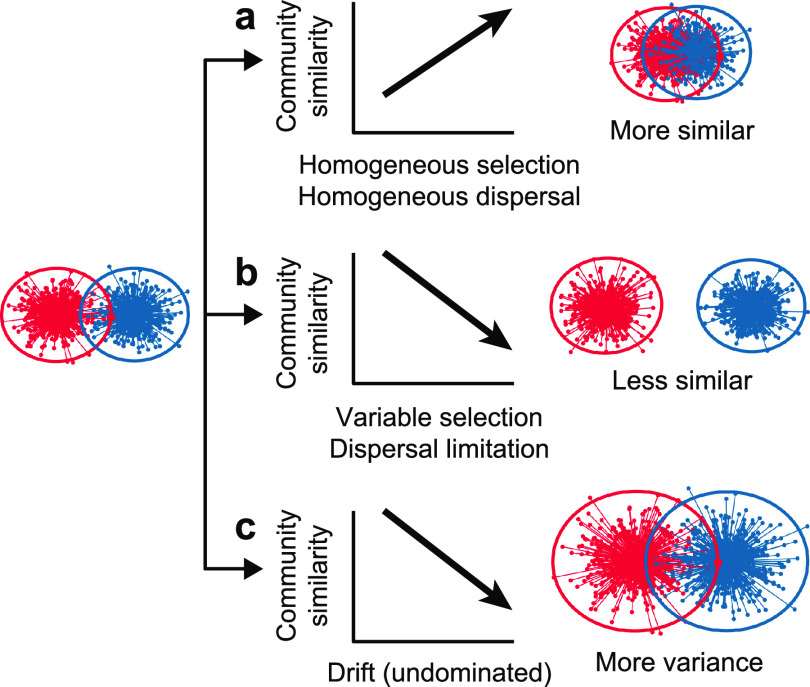
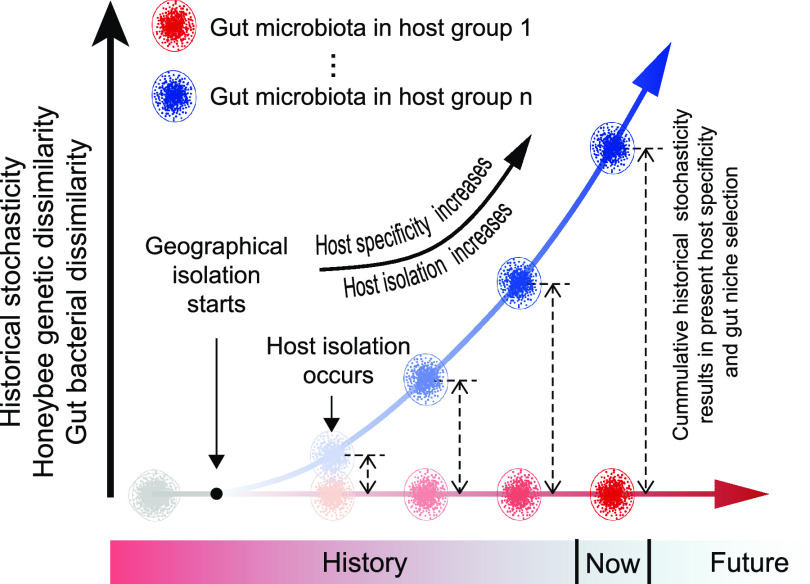
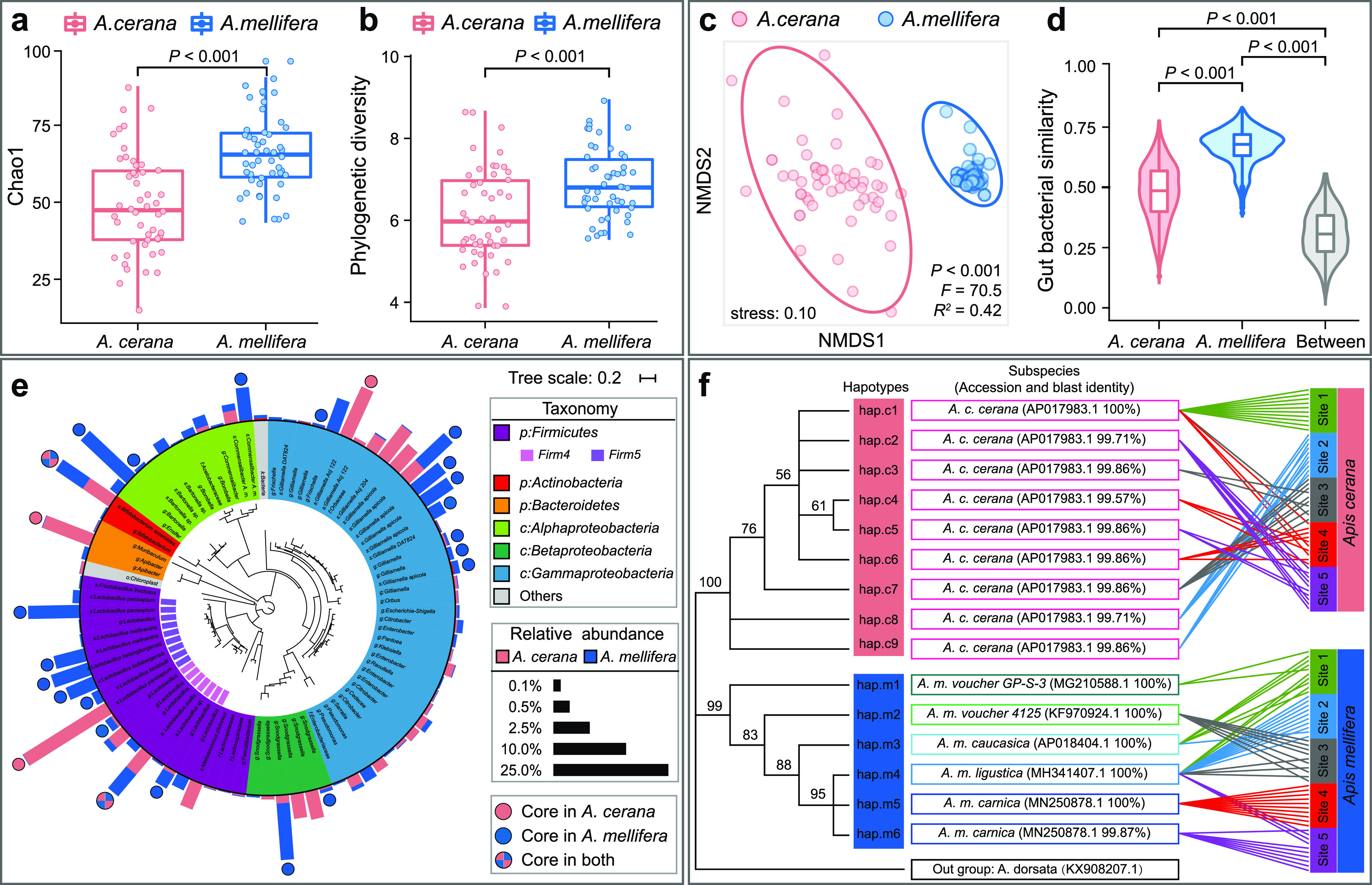
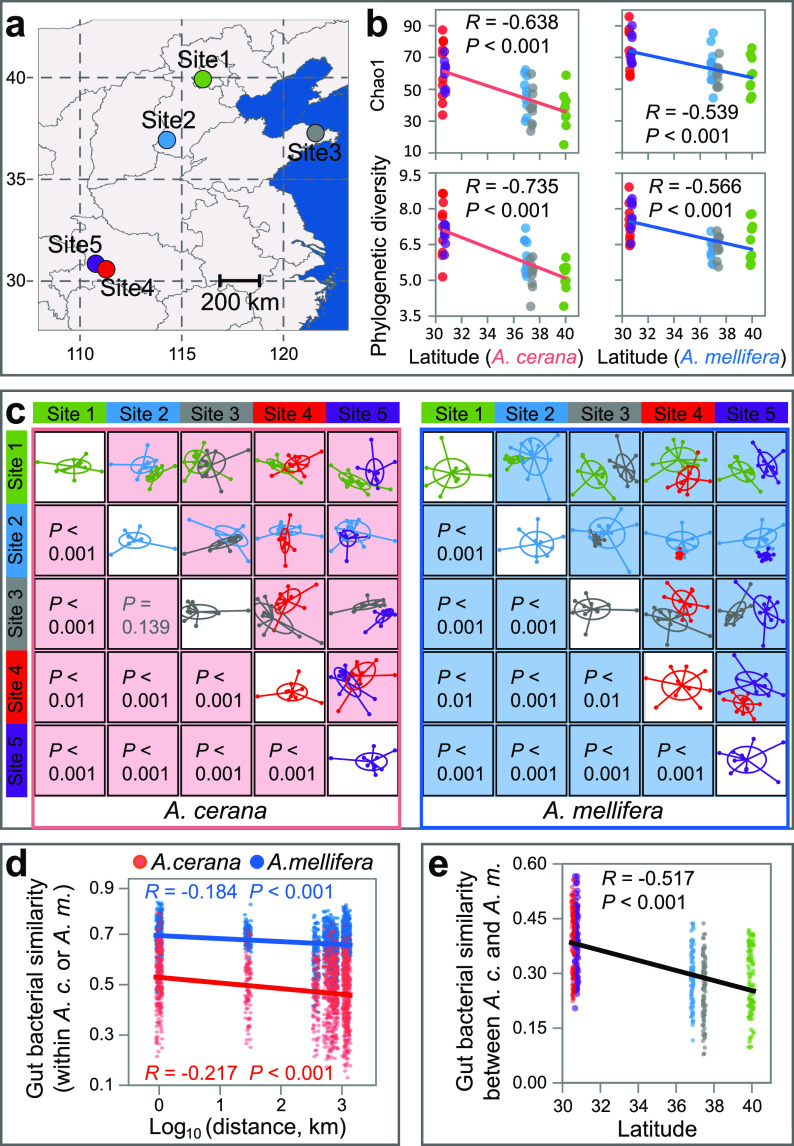
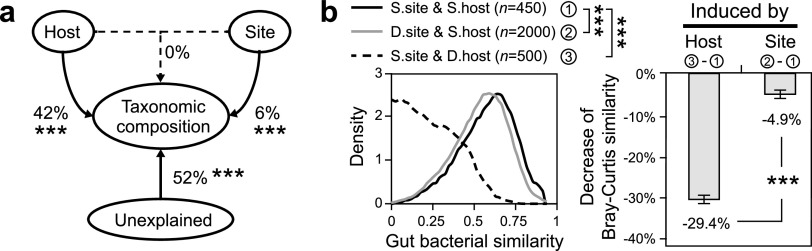
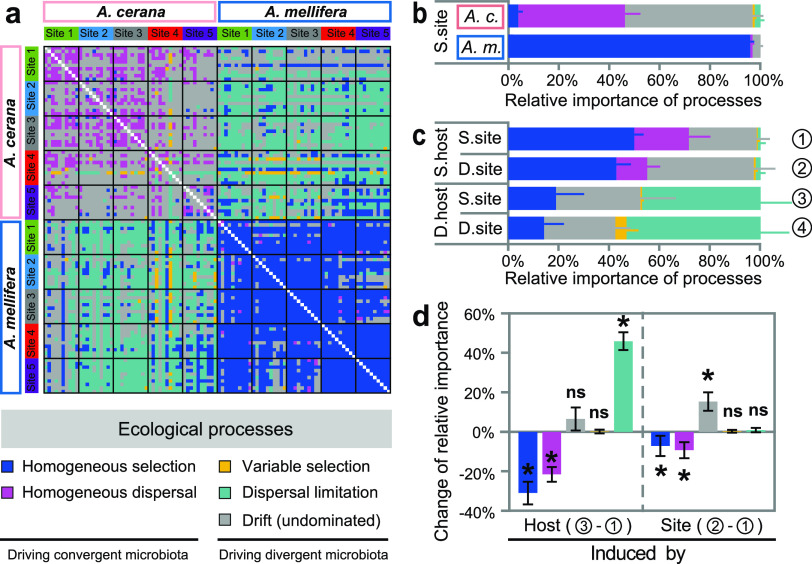
Honeybee gut microbiota modulates the health and fitness of honeybees, the ecologically and economically important pollinators and honey producers. However, which processes drive the assembly and shift of honeybee gut microbiota remains unknown. To explore the patterns of honeybee gut bacterial communities across host species and geographical sites and the relative contribution of different processes (i.e., homogeneous selection, variable selection, homogeneous dispersal, dispersal limitation, and an undominated process) in driving the patterns, two honeybee species (Apis cerana and Apis mellifera) were sampled from five geographically distant sites along a latitudinal gradient, followed by gut bacterial 16S rRNA gene sequencing. The gut bacterial communities differed significantly between and , which was driven by the interhost dispersal limitation associated with the long-term coevolution between hosts and their prokaryotic symbionts. harbored more diverse but less varied gut bacterial communities than due to the dominant role of homogeneous selection in converging intestinal communities. For each honeybee species, the gut bacterial communities differed across geographical sites, with individuals from lower latitudes harboring higher diversity; also, there was significant decay of gut community similarity against geographic distance. The geographical variation of honeybee gut bacterial communities was mainly driven by an undominated process (e.g., stochastic drift) rather than variable selection or dispersal limitation. This study elucidates that variations in host and geography alter the relative contribution of different processes in assembling honeybee gut microbiota and, thus, provides insights into the mechanisms underlying honeybee gut microbial shifts across evolutionary time. Honeybees provide crucial pollination services and valuable apiarian products. The symbiotic intestinal communities facilitate honeybee health and fitness by promoting nutrient assimilation, detoxifying toxins, and resisting pathogens. Thus, understanding the processes that govern honeybee gut bacterial communities is imperative for better managing gut microbiota to improve honeybee health. However, little is known about the processes driving the assembly and shift of honeybee gut bacterial communities. This study quantitatively deciphers the relative importance of selection, dispersal, and undominated processes in governing the assembly of honeybee gut bacterial communities and explores how their relative importance varies across biological and spatial scales. Our study provides new insights into the mechanisms underlying the maintenance and shift of honeybee gut microbiota.
蜜蜂肠道微生物群调节着蜜蜂的健康和活力,蜜蜂是具有生态和经济重要性的传粉者和蜂蜜生产者。然而,哪些过程驱动着蜜蜂肠道微生物群的组装和变化仍然未知。为了探索宿主物种和地理地点之间的蜜蜂肠道细菌群落模式,以及不同过程(即同质选择、变量选择、同质扩散、扩散限制和非主导过程)在驱动模式中的相对贡献,我们从纬度梯度上的五个地理遥远地点采集了两种蜜蜂(中华蜜蜂和西方蜜蜂),并进行了肠道细菌 16S rRNA 基因测序。结果发现, 和 之间的肠道细菌群落存在显著差异,这是由宿主与其原核共生体之间长期共同进化所导致的种间扩散限制所驱动的。 比 拥有更多样但变化较少的肠道细菌群落,这是由于同质选择在收敛 肠道群落方面的主导作用。对于每种蜜蜂,肠道细菌群落在地理地点上存在差异,来自较低纬度的个体具有更高的多样性;此外,肠道群落相似性对地理距离的显著衰减。蜜蜂肠道细菌群落的地理变化主要由非主导过程(例如随机漂移)驱动,而不是变量选择或扩散限制。本研究阐明了宿主和地理的变化改变了不同过程在组装蜜蜂肠道微生物群中的相对贡献,从而为理解蜜蜂肠道微生物在进化时间上的变化机制提供了新的视角。 蜜蜂提供了至关重要的授粉服务和有价值的蜂产品。共生肠道群落通过促进营养吸收、解毒毒素和抵抗病原体来促进蜜蜂的健康和活力。因此,了解控制蜜蜂肠道细菌群落的过程对于更好地管理肠道微生物群以提高蜜蜂健康至关重要。然而,对于驱动蜜蜂肠道细菌群落组装和变化的过程知之甚少。本研究定量解析了选择、扩散和非主导过程在控制蜜蜂肠道细菌群落组装中的相对重要性,并探讨了它们在生物和空间尺度上的相对重要性如何变化。我们的研究为蜜蜂肠道微生物群的维持和变化的机制提供了新的见解。