Health Data Science Unit, Faculty of Medicine, University of Kelaniya, Ragama, Sri Lanka.
Department of Public Health, Faculty of Medicine, University of Kelaniya, Ragama, Sri Lanka.
PLoS Negl Trop Dis. 2021 Jun 1;15(6):e0009447. doi: 10.1371/journal.pntd.0009447. eCollection 2021 Jun.
Snakebite incidence shows both spatial and temporal variation. However, no study has evaluated spatiotemporal patterns of snakebites across a country or region in detail. We used a nationally representative population sample to evaluate spatiotemporal patterns of snakebite in Sri Lanka.
We conducted a community-based cross-sectional survey representing all nine provinces of Sri Lanka. We interviewed 165 665 people (0.8% of the national population), and snakebite events reported by the respondents were recorded. Sri Lanka is an agricultural country; its central, southern and western parts receive rain mainly from Southwest monsoon (May to September) and northern and eastern parts receive rain mainly from Northeast monsoon (November to February). We developed spatiotemporal models using multivariate Poisson process modelling to explain monthly snakebite and envenoming incidences in the country. These models were developed at the provincial level to explain local spatiotemporal patterns.
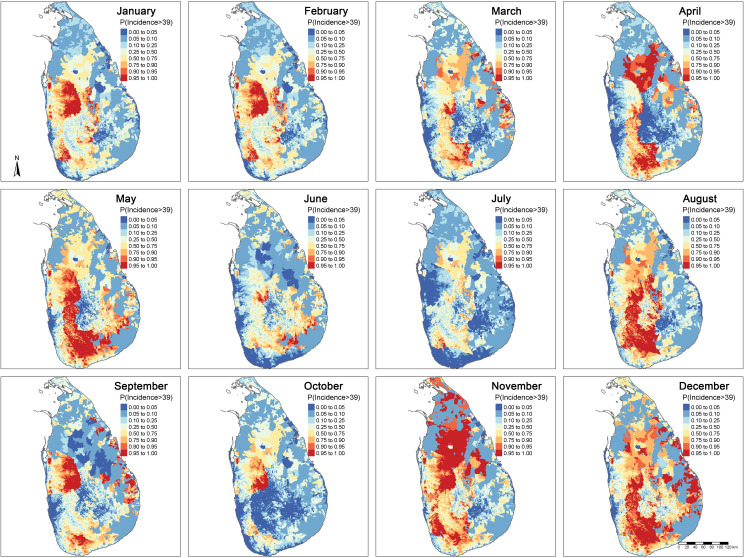
Snakebites and envenomings showed clear spatiotemporal patterns. Snakebite hotspots were found in North-Central, North-West, South-West and Eastern Sri Lanka. They exhibited biannual seasonal patterns except in South-Western inlands, which showed triannual seasonality. Envenoming hotspots were confined to North-Central, East and South-West parts of the country. Hotspots in North-Central regions showed triannual seasonal patterns and South-West regions had annual patterns. Hotspots remained persistent throughout the year in Eastern regions. The overall monthly snakebite and envenoming incidences in Sri Lanka were 39 (95%CI: 38-40) and 19 (95%CI: 13-30) per 100 000, respectively, translating into 110 000 (95%CI: 107 500-112 500) snakebites and 45 000 (95%CI: 32 000-73 000) envenomings in a calendar year.
CONCLUSIONS/SIGNIFICANCE: This study provides information on community-based monthly incidence of snakebites and envenomings over the whole country. Thus, it provides useful insights into healthcare decision-making, such as, prioritizing locations to establish specialized centres for snakebite management and allocating resources based on risk assessments which take into account both location and season.
蛇伤的发生具有时空变化。然而,目前尚无研究详细评估一个国家或地区的蛇伤时空模式。我们使用具有全国代表性的人群样本,评估斯里兰卡的蛇伤时空模式。
我们进行了一项基于社区的横断面调查,代表了斯里兰卡的九个省份。我们采访了 165665 人(占全国人口的 0.8%),并记录了受访者报告的蛇伤事件。斯里兰卡是一个农业国家,其中部、南部和西部主要受西南季风(5 月至 9 月)影响,北部和东部主要受东北季风(11 月至 2 月)影响。我们使用多变量泊松过程模型开发了时空模型,以解释该国的月度蛇伤和中毒发病率。这些模型在省级水平上进行开发,以解释局部时空模式。
蛇伤和中毒表现出明显的时空模式。蛇伤热点位于斯里兰卡的中北部、西北部、西南部和东部。除了西南部内陆地区呈三年季节性外,它们呈双年季节性。中毒热点局限于该国的中北部、东部和西南部。中北部地区的热点呈三年季节性,西南部地区呈年度模式。东部地区的热点全年持续存在。斯里兰卡每月的蛇伤和中毒总发病率分别为 39(95%置信区间:38-40)和 19(95%置信区间:13-30)/100000,换算成每年有 110000(95%置信区间:107500-112500)例蛇伤和 45000(95%置信区间:32000-73000)例中毒。
结论/意义:本研究提供了全国范围内基于社区的每月蛇伤和中毒发病率的信息。因此,它为医疗保健决策提供了有用的信息,例如,确定建立专门的蛇伤管理中心的优先地点,并根据风险评估分配资源,同时考虑位置和季节。