Department of Human Development & Family Sciences, University of Connecticut, Storrs, Connecticut, United States of America.
Rudd Center for Food Policy and Obesity, University of Connecticut, Hartford, Connecticut, United States of America.
PLoS One. 2021 Jun 1;16(6):e0251566. doi: 10.1371/journal.pone.0251566. eCollection 2021.
BACKGROUND/OBJECTIVES: Considerable evidence from U.S. studies suggests that weight stigma is consequential for patient-provider interactions and healthcare for people with high body weight. Despite international calls for efforts to reduce weight stigma in the medical community, cross-country research is lacking in this field. This study provides the first multinational investigation of associations between weight stigma and healthcare experiences across six Western countries.
Participants were 13,996 adults residing in Australia, Canada, France, Germany, the UK, and the US who were actively enrolled in an internationally available behavioral weight management program. Participants completed identical online surveys in the dominant language for their country that assessed experienced weight stigma, internalized weight bias, and healthcare behaviors and experiences including perceived quality of care, avoidance or delay of seeking care, experiences with providers, and perceived weight stigma from doctors.
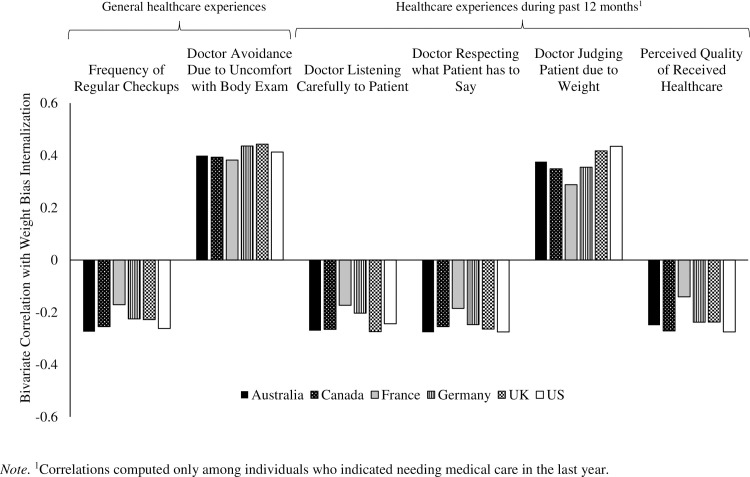
Among participants who reported a history of weight stigma (56-61%), two-thirds of participants in each country reported experiencing weight stigma from doctors. Across all six countries, after accounting for demographics, BMI, and experienced stigma, participants with higher internalized weight bias reported greater healthcare avoidance, increased perceived judgment from doctors due to body weight, lower frequency of obtaining routine checkups, less frequent listening and respect from providers, and lower quality of healthcare. Additionally, experienced weight stigma (from any source) was indirectly associated with poorer healthcare experiences through weight bias internalization, consistently across the six countries.
Weight stigma in healthcare is prevalent among adults actively engaged in weight management across different Western countries, and internalized weight bias has negative implications for healthcare even after controlling for BMI. The similar findings across all six countries underscore the negative consequences of weight stigma on healthcare behaviors and experiences, and emphasize the need for collective international efforts to address this problem.
背景/目的:来自美国研究的大量证据表明,体重歧视会对医患互动和高体重人群的医疗保健产生影响。尽管国际社会呼吁医学界努力减少体重歧视,但在这一领域缺乏跨国研究。本研究首次对六个西方国家的体重歧视与医疗保健体验之间的关联进行了跨国调查。
参与者为 13996 名居住在澳大利亚、加拿大、法国、德国、英国和美国的成年人,他们正在积极参与一项国际上可用的行为体重管理计划。参与者用其所在国家的主要语言完成了相同的在线调查,评估了经历过的体重歧视、内化的体重偏见以及医疗保健行为和体验,包括护理质量感知、避免或延迟寻求护理、与提供者的接触以及医生感知的体重歧视。
在报告有体重歧视史的参与者中(56%-61%),每个国家中有三分之二的参与者报告曾受到医生的体重歧视。在所有六个国家中,在考虑了人口统计学、BMI 和经历过的歧视后,内化的体重偏见程度较高的参与者更倾向于避免医疗保健,因体重而更多地感知到医生的评判,常规检查的频率较低,与提供者的沟通和尊重较少,医疗质量较低。此外,在所有六个国家中,经历过的体重歧视(来自任何来源)通过内化的体重偏见与较差的医疗保健体验间接相关。
在不同的西方国家,积极参与体重管理的成年人中,医疗保健中的体重歧视很普遍,即使控制了 BMI,内化的体重偏见也会对医疗保健产生负面影响。所有六个国家的相似发现强调了体重歧视对医疗保健行为和体验的负面影响,强调了需要国际社会共同努力解决这一问题。