Division of Internal Medicine, ASST Fatebenefratelli Sacco, Luigi Sacco Hospital-Polo Universitario-University of Milan, Milan, Italy.
Division of Anesthesiology and Intensive Care, ASST Fatebenefratelli Sacco, Luigi Sacco Hospital-Polo Universitario-University of Milan, Milan, Italy.
PLoS One. 2021 Jun 1;16(6):e0251775. doi: 10.1371/journal.pone.0251775. eCollection 2021.
The term Idiopathic Systemic Capillary Leak Syndrome (ISCLS) refers to an uncommon condition of severe distributive shock, resulting from an abrupt shift of fluids and proteins from the intravascular to the interstitial compartment. We hypothesise that the autonomic nervous system (ANS) fails in regulating the response to hypovolemia in acute ISCLS and that ANS variables characterise the progression to the recovery.
Prospective cohort study of patients admitted to ICU for severe ISCLS flares.
Single, referral center in Italy for ISCLS.
Analysis of cardiovascular signals recorded during seven severe ISCLS attacks and one prodromal period in five patients.
ANS was studied non-invasively by means of heart rate variability (HRV) and blood pressure variability analysis, as an estimation of vagal and sympathetic modulation directed to the heart and vessels. Heart rate and systolic arterial pressure (SAP) variability were also used to assess baroreflex sensitivity. ANS variables were measured during the subsequent phases which characterise ISCLS flares, namely the acute phase, the post-acute phase, and the recovery phase.
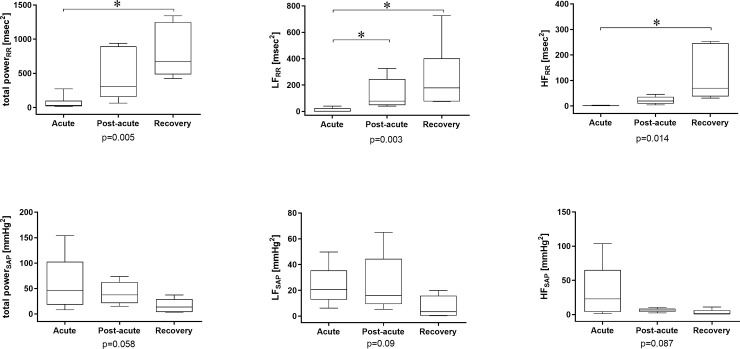
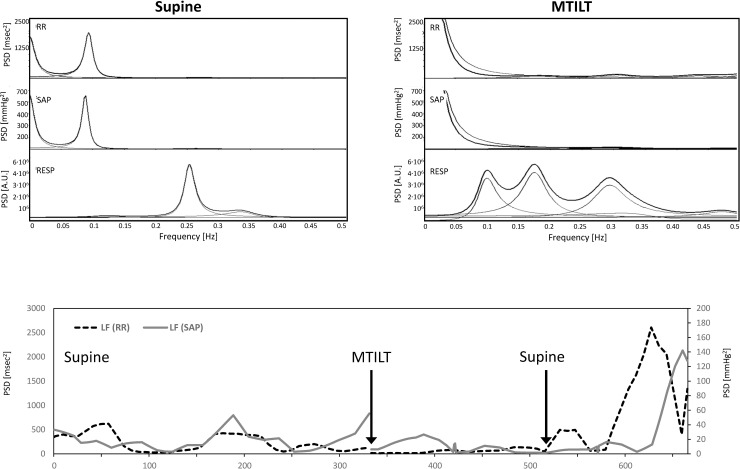
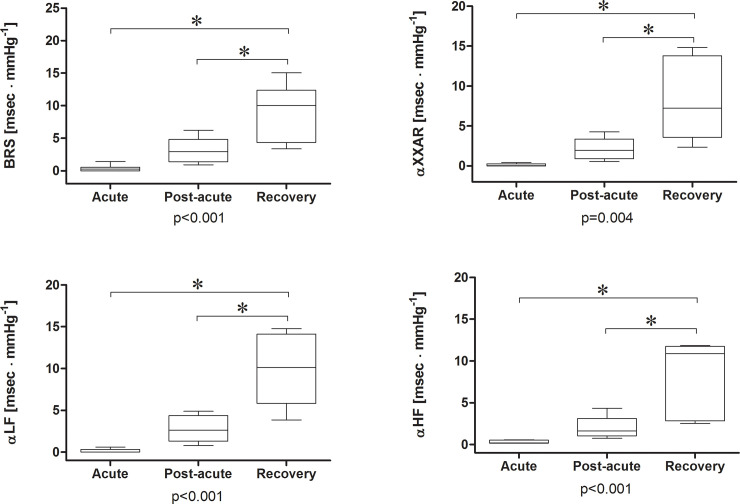
HRV was severely depressed during the acute phase accounting for the loss of ANS modulation during massive capillary extravasation. This phase was characterised by shock and impaired baroreflex control, which allowed SAP to oscillate driven by respiratory activity. Impending shock and transition from shock to a post-acute phase were marked by change of baroreflex spectral variables. The baroreflex control was fully restored during recovery.
ANS modulation and baroreflex control are severely impaired during the acute haemodynamic instability which characterises ISCLS crises and their progressive restoration may be a clue of improvement. ANS indices during ISCLS flares might serve as useful biomarkers, able to timely announce the transition from one phase to the subsequent one, thus helping to adapt therapy accordingly.
特发性全身性毛细血管渗漏综合征(ISCLS)是一种罕见的分布性休克,由血管内液体和蛋白质突然转移到间质腔引起。我们假设自主神经系统(ANS)在急性 ISCLS 中不能调节对低血容量的反应,并且 ANS 变量可以描述进展到恢复的过程。
对因严重 ISCLS 加重而入住 ICU 的患者进行前瞻性队列研究。
意大利一家 ISCLS 转诊中心。
对五名患者的七次严重 ISCLS 发作和一次前驱期进行心血管信号记录的分析。
通过心率变异性(HRV)和血压变异性分析对 ANS 进行非侵入性研究,作为对心脏和血管的迷走神经和交感神经调节的估计。心率和收缩压(SAP)变异性也用于评估压力反射敏感性。在随后的阶段中测量 ANS 变量,这些阶段可以描绘出 ISCLS 发作,即急性阶段、急性后阶段和恢复阶段。
在急性阶段,HRV 严重降低,表明在大量毛细血管渗漏时 ANS 调节丧失。在这个阶段,休克和压力反射控制受损,允许 SAP 随着呼吸活动的驱动而波动。即将发生的休克和从休克到急性后阶段的过渡,以压力反射谱变量的变化为特征。在恢复期间,压力反射控制完全恢复。
在急性血流动力学不稳定期间,ANS 调节和压力反射控制严重受损,这是 ISCLS 危象的特征,其逐渐恢复可能是改善的线索。在 ISCLS 发作期间的 ANS 指数可能作为有用的生物标志物,能够及时宣布从一个阶段到下一个阶段的过渡,从而有助于相应地调整治疗。