California Institute for Quantitative Biosciences, Departments of Chemistry and of Molecular and Cell Biology, University of California, Berkeley, CA 94720, USA.
Int J Mol Sci. 2021 May 21;22(11):5439. doi: 10.3390/ijms22115439.
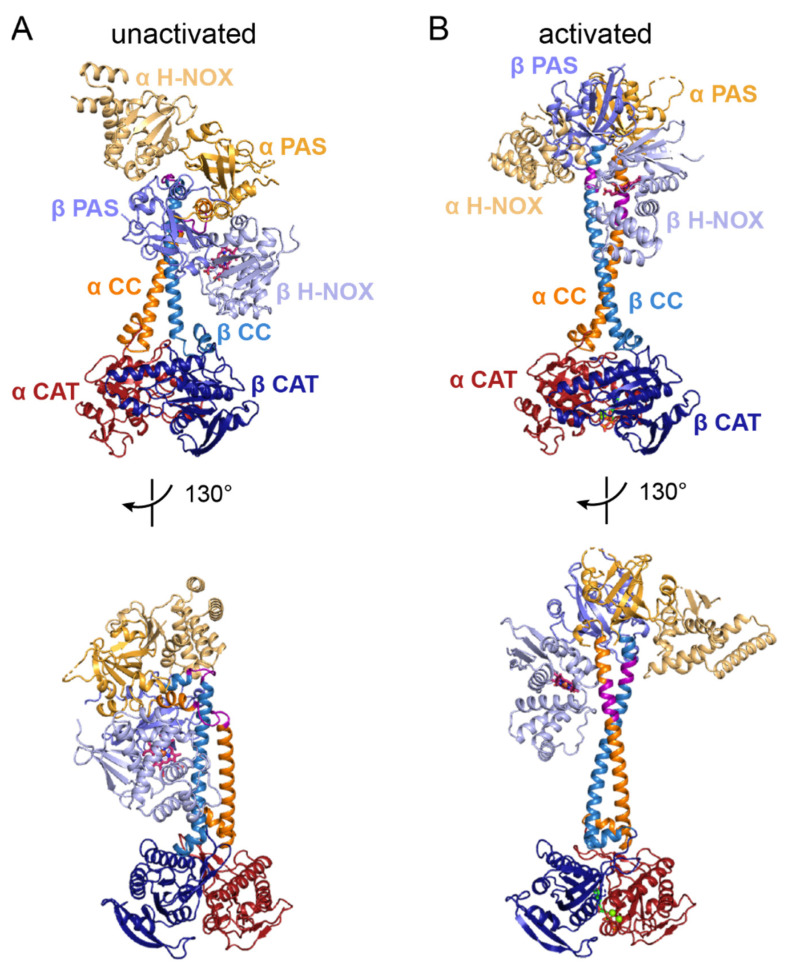
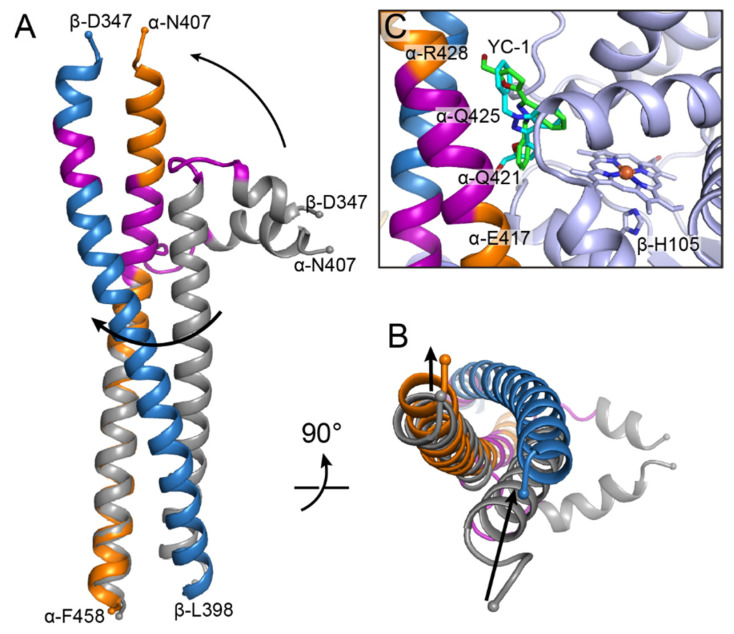
The enzyme soluble guanylate cyclase (sGC) is the prototypical nitric oxide (NO) receptor in humans and other higher eukaryotes and is responsible for transducing the initial NO signal to the secondary messenger cyclic guanosine monophosphate (cGMP). Generation of cGMP in turn leads to diverse physiological effects in the cardiopulmonary, vascular, and neurological systems. Given these important downstream effects, sGC has been biochemically characterized in great detail in the four decades since its discovery. Structures of full-length sGC, however, have proven elusive until very recently. In 2019, advances in single particle cryo-electron microscopy (cryo-EM) enabled visualization of full-length sGC for the first time. This review will summarize insights revealed by the structures of sGC in the unactivated and activated states and discuss their implications in the mechanism of sGC activation.
可溶性鸟苷酸环化酶(sGC)是人体内和其他高等真核生物中典型的一氧化氮(NO)受体,负责将初始的 NO 信号转导到第二信使环鸟苷酸单磷酸(cGMP)。cGMP 的产生反过来又会在心肺、血管和神经系统中引起多种生理效应。鉴于这些重要的下游效应,sGC 自发现以来的四十年中已经在生化方面得到了详细的描述。然而,全长 sGC 的结构直到最近才被揭示。2019 年,单颗粒冷冻电镜(cryo-EM)的进展首次使全长 sGC 的可视化成为可能。这篇综述将总结未激活和激活状态下 sGC 结构所揭示的见解,并讨论它们在 sGC 激活机制中的意义。