Holt Kelly, Niazi Imran Khan, Amjad Imran, Kumari Nitika, Rashid Usman, Duehr Jens, Navid Muhammad Samran, Shafique Muhammad, Haavik Heidi
Centre for Chiropractic Research, New Zealand College of Chiropractic, Auckland 1060, New Zealand.
Faculty of Health & Environmental Sciences, Health & Rehabilitation Research Institute, AUT University, Auckland 0627, New Zealand.
Brain Sci. 2021 May 21;11(6):676. doi: 10.3390/brainsci11060676.
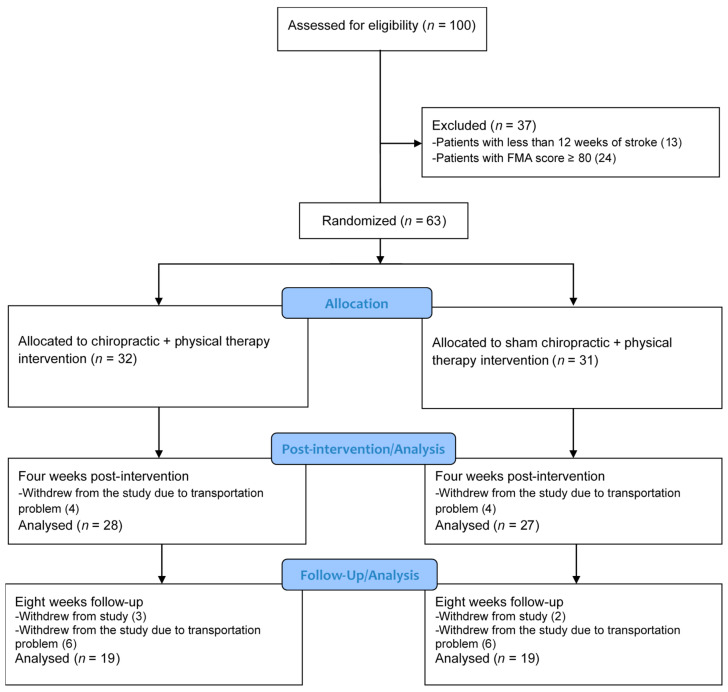
Chiropractic spinal adjustments have been shown to result in short-term increases in muscle strength in chronic stroke patients, however, the effect of longer-term chiropractic spinal adjustments on people with chronic stroke is unknown. This exploratory study assessed whether 4 weeks of chiropractic spinal adjustments, combined with physical therapy (chiro + PT), had a greater impact than sham chiropractic with physical therapy (sham + PT) did on motor function (Fugl Meyer Assessment, FMA) in 63 subacute or chronic stroke patients. Secondary outcomes included health-related quality of life and other measures of functional mobility and disability. Outcomes were assessed at baseline, 4 weeks (post-intervention), and 8 weeks (follow-up). Data were analyzed using linear mixed-effects models or generalized linear mixed models. A post-hoc responder analysis was performed to investigate the clinical significance of findings. At 4 weeks, there was a larger effect of chiro + PT, compared with sham + PT, on the FMA (difference = 6.1, = 0.04). The responder analysis suggested the improvements in motor function seen following chiropractic spinal adjustments may have been clinically significant. There was also a robust improvement in both groups in most measures from baseline to the 4- and 8-week assessments, but between-group differences were no longer significant at the 8-week assessment. Four weeks of chiro + PT resulted in statistically significant improvements in motor function, compared with sham + PT, in people with subacute or chronic stroke. These improvements appear to be clinically important. Further trials, involving larger group sizes and longer follow-up and intervention periods, are required to corroborate these findings and further investigate the impacts of chiropractic spinal adjustments on motor function in post-stroke survivors. ClinicalTrials.gov Identifier NCT03849794.
整脊脊柱调整已被证明可使慢性中风患者的肌肉力量在短期内增加,然而,长期整脊脊柱调整对慢性中风患者的影响尚不清楚。这项探索性研究评估了63名亚急性或慢性中风患者接受4周的整脊脊柱调整联合物理治疗(整脊+物理治疗)是否比假整脊联合物理治疗(假整脊+物理治疗)对运动功能(Fugl Meyer评估,FMA)有更大影响。次要结局包括与健康相关的生活质量以及功能活动能力和残疾的其他指标。在基线、4周(干预后)和8周(随访)时评估结局。使用线性混合效应模型或广义线性混合模型分析数据。进行事后反应者分析以研究结果的临床意义。在4周时,与假整脊+物理治疗相比,整脊+物理治疗对FMA的影响更大(差异=6.1,P=0.04)。反应者分析表明,整脊脊柱调整后运动功能的改善可能具有临床意义。从基线到4周和8周评估,两组在大多数指标上也都有显著改善,但在8周评估时组间差异不再显著。与假整脊+物理治疗相比,4周的整脊+物理治疗使亚急性或慢性中风患者的运动功能有统计学显著改善。这些改善似乎具有临床重要性。需要进一步的试验,纳入更大的样本量、更长的随访和干预期,以证实这些发现并进一步研究整脊脊柱调整对中风后幸存者运动功能的影响。ClinicalTrials.gov标识符:NCT03849794。