Islam Md Aminul, Albarracin Leonardo, Melnikov Vyacheslav, Andrade Bruno G N, Cuadrat Rafael R C, Kitazawa Haruki, Villena Julio
Food and Feed Immunology Group, Laboratory of Animal Food Function, Graduate School of Agricultural Science, Tohoku University, Sendai 981-8555, Japan.
Department of Medicine, Faculty of Veterinary Science, Bangladesh Agricultural University, Mymensingh 2202, Bangladesh.
Pathogens. 2021 May 21;10(6):634. doi: 10.3390/pathogens10060634.
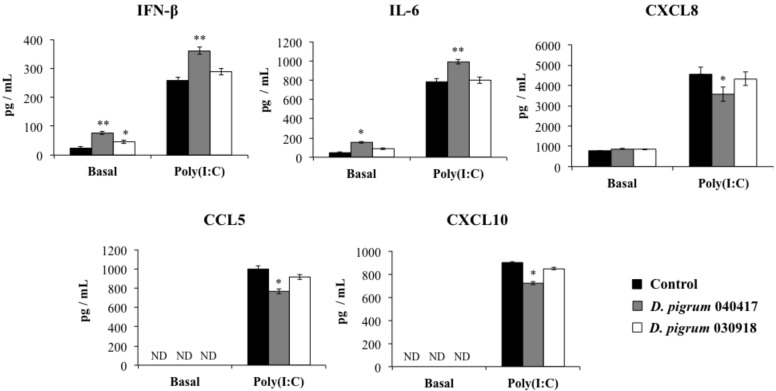
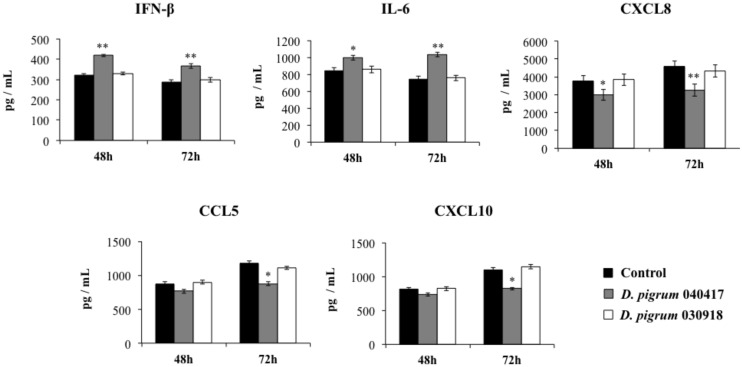
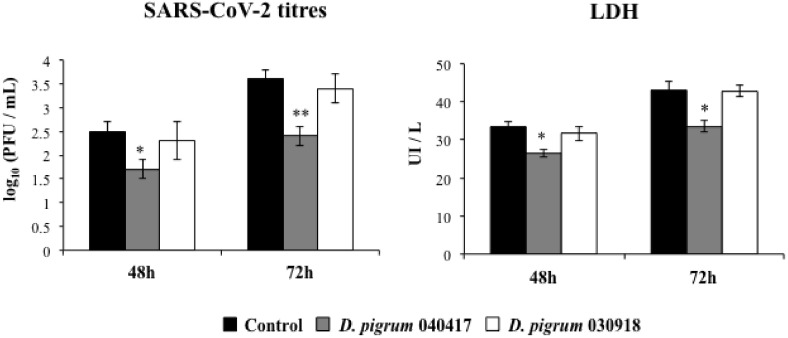
In a previous work, we demonstrated that nasally administered 040417 beneficially modulated the respiratory innate immune response triggered by the activation of Toll-like receptor 3 (TLR3) and improved protection against Respiratory Syncytial Virus (RSV) in mice. In this work, we aimed to evaluate the immunomodulatory effects of 040417 in human respiratory epithelial cells and the potential ability of this immunobiotic bacterium to increase the protection against Acute Respiratory Syndrome Coronavirus 2 (SARS-CoV-2). The respiratory commensal bacterium 040417 differentially modulated the production of IFN-β, IL-6, CXCL8, CCL5 and CXCL10 in the culture supernatants of Calu-3 cells stimulated with poly(I:C) or challenged with SARS-CoV-2. The differential cytokine profile induced by the 040417 strain was associated with a significant reduction in viral replication and cellular damage after coronavirus infection. Of note, 030918 was not able to modify the resistance of Calu-3 cells to SARS-CoV-2 infection, indicating a strain-specific immunomodulatory effect for respiratory commensal bacteria. The findings of this work improve our understanding of the immunological mechanisms involved in the modulation of respiratory immunity induced by respiratory commensal bacteria, by demonstrating their specific effect on respiratory epithelial cells. In addition, the results suggest that particular strains such as 040417 could be used as a promising alternative for combating SARS-CoV-2 and reducing the severity of COVID-19.
在之前的一项研究中,我们证明了经鼻腔给药的040417能有益地调节由Toll样受体3(TLR3)激活引发的呼吸道固有免疫反应,并增强小鼠对呼吸道合胞病毒(RSV)的抵抗力。在这项研究中,我们旨在评估040417对人呼吸道上皮细胞的免疫调节作用,以及这种免疫益生菌增加对严重急性呼吸综合征冠状病毒2(SARS-CoV-2)抵抗力的潜在能力。呼吸道共生菌040417对经聚肌苷酸-聚胞苷酸(poly(I:C))刺激或经SARS-CoV-2攻击的Calu-3细胞培养上清液中IFN-β、IL-6、CXCL8、CCL5和CXCL10的产生进行了差异性调节。040417菌株诱导的差异性细胞因子谱与冠状病毒感染后病毒复制和细胞损伤的显著减少相关。值得注意的是,030918不能改变Calu-3细胞对SARS-CoV-2感染的抵抗力,这表明呼吸道共生菌具有菌株特异性的免疫调节作用。这项研究的结果通过证明呼吸道共生菌对呼吸道上皮细胞的特定作用,增进了我们对参与调节呼吸道免疫的免疫机制的理解。此外,结果表明,诸如040417这样的特定菌株有望作为对抗SARS-CoV-2和减轻COVID-19严重程度的替代方法。