Federal Research Center Institute of Cytology and Genetics, Siberian Branch of the Russian Academy of Sciences, 630090 Novosibirsk, Russia.
Natural Science Faculty, Novosibirsk National Research State University, 630090 Novosibirsk, Russia.
Int J Mol Sci. 2021 May 16;22(10):5248. doi: 10.3390/ijms22105248.
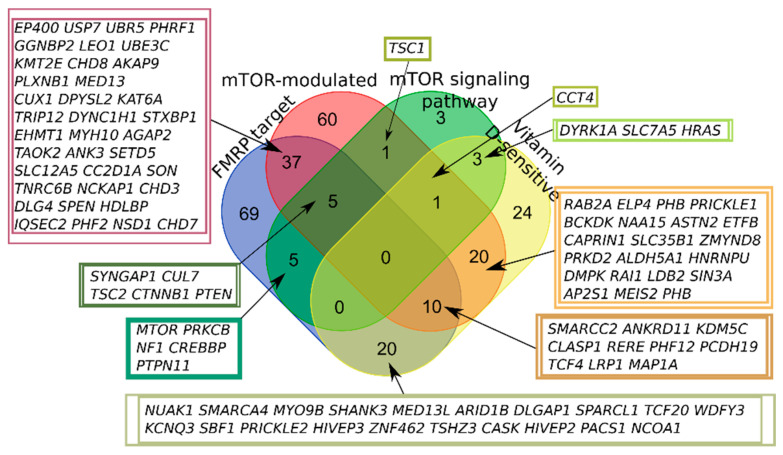
Autism spectrum disorder (ASD) is characterized by uncommon genetic heterogeneity and a high heritability concurrently. Most autoimmune disorders (AID), similarly to ASD, are characterized by impressive genetic heterogeneity and heritability. We conducted gene-set analyses and revealed that 584 out of 992 genes (59%) included in a new release of the SFARI Gene database and 439 out of 871 AID-associated genes (50%) could be attributed to one of four groups: 1. FMRP (fragile X mental retardation protein) target genes, 2. mTOR signaling network genes, 3. mTOR-modulated genes, and 4. vitamin D3-sensitive genes. With the exception of FMRP targets, which are obviously associated with the direct involvement of local translation disturbance in the pathological mechanisms of ASD, the remaining categories are represented among AID genes in a very similar percentage as among ASD predisposition genes. Thus, mTOR signaling pathway genes make up 4% of ASD and 3% of AID genes, mTOR-modulated genes-31% of both ASD and AID genes, and vitamin D-sensitive genes-20% of ASD and 23% of AID genes. The network analysis revealed 3124 interactions between 528 out of 729 AID genes for the 0.7 cutoff, so the great majority (up to 67%) of AID genes are related to the mTOR signaling pathway directly or indirectly. Our present research and available published data allow us to hypothesize that both a certain part of ASD and AID comprise a connected set of disorders sharing a common aberrant pathway (mTOR signaling) rather than a vast set of different disorders. Furthermore, an immune subtype of the autism spectrum might be a specific type of autoimmune disorder with an early manifestation of a unique set of predominantly behavioral symptoms.
自闭症谱系障碍 (ASD) 的特征是罕见的遗传异质性和高遗传性。大多数自身免疫性疾病 (AID) 与 ASD 类似,具有显著的遗传异质性和遗传性。我们进行了基因集分析,结果显示,在 SFARI 基因数据库的一个新版本中包含的 992 个基因中的 584 个(59%)和 871 个与 AID 相关的基因中的 439 个(50%)可以归为以下四个组之一:1. FMRP(脆性 X 智力低下蛋白)靶基因,2. mTOR 信号网络基因,3. mTOR 调节基因,和 4. 维生素 D3 敏感基因。除了 FMRP 靶基因明显与 ASD 病理机制中局部翻译障碍的直接参与有关外,其余类别在 AID 基因中的代表性与 ASD 易感性基因中的代表性非常相似。因此,mTOR 信号通路基因在 ASD 中占 4%,在 AID 中占 3%,mTOR 调节基因在 ASD 和 AID 中分别占 31%,维生素 D 敏感基因在 ASD 和 AID 中分别占 20%。网络分析显示,在 0.7 截止值下,729 个 AID 基因中有 528 个基因之间存在 3124 个相互作用,因此,绝大多数(高达 67%)AID 基因直接或间接地与 mTOR 信号通路有关。我们目前的研究和现有的已发表数据使我们假设,ASD 的一部分和 AID 都包含一组共享共同异常途径(mTOR 信号通路)的疾病,而不是一组广泛的不同疾病。此外,自闭症谱系中的免疫亚型可能是一种特定类型的自身免疫性疾病,具有独特的行为症状为主的早期表现。