Lin Che-Yu, Chang Ke-Vin
Institute of Applied Mechanics, College of Engineering, National Taiwan University, No. 1, Sec. 4, Roosevelt Road, Taipei 10617, Taiwan.
Department of Physical Medicine and Rehabilitation, National Taiwan University Hospital and National Taiwan University College of Medicine, Taipei 100, Taiwan.
Materials (Basel). 2021 May 16;14(10):2590. doi: 10.3390/ma14102590.
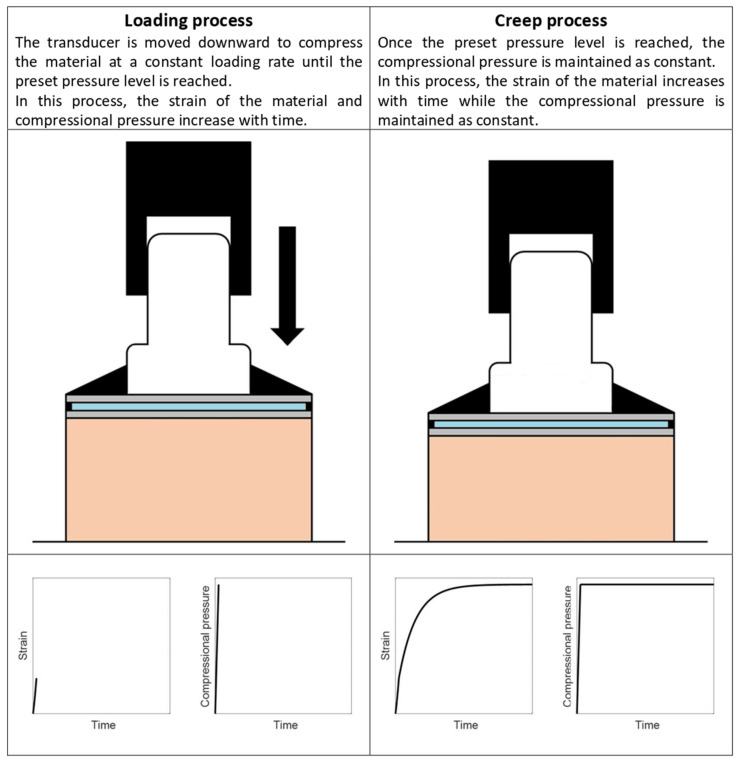
Most biomaterials and tissues are viscoelastic; thus, evaluating viscoelastic properties is important for numerous biomedical applications. Compressional viscoelastography is an ultrasound imaging technique used for measuring the viscoelastic properties of biomaterials and tissues. It analyzes the creep behavior of a material under an external mechanical compression. The aim of this study is to use finite element analysis to investigate how loading conditions (the distribution of the applied compressional pressure on the surface of the sample) and boundary conditions (the fixation method used to stabilize the sample) can affect the measurement accuracy of compressional viscoelastography. The results show that loading and boundary conditions in computational simulations of compressional viscoelastography can severely affect the measurement accuracy of the viscoelastic properties of materials. The measurement can only be accurate if the compressional pressure is exerted on the entire top surface of the sample, as well as if the bottom of the sample is fixed only along the vertical direction. These findings imply that, in an experimental validation study, the phantom design should take into account that the surface area of the pressure plate must be equal to or larger than that of the top surface of the sample, and the sample should be placed directly on the testing platform without any fixation (such as a sample container). The findings indicate that when applying compressional viscoelastography to real tissues in vivo, consideration should be given to the representative loading and boundary conditions. The findings of the present simulation study will provide a reference for experimental phantom designs regarding loading and boundary conditions, as well as guidance towards validating the experimental results of compressional viscoelastography.
大多数生物材料和组织都是粘弹性的;因此,评估粘弹性特性对于众多生物医学应用而言至关重要。压缩粘弹性成像术是一种用于测量生物材料和组织粘弹性特性的超声成像技术。它分析材料在外部机械压缩下的蠕变行为。本研究的目的是使用有限元分析来研究加载条件(施加在样品表面的压缩压力分布)和边界条件(用于稳定样品的固定方法)如何影响压缩粘弹性成像术的测量精度。结果表明,在压缩粘弹性成像术的计算模拟中,加载和边界条件会严重影响材料粘弹性特性的测量精度。只有当压缩压力施加在样品的整个顶表面上,并且样品底部仅沿垂直方向固定时,测量才会准确。这些发现意味着,在实验验证研究中,体模设计应考虑压板的表面积必须等于或大于样品顶表面的面积,并且样品应直接放置在测试平台上而无需任何固定(例如样品容器)。研究结果表明,在将压缩粘弹性成像术应用于体内真实组织时,应考虑具有代表性的加载和边界条件。本模拟研究的结果将为关于加载和边界条件的实验体模设计提供参考,以及为验证压缩粘弹性成像术的实验结果提供指导。