SOUSEIKAI Fukuoka Mirai Hospital Clinical Research Center, Kashiiteriha 3-5-1, Higashi-ku, Fukuoka 813-0017, Japan.
Department of Public Health, Dokkyo Medical University School of Medicine, 880 Kitakobayashi, Mibu-machi, Shimotsuga-gun, Tochigi 321-0293, Japan.
Int J Environ Res Public Health. 2021 May 12;18(10):5096. doi: 10.3390/ijerph18105096.
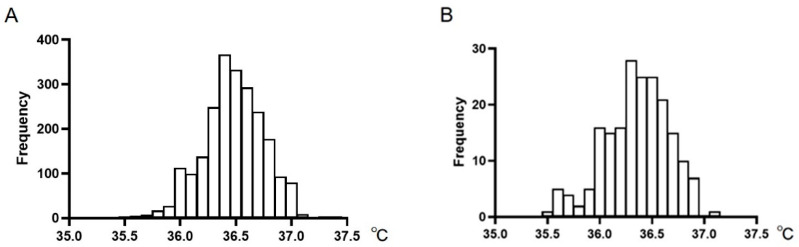
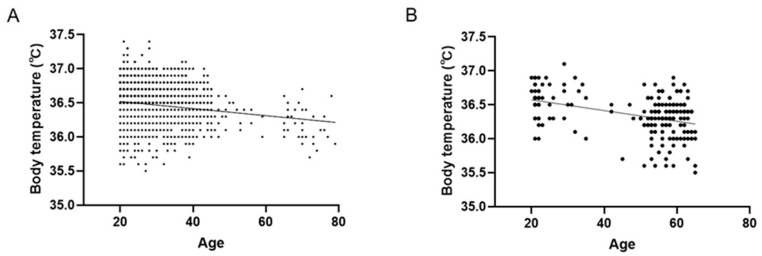
Body temperature is important for diagnosing illnesses. However, its assessment is often a difficult task, considering the large individual differences. Although 37 °C has been the gold standard of body temperature for over a century, the temperature of modern people is reportedly decreasing year by year. However, a mean axillary temperature of 36.89 ± 0.34 °C reported in 1957 is still cited in Japan. To assess the measured axillary temperature appropriately, understanding its distribution in modern people is important. This study retrospectively analyzed 2454 axillary temperature measurement data of healthy Japanese adults in 2019 (age range, 20-79 years; 2258 males). Their mean temperature was 36.47 ± 0.28 °C (36.48 ± 0.27 °C in males and 36.35 ± 0.31 °C in females). Approximately 5% of the 20-39-year-old males had body temperature ≥37 °C, whereas 8% had a temperature ≥ 37 °C in the afternoon. However, none of the subjects aged ≥50 years reported body temperature ≥37 °C. In multivariable regression analysis, age, blood pressure, pulse rate, and measurement time of the day were associated with axillary temperature. Our data showed that the body temperature of modern Japanese adults was lower than that reported previously. When assessing body temperature, the age, blood pressure, pulse rate, and measurement time of the day should be considered.
体温对于疾病的诊断很重要。然而,由于个体差异较大,其评估往往是一项艰巨的任务。尽管 37°C 作为体温的金标准已经有一个多世纪了,但据报道,现代人的体温正在逐年下降。然而,日本仍在引用 1957 年报道的平均腋温 36.89±0.34°C。为了正确评估测量的腋温,了解其在现代人中的分布情况很重要。本研究回顾性分析了 2019 年 2454 例健康日本成年人的腋温测量数据(年龄范围 20-79 岁;2258 名男性)。他们的平均体温为 36.47±0.28°C(男性 36.48±0.27°C,女性 36.35±0.31°C)。约 5%的 20-39 岁男性体温≥37°C,而 8%的人在下午体温≥37°C。然而,≥50 岁的受试者均无体温≥37°C的报告。在多变量回归分析中,年龄、血压、脉搏率和测量时间与腋温相关。我们的数据显示,现代日本成年人的体温低于之前报道的水平。在评估体温时,应考虑年龄、血压、脉搏率和测量时间。