Matute Alexis, Tabart Jessica, Cheramy-Bien Jean-Paul, Kevers Claire, Dommes Jacques, Defraigne Jean-Olivier, Pincemail Joël
Laboratory of Plant Molecular Biology and Biotechnology, UR InBios-Phytosystems, University of Liège, Sart Tilman, 4000 Liège, Belgium.
Department of Cardiovascular Surgery, CREDEC and Platform Nutrition Antioxydante et Santé, CHU and University of Liège, Sart Tilman, 4000 Liège, Belgium.
Antioxidants (Basel). 2021 May 12;10(5):770. doi: 10.3390/antiox10050770.
In support of claims that their products have antioxidant properties, the food industry and dietary supplement manufacturers rely solely on the in vitro determination of the ORAC (oxygen radical antioxidant capacity) value, despite its acknowledged lack of any in vivo relevance. It thus appears necessary to use tests exploiting biological materials (blood, white blood cells) capable of producing physiological free radicals, in order to evaluate more adequately the antioxidant capacities of foods such as fruit and vegetable juices.
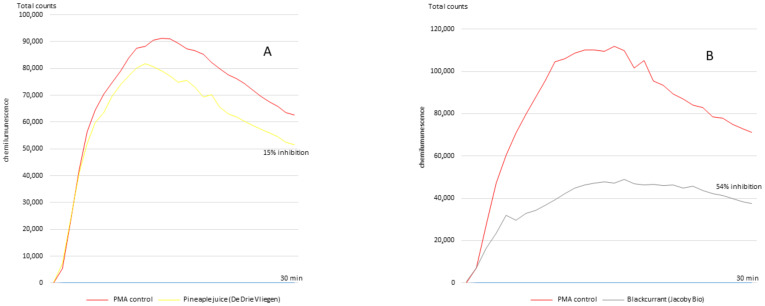
Two approaches to assessing the antioxidant capacities of 21 commercial fruit and vegetable juices were compared: the ORAC assay and the "PMA-whole blood assay," which uses whole blood stimulated by phorbol myristate acetate to produce the superoxide anion. We described in another paper the total polyphenol contents (TPCs) and individual phenolic compound contents of all the juices were investigated.
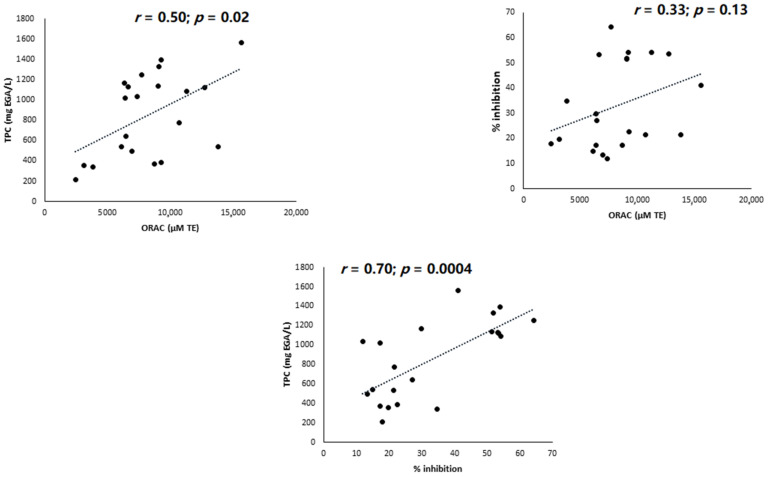
Ranking of the juices from highest to lowest antioxidant capacity differed considerably according to the test used, so there was no correlation ( = 0.33, = 0.13) between the two assays when considering all juices. Although the results of the ORAC assay correlated positively with TPC ( = 0.50, = 0.02), a much stronger correlation ( = 0.70, = 0.004) emerged between TPC and % superoxide anion inhibition. In the PMA-whole blood assay, peonidin-3--glucoside, epigallocatechin gallate, catechin, and quercetin present in juices were found to inhibit superoxide anion production at concentrations below 1 µM, with a strong positive correlation.
Associated with the determination of total and individual phenolic compounds contained in fruit and vegetable juices, the PMA-whole blood assay appears better than the ORAC assay for evaluating juice antioxidant capacity.
食品行业和膳食补充剂制造商声称其产品具有抗氧化特性,他们完全依赖于体外测定氧自由基抗氧化能力(ORAC)值,尽管人们公认该值缺乏任何体内相关性。因此,似乎有必要使用利用能够产生生理性自由基的生物材料(血液、白细胞)的测试,以便更充分地评估果汁等食品的抗氧化能力。
比较了两种评估21种市售果蔬汁抗氧化能力的方法:ORAC测定法和“佛波酯-全血测定法”,后者使用佛波酯肉豆蔻酸酯刺激全血产生超氧阴离子。我们在另一篇论文中描述了对所有果汁的总多酚含量(TPC)和单个酚类化合物含量进行了研究。
根据所使用的测试方法,果汁抗氧化能力从高到低的排名差异很大,因此在考虑所有果汁时,两种测定方法之间没有相关性(r = 0.33,P = 0.13)。虽然ORAC测定结果与TPC呈正相关(r = 0.50,P = 0.02),但TPC与超氧阴离子抑制率之间出现了更强的相关性(r = 0.70,P = 0.004)。在佛波酯-全血测定中,发现果汁中存在的芍药素-3-O-葡萄糖苷、表没食子儿茶素没食子酸酯、儿茶素和槲皮素在浓度低于1μM时可抑制超氧阴离子的产生,且呈强正相关。
与测定果蔬汁中总酚类化合物和单个酚类化合物相关,佛波酯-全血测定法在评估果汁抗氧化能力方面似乎比ORAC测定法更好。