Bignotti Fabio, Baldi Francesco, Grassi Mario, Abrami Michela, Spagnoli Gloria
Department of Mechanical and Industrial Engineering, University of Brescia, via Branze 38, I-25123 Brescia, Italy.
Department of Engineering and Architecture, University of Trieste, Building B, via Valerio 6, I-34127 Trieste, Italy.
Polymers (Basel). 2021 May 6;13(9):1489. doi: 10.3390/polym13091489.
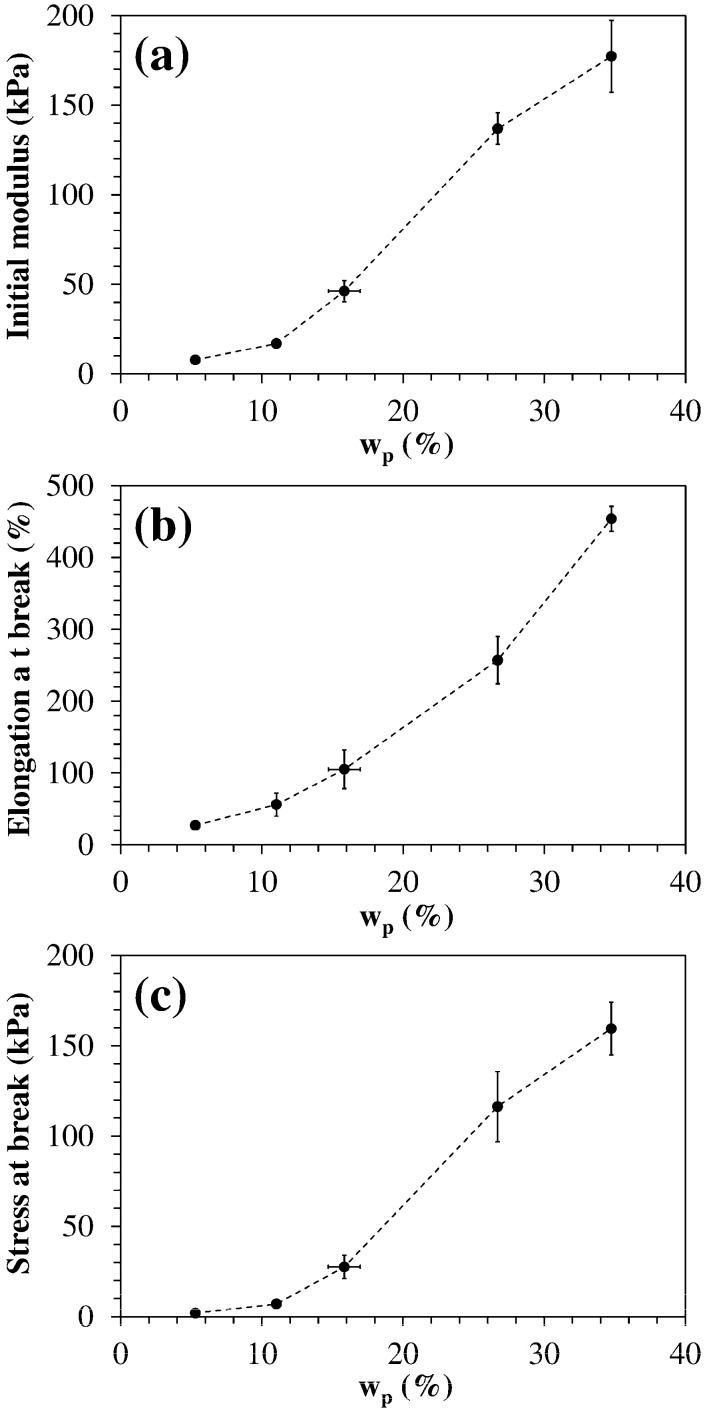
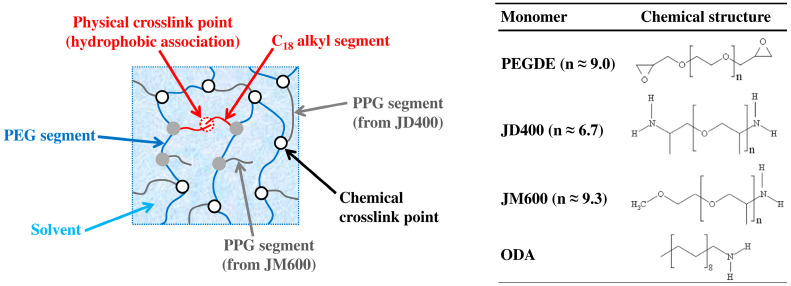
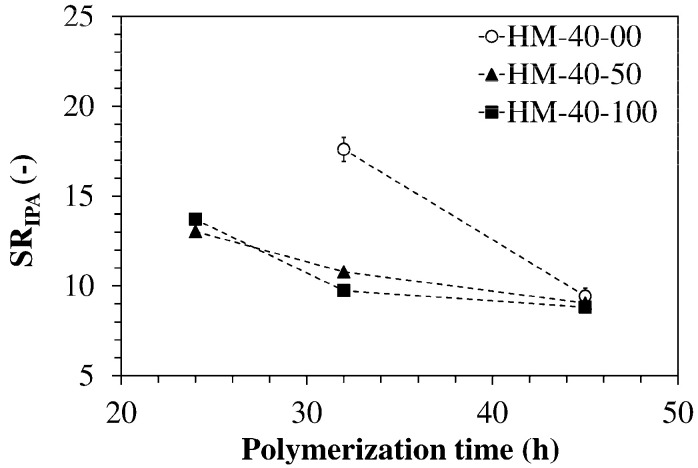
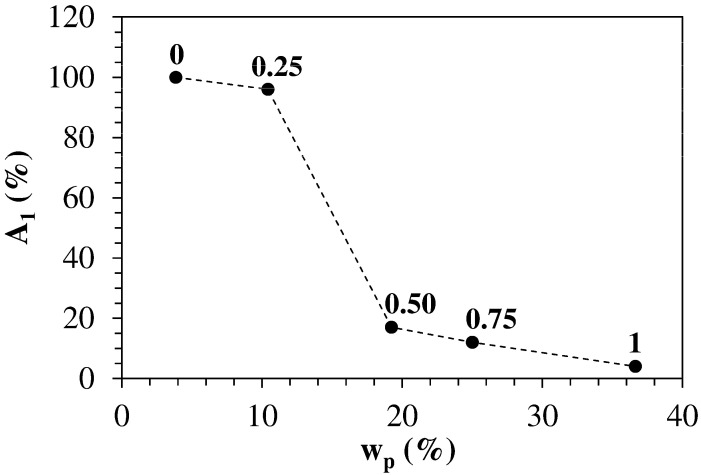
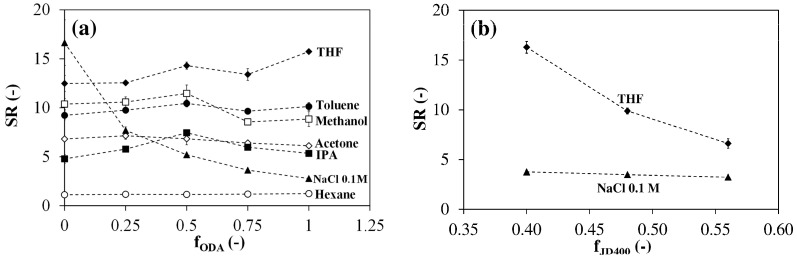
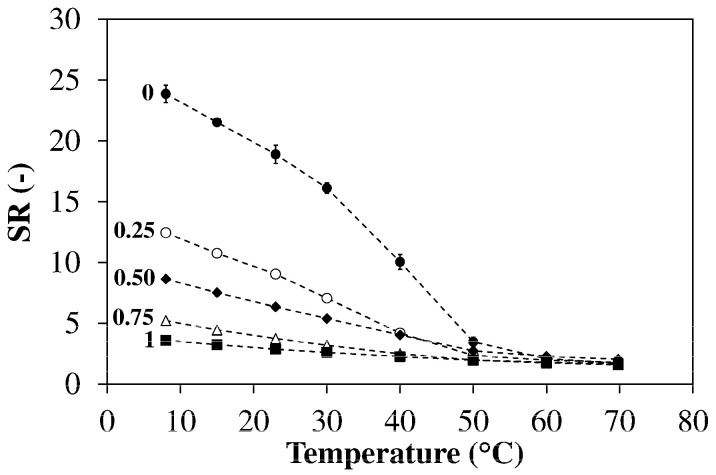
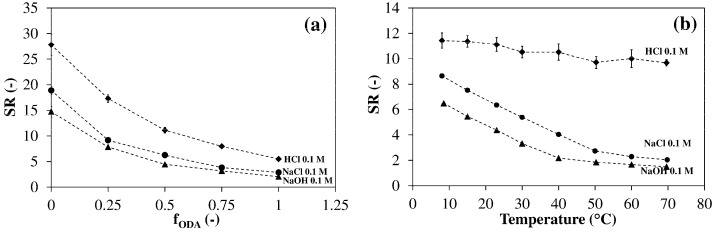
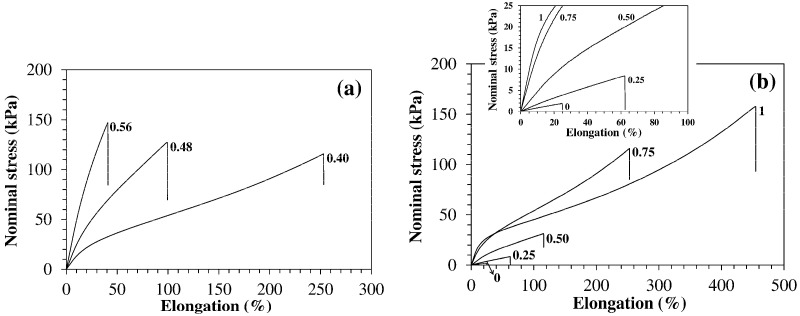
This work reports on a novel method to synthesize hydrophobically-modified hydrogels by curing epoxy monomers with amines. The resulting networks contain hydrophilic poly(ethylene glycol) (PEG) segments, poly(propylene glycol) (PPG) segments, and C alkyl segments. By varying the content of C segments, networks with different hydrophilic-lipophilic balance (HLB) are obtained. All networks show an amphiphilic behavior, swelling considerably both in organic solvents and in aqueous media. In the latter they display a thermosensitive behavior, which is highly affected by the network HLB and the pH of the solution. A decrease in HLB results in an increment of the polymer weight content (w) due to hydrophobic association. Furthermore, a reduction in HLB induces a remarkable increase in initial modulus, elongation at break and tensile strength, especially when w becomes greater than about 10%. Low field nuclear magnetic resonance (LF-NMR) experiments evidence that, when HLB decreases, a sudden and considerable increase in hydrogel heterogeneity takes place due to occurrence of extensive physical crosslinking. Available data suggest that in systems with w ≳ 10% a continuous physical network superimposes to the pre-existing chemical network and leads to a sort of double network capable of considerably improving hydrogel toughness.
这项工作报道了一种通过用胺固化环氧单体来合成疏水改性水凝胶的新方法。所得网络包含亲水性聚乙二醇(PEG)链段、聚丙二醇(PPG)链段和C烷基链段。通过改变C链段的含量,可获得具有不同亲水亲油平衡(HLB)的网络。所有网络均表现出两亲性行为,在有机溶剂和水介质中均有显著溶胀。在后者中,它们表现出热敏行为,这受到网络HLB和溶液pH值的高度影响。由于疏水缔合,HLB的降低导致聚合物重量含量(w)增加。此外,HLB的降低会导致初始模量、断裂伸长率和拉伸强度显著增加,尤其是当w大于约10%时。低场核磁共振(LF-NMR)实验表明,当HLB降低时,由于广泛的物理交联的发生,水凝胶的不均匀性会突然显著增加。现有数据表明,在w≳10%的体系中,连续的物理网络叠加在预先存在的化学网络上,形成一种能够显著提高水凝胶韧性的双网络。