Kushikata Tetsuya, Hirota Kazuyoshi, Saito Junichi, Takekawa Daiki
Department of Anesthesiology, Graduate School of Medicine, Hirosaki University, Zaifu 5, Hirosaki 0368562, Japan.
Department of Anesthesia, Hirosaki University Hospital, Honcho 53, Hirosaki 0368563, Japan.
Pharmaceuticals (Basel). 2021 May 19;14(5):483. doi: 10.3390/ph14050483.
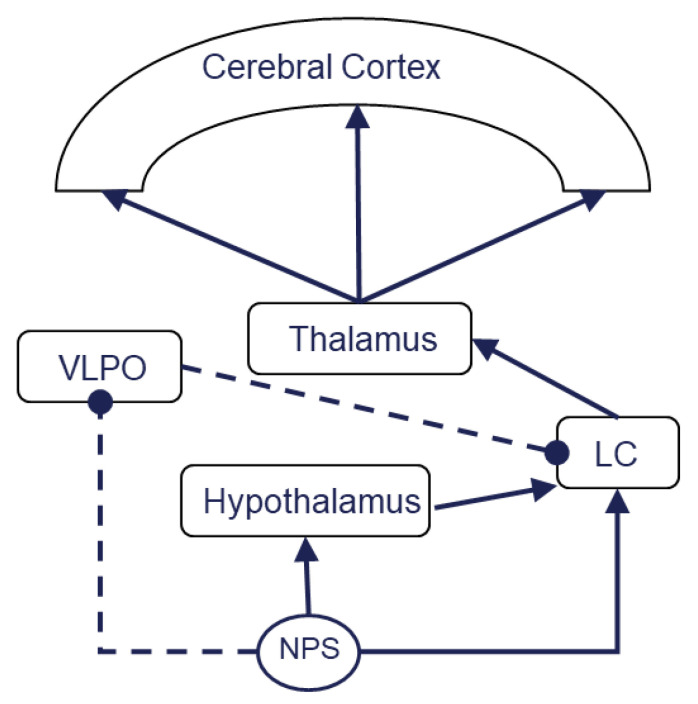
Neuropeptide S (NPS) is an endogenous peptide that regulates various physiological functions, such as immune functions, anxiety-like behaviors, learning and memory, the sleep-wake rhythm, ingestion, energy balance, and drug addiction. These processes include the NPS receptor (NPSR1). The NPS-NPSR1 system is also significantly associated with the onset of disease, as well as these physiologic functions. For example, NPS is involved in bronchial asthma, anxiety and awakening disorders, and rheumatoid arthritis. In this review, among the various functions, we focus on the role of NPS in anesthesia-induced loss of consciousness; analgesia, mainly by anesthesia; and sleep-wakefulness. Progress in the field regarding the functions of endogenous peptides in the brain, including NPS, suggests that these three domains share common mechanisms. Further NPS research will help to elucidate in detail how these three domains interact with each other in their functions, and may contribute to improving the quality of medical care.
神经肽 S(NPS)是一种内源性肽,可调节多种生理功能,如免疫功能、焦虑样行为、学习和记忆、睡眠-觉醒节律、摄食、能量平衡及药物成瘾等。这些过程涉及神经肽 S 受体(NPSR1)。NPS-NPSR1 系统也与疾病的发生以及这些生理功能显著相关。例如,NPS 参与支气管哮喘、焦虑和觉醒障碍以及类风湿关节炎。在本综述中,在各种功能中,我们重点关注 NPS 在麻醉诱导的意识丧失、主要由麻醉引起的镇痛以及睡眠-觉醒方面的作用。包括 NPS 在内的脑内源性肽功能领域的进展表明,这三个方面具有共同机制。进一步的 NPS 研究将有助于详细阐明这三个方面在功能上如何相互作用,并可能有助于提高医疗质量。