Department of Urology, Hualien Tzu Chi Hospital, Buddhist Tzu Chi Medical Foundation, Tzu Chi University, Hualien 970, Taiwan.
Toxins (Basel). 2021 May 19;13(5):362. doi: 10.3390/toxins13050362.
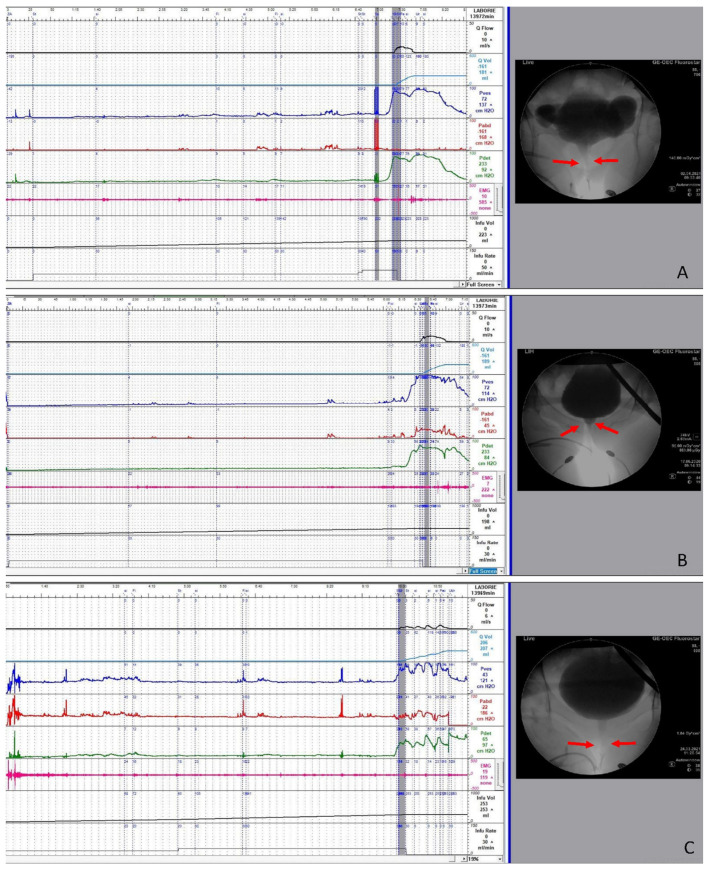
Although female dysfunctional voiding (DV) is common in urological practice, it is difficult to treat. This study evaluated the therapeutic efficacy of urethral botulinum toxin A (BoNT-A) on non-neurogenic female DV. Based on the videourodynamic study (VUDS), the DV was classified into three subgroups according to the obstructive site. A successful treatment outcome was defined as an improvement of voiding efficiency by 10% and reported global response assessment by ≥1. The study compared therapeutic efficacy, baseline urodynamic parameters, and changes in urodynamic parameters between the treatment success and failure groups and among three DV subgroups. Predictive factors for successful treatment were also investigated. A total of 81 women with DV were categorized into three groups: 55 (67.9%) had mid-urethral DV, 19 (23.5%) had distal urethral DV, and 7 (8.6%) had combined BN dysfunction and mid-urethral DV after BN transurethral incision. The treatment outcome was successful for 55 (67.9%) patients and failed for 26 (32.1%). Successfully treated patients had a significant decrease of detrusor pressure, post-void residual volume, and bladder outlet obstruction index, as well as an increase in voiding efficiency at follow-up versus the treatment failure group. The logistic regression of urodynamic parameters and clinical variables revealed that a greater volume of first sensation of filling predicts a successful BoNT-A treatment outcome ( = 0.047). The urethral BoNT-A injection is effective in treating non-neurogenic women with DV, with a success rate of 67.9%. The videourodynamic characteristics of DV may differ among patients but does not affect the treatment outcome.
尽管女性排尿功能障碍(DV)在泌尿科很常见,但很难治疗。本研究评估了尿道肉毒毒素 A(BoNT-A)治疗非神经源性女性 DV 的疗效。根据尿动力学研究(VUDS),根据梗阻部位将 DV 分为三个亚组。成功的治疗结果定义为排尿效率提高 10%,全球报告反应评估≥1。该研究比较了治疗效果、基线尿动力学参数以及治疗成功和失败组以及三个 DV 亚组之间尿动力学参数的变化。还研究了成功治疗的预测因素。共有 81 例 DV 女性患者分为三组:55 例(67.9%)为中尿道 DV,19 例(23.5%)为远端尿道 DV,7 例(8.6%)为 BN 经尿道切开术后合并逼尿肌功能障碍和中尿道 DV。55 例(67.9%)患者治疗效果成功,26 例(32.1%)治疗失败。与治疗失败组相比,成功治疗的患者在随访时逼尿肌压力、残余尿量和膀胱出口梗阻指数显著降低,排尿效率显著提高。对尿动力学参数和临床变量的逻辑回归显示,首次感觉充盈量的增加预示着 BoNT-A 治疗成功(=0.047)。尿道 BoNT-A 注射对治疗非神经源性女性 DV 有效,成功率为 67.9%。DV 的尿动力学特征在患者之间可能存在差异,但不影响治疗效果。