Facultad de Medicina, Instituto de Aparato Locomotor y Rehabilitación, Universidad Austral de Chile, Valdivia 5090000, Chile.
Instituto de Enfermería, Universidad Austral de Chile, Valdivia 5090000, Chile.
Int J Environ Res Public Health. 2021 May 19;18(10):5431. doi: 10.3390/ijerph18105431.
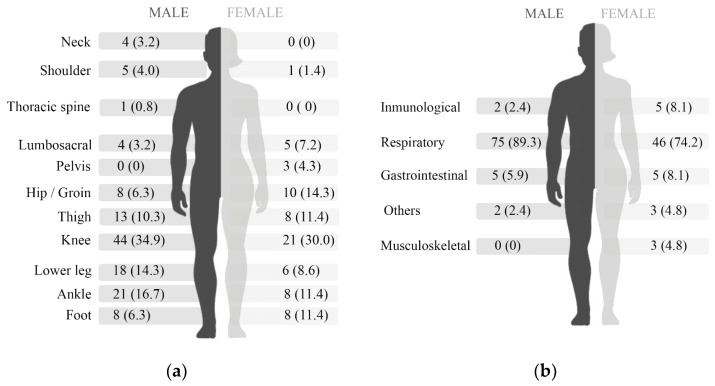
We aimed to (i) determine self-reported injury and illness frequency in trail runners 4 weeks preceding competition; (ii) compare athletes with and without injury/illness by sex, age, body mass index (BMI) and competition distance; (iii) describe mechanism of injury, anatomical region (injury)/organ system (illness) involved, consequences of injury on preparation and self-perception of injury severity; (iv) compare anatomical region (injury) and organ system (illness) by sex. A total of 654 trail runners (age 36.2, IQR 30.6-43.0; 36.9% females) participated in this retrospective cross-sectional study by completing a self-reported questionnaire. Injury and illness frequency rates were 31.3% ( = 205, CI: 27.7-35.0%) and 22.3% ( = 146, CI: 19.1-25.7%), respectively. No significant difference was found between injured vs. non-injured or ill vs. non-ill study participants by sex, age, BMI and competition distance. Regarding injuries, gradual onset (41.6%) and knee (33.2%) were the most indicated mechanism and anatomical region of injury. At least 85.4% of trail runners changed their training following injury and 79% indicated that their injury would affect their competition performance. Regarding illness, the respiratory tract was the most frequent organ system involved (82.9%). Male and female participants reported similar proportions of anatomical regions (injury) and organ systems (illness) affected. These results could help to generate education strategies and appropriate medical support before and during these competitions.
(i) 确定参赛前 4 周的越野跑运动员自我报告的损伤和疾病频率;(ii) 通过性别、年龄、体重指数(BMI)和比赛距离比较有无损伤/疾病的运动员;(iii) 描述损伤机制、涉及的解剖区域(损伤)/器官系统(疾病)、损伤对准备的影响以及自我感知的损伤严重程度;(iv) 按性别比较解剖区域(损伤)和器官系统(疾病)。共有 654 名越野跑运动员(年龄 36.2,IQR 30.6-43.0;36.9%女性)通过完成自我报告问卷参与了这项回顾性横断面研究。损伤和疾病的频率分别为 31.3%(=205,CI:27.7-35.0%)和 22.3%(=146,CI:19.1-25.7%)。在性别、年龄、BMI 和比赛距离方面,受伤与未受伤或患病与未患病的研究参与者之间没有显著差异。关于损伤,渐进性发病(41.6%)和膝关节(33.2%)是最常见的损伤机制和解剖区域。至少 85.4%的越野跑运动员在受伤后改变了训练计划,79%的运动员表示受伤会影响比赛表现。关于疾病,呼吸道是最常见的受累器官系统(82.9%)。男性和女性参与者报告的受影响解剖区域(损伤)和器官系统(疾病)的比例相似。这些结果可以帮助在这些比赛之前和期间制定教育策略和提供适当的医疗支持。