Liu Yuhong, Li Jing, Liu Chang
Hebei Key Laboratory of Electromagnetic Environmental Effects and Information Processing, Shijiazhuang Tiedao University, Shijiazhuang 050043, China.
State Key Laboratory of Information Photonics and Optical Communications, Beijing University of Posts and Telecommunications, Beijing 100876, China.
Materials (Basel). 2021 May 18;14(10):2637. doi: 10.3390/ma14102637.
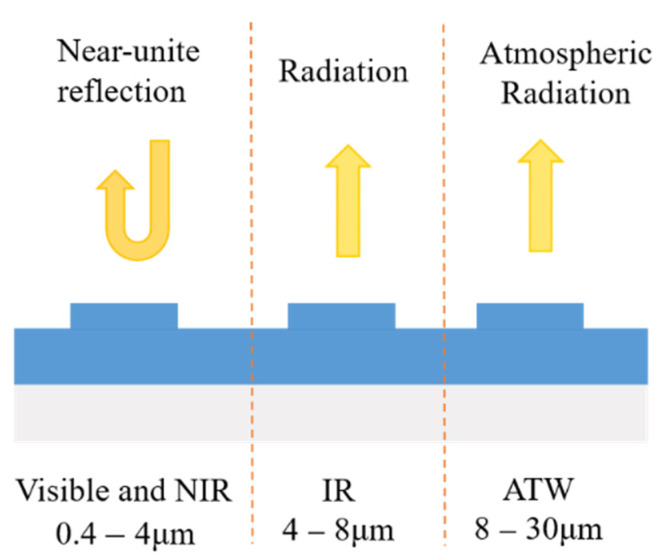
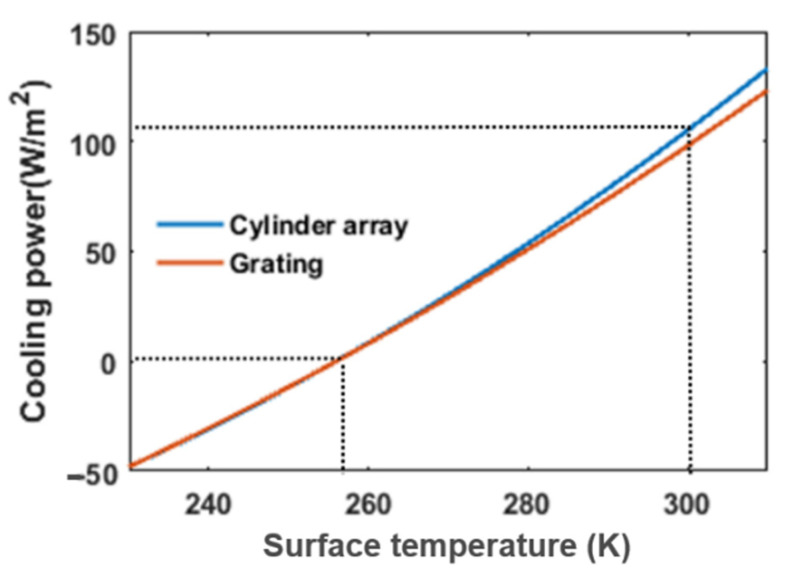
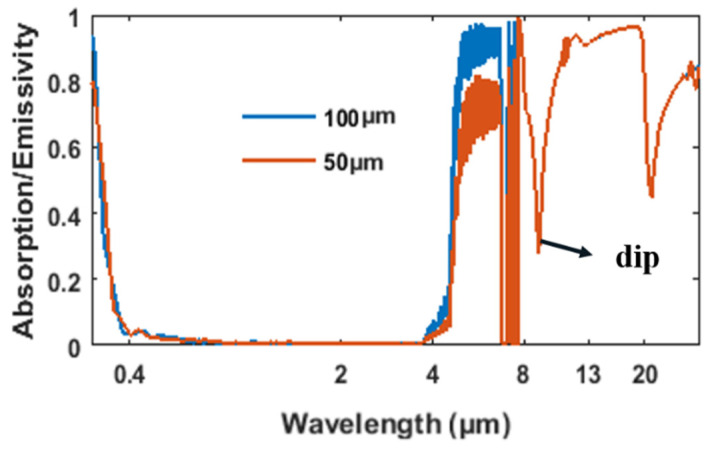
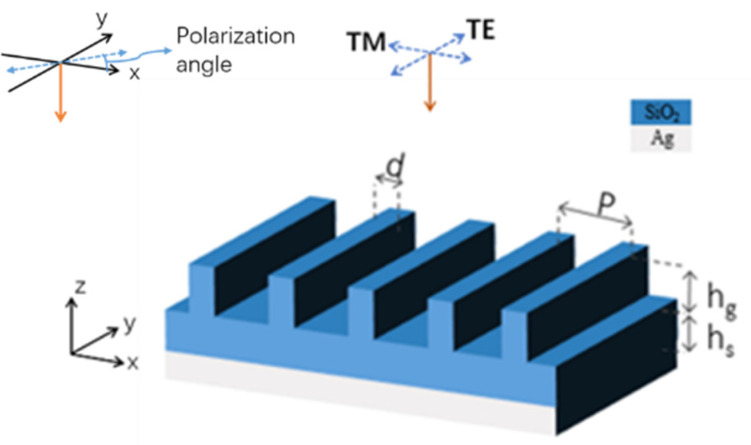
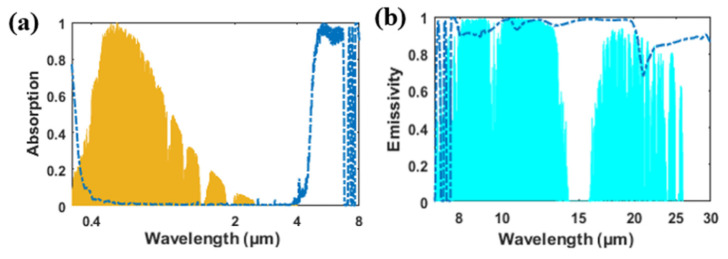
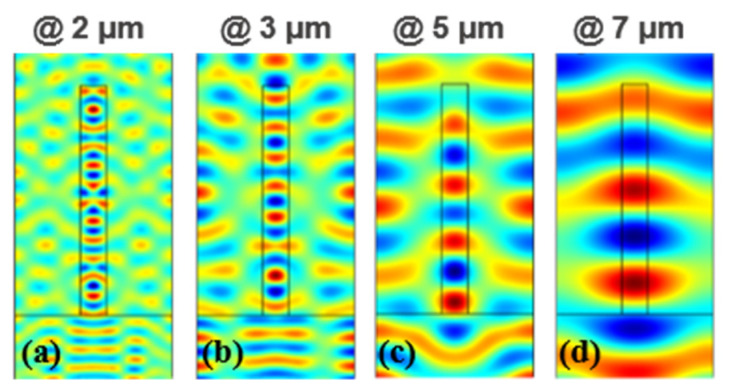
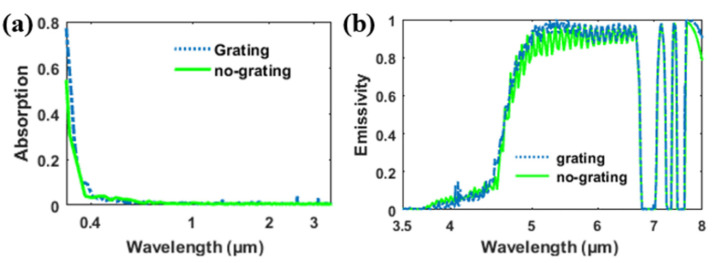
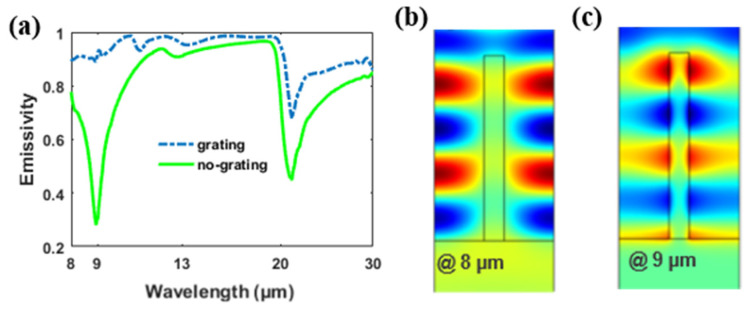
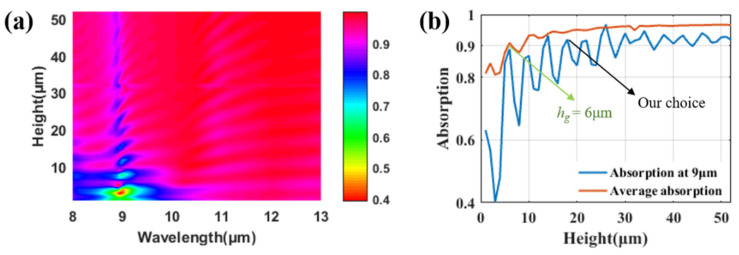
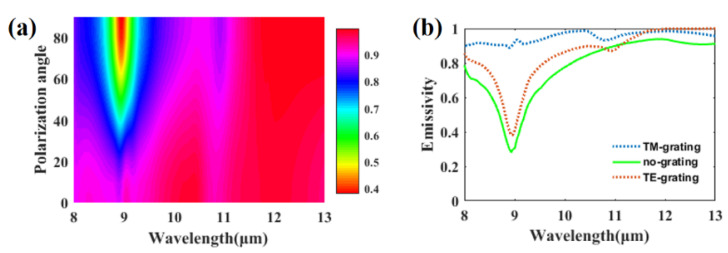
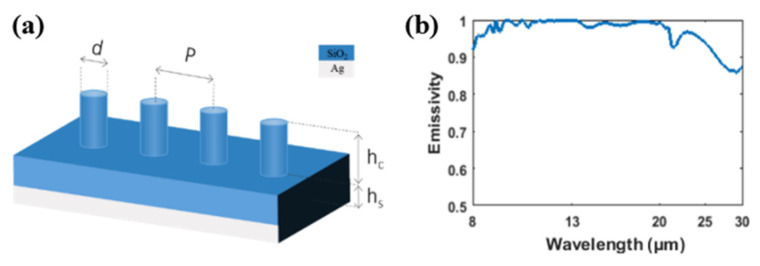
Passive radiative cooling, which cools an item without any electrical input, has drawn much attention in recent years. In many radiative coolers, silica is widely used due to its high emissivity in the mid-infrared region. However, the performance of a bare silica film is poor due to the occurrence of an emitting dip (about 30% emissivity) in the atmospheric transparent window (8-13 μm). In this work, we demonstrate that the emissivity of silica film can be improved by sculpturing structures on its surface. According to our simulation, over 90% emissivity can be achieved at 8-13 μm when periodical silica deep grating is applied on a plane silica film. With the high emissivity at the atmospheric transparent window and the extremely low absorption in the solar spectrum, the structure has excellent cooling performance (about 100 W/m). The enhancement is because of the coupling between the incident light with the surface modes. Compared with most present radiative coolers, the proposed cooler is much easier to be fabricated. However, 1-D gratings are sensitive to incident polarization, which leads to a degradation in cooling performance. To solve this problem, we further propose another radiative cooler based on a silica cylinder array. The new cooler's insensitivity to polarization angle and its average emissivity in the atmospheric transparent window is about 98%. Near-unit emissivity and their simple structures enable the two coolers to be applied in real cooling systems.
被动辐射冷却无需任何电输入就能冷却物体,近年来备受关注。在许多辐射冷却器中,二氧化硅因其在中红外区域的高发射率而被广泛使用。然而,由于在大气透明窗口(8 - 13μm)出现发射低谷(发射率约30%),裸二氧化硅薄膜的性能较差。在这项工作中,我们证明了通过在二氧化硅薄膜表面雕刻结构可以提高其发射率。根据我们的模拟,当在平面二氧化硅薄膜上应用周期性二氧化硅深光栅时,在8 - 13μm处可实现超过90%的发射率。由于在大气透明窗口具有高发射率以及在太阳光谱中极低的吸收率,该结构具有优异的冷却性能(约100W/m)。这种增强是由于入射光与表面模式之间的耦合。与目前大多数辐射冷却器相比,所提出的冷却器更容易制造。然而,一维光栅对入射偏振敏感,这会导致冷却性能下降。为了解决这个问题,我们进一步提出了另一种基于二氧化硅圆柱阵列的辐射冷却器。新冷却器对偏振角不敏感,其在大气透明窗口的平均发射率约为98%。接近单位发射率及其简单的结构使这两种冷却器能够应用于实际冷却系统。