Quezada Carolina, Estay Humberto, Cassano Alfredo, Troncoso Elizabeth, Ruby-Figueroa René
Programa Institucional de Fomento a la Investigación, Desarrollo e Innovación (PIDi), Universidad Tecnológica Metropolitana, Santiago 8940577, Chile.
Programa de Doctorado en Ciencia de Materiales e Ingeniería de Procesos (Doctoral Program in Materials Science and Process Engineering), Universidad Tecnológica Metropolitana, Santiago 8940577, Chile.
Membranes (Basel). 2021 May 18;11(5):368. doi: 10.3390/membranes11050368.
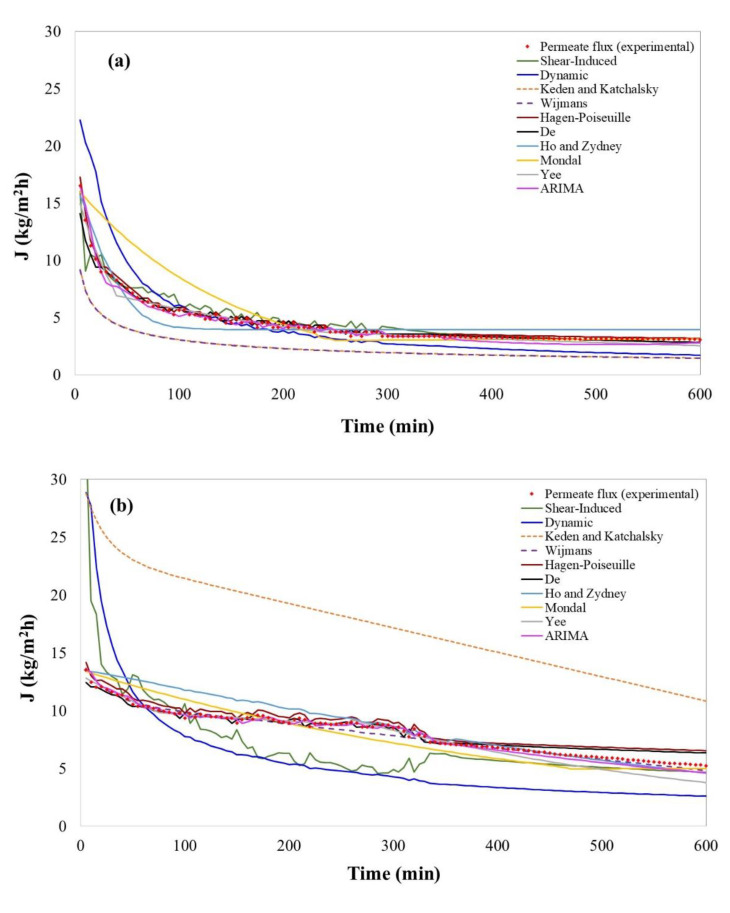
In any membrane filtration, the prediction of permeate flux is critical to calculate the membrane surface required, which is an essential parameter for scaling-up, equipment sizing, and cost determination. For this reason, several models based on phenomenological or theoretical derivation (such as gel-polarization, osmotic pressure, resistance-in-series, and fouling models) and non-phenomenological models have been developed and widely used to describe the limiting phenomena as well as to predict the permeate flux. In general, the development of models or their modifications is done for a particular synthetic model solution and membrane system that shows a good capacity of prediction. However, in more complex matrices, such as fruit juices, those models might not have the same performance. In this context, the present work shows a review of different phenomenological and non-phenomenological models for permeate flux prediction in UF, and a comparison, between selected models, of the permeate flux predictive capacity. Selected models were tested with data from our previous work reported for three fruit juices (bergamot, kiwi, and pomegranate) processed in a cross-flow system for 10 h. The validation of each selected model's capacity of prediction was performed through a robust statistical examination, including a residual analysis. The results obtained, within the statistically validated models, showed that phenomenological models present a high variability of prediction (values of R-square in the range of 75.91-99.78%), Mean Absolute Percentage Error (MAPE) in the range of 3.14-51.69, and Root Mean Square Error (RMSE) in the range of 0.22-2.01 among the investigated juices. The non-phenomenological models showed a great capacity to predict permeate flux with R-squares higher than 97% and lower MAPE (0.25-2.03) and RMSE (3.74-28.91). Even though the estimated parameters have no physical meaning and do not shed light into the fundamental mechanistic principles that govern these processes, these results suggest that non-phenomenological models are a useful tool from a practical point of view to predict the permeate flux, under defined operating conditions, in membrane separation processes. However, the phenomenological models are still a proper tool for scaling-up and for an understanding the UF process.
在任何膜过滤过程中,预测渗透通量对于计算所需的膜面积至关重要,而膜面积是放大、设备选型和成本确定的关键参数。因此,已经开发了几种基于现象学或理论推导的模型(如凝胶极化模型、渗透压模型、串联阻力模型和污染模型)以及非现象学模型,并广泛用于描述极限现象以及预测渗透通量。一般来说,模型的开发或修改是针对特定的合成模型溶液和膜系统进行的,这些模型溶液和膜系统具有良好的预测能力。然而,在更复杂的基质中,如果汁,这些模型可能表现不佳。在此背景下,本工作综述了用于超滤中渗透通量预测的不同现象学和非现象学模型,并比较了所选模型的渗透通量预测能力。所选模型使用了我们之前工作中报道的三种果汁(佛手柑、猕猴桃和石榴)在错流系统中处理10小时的数据进行测试。通过包括残差分析在内的稳健统计检验,对每个所选模型的预测能力进行了验证。在经过统计验证的模型中,结果表明,现象学模型的预测具有较高的变异性(决定系数R²值在75.91 - 99.78%范围内),在所研究的果汁中,平均绝对百分比误差(MAPE)在3.14 - 51.69范围内,均方根误差(RMSE)在0.22 - 2.01范围内。非现象学模型显示出很强的预测渗透通量的能力,决定系数R²高于97%,平均绝对百分比误差(MAPE)较低(0.25 - 2.03),均方根误差(RMSE)较低(3.74 - 28.91)。尽管估计参数没有物理意义,也没有揭示控制这些过程的基本机理,但这些结果表明,从实际角度来看,非现象学模型是在定义的操作条件下预测膜分离过程中渗透通量的有用工具。然而,现象学模型仍然是放大和理解超滤过程的合适工具。