Farré-Alins Víctor, Palomino-Antolín Alejandra, Narros-Fernández Paloma, Lopez-Rodriguez Ana Belen, Decouty-Perez Céline, Muñoz-Montero Alicia, Zamorano-Fernández Jorge, Mansilla-Fernández Beatriz, Giner-García Javier, García-Feijoo Pablo, Sáez-Alegre Miguel, Palpán-Flores Alexis J, Roda-Frade José María, Carabias Cristina S, Rosa Juliana M, Civantos-Martín Belén, Yus-Teruel Santiago, Gandía Luis, Lagares Alfonso, Hernández-García Borja J, Egea Javier
Molecular Neuroinflammation and Neuronal Plasticity Research Laboratory, Research Unit, Hospital Universitario Santa Cristina, Instituto de Investigación Sanitaria-Hospital Universitario de la Princesa, 28009 Madrid, Spain.
Instituto Teófilo Hernando, Departamento de Farmacología y Terapéutica, Facultad de Medicina, UAM, 28029 Madrid, Spain.
Biomedicines. 2021 May 25;9(6):599. doi: 10.3390/biomedicines9060599.
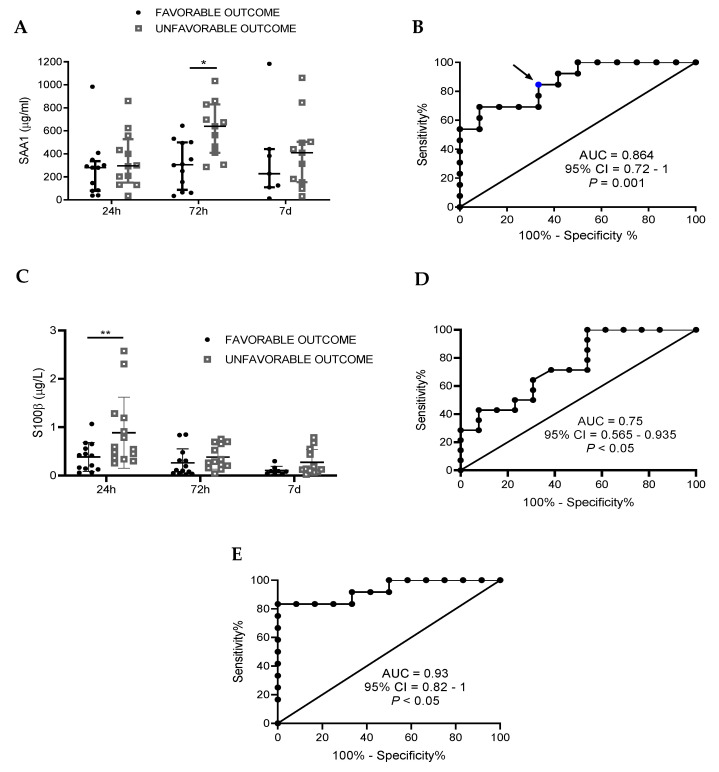
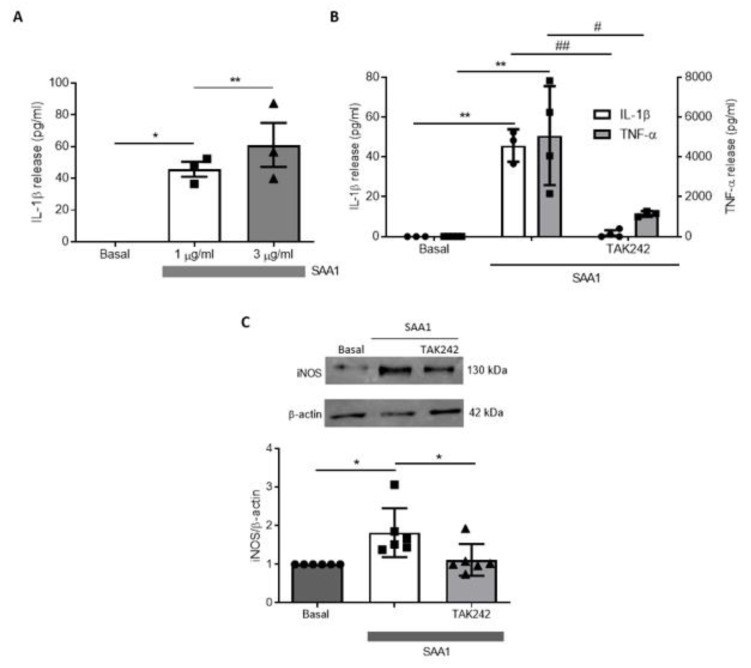
Traumatic brain injury (TBI) is one of the leading causes of mortality and disability worldwide without any validated biomarker or set of biomarkers to help the diagnosis and evaluation of the evolution/prognosis of TBI patients. To achieve this aim, a deeper knowledge of the biochemical and pathophysiological processes triggered after the trauma is essential. Here, we identified the serum amyloid A1 protein-Toll-like receptor 4 (SAA1-TLR4) axis as an important link between inflammation and the outcome of TBI patients. Using serum and mRNA from white blood cells (WBC) of TBI patients, we found a positive correlation between serum SAA1 levels and injury severity, as well as with the 6-month outcome of TBI patients. SAA1 levels also correlate with the presence of TLR4 mRNA in WBC. In vitro, we found that SAA1 contributes to inflammation via TLR4 activation that releases inflammatory cytokines, which in turn increases SAA1 levels, establishing a positive proinflammatory loop. In vivo, post-TBI treatment with the TLR4-antagonist TAK242 reduces SAA1 levels, improves neurobehavioral outcome, and prevents blood-brain barrier disruption. Our data support further evaluation of (i) post-TBI treatment in the presence of TLR4 inhibition for limiting TBI-induced damage and (ii) SAA1-TLR4 as a biomarker of injury progression in TBI patients.
创伤性脑损伤(TBI)是全球范围内导致死亡和残疾的主要原因之一,目前尚无经过验证的生物标志物或生物标志物组合来帮助诊断和评估TBI患者的病情演变/预后。为实现这一目标,深入了解创伤后引发的生化和病理生理过程至关重要。在此,我们确定血清淀粉样蛋白A1蛋白- Toll样受体4(SAA1-TLR4)轴是炎症与TBI患者预后之间的重要联系。利用TBI患者白细胞(WBC)的血清和mRNA,我们发现血清SAA1水平与损伤严重程度以及TBI患者的6个月预后呈正相关。SAA1水平还与WBC中TLR4 mRNA的存在相关。在体外,我们发现SAA1通过激活TLR4促进炎症反应,释放炎性细胞因子,进而增加SAA1水平,形成一个正向的促炎循环。在体内,TBI后用TLR4拮抗剂TAK242治疗可降低SAA1水平,改善神经行为预后,并防止血脑屏障破坏。我们的数据支持进一步评估:(i)在存在TLR4抑制的情况下进行TBI后治疗以限制TBI诱导的损伤;(ii)SAA1-TLR4作为TBI患者损伤进展的生物标志物。