Disciplina de Obstetrícia, Departamento de Obstetrícia e Ginecologia, Faculdade de Medicina FMUSP, Universidade de São Paulo, Av. Dr. Enéas Carvalho de Aguiar, 255, Cerqueira César 05403-000, São Paulo, Brazil.
Nutrients. 2021 May 28;13(6):1842. doi: 10.3390/nu13061842.
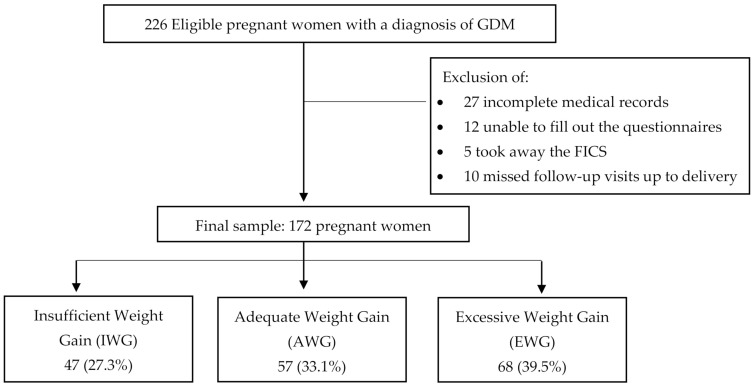
The aim of this study was to evaluate the Diet Quality Index (DQI) and the Physical Activity (PA) levels associated with adequacy of gestational weight gain in pregnant women with gestational diabetes mellitus (GDM). A total of 172 pregnant women with a single fetus and a diagnosis of GDM participated. Food intake was self-reported on the food frequency questionnaire and DQI was quantified using the index validated and revised for Brazil (DQI-R). To assess PA, the Pregnancy Physical Activity Questionnaire was administered. Gestational weight gain was classified, following the criteria of the Institute of Medicine, into adequate (AWG), insufficient (IWG), or excessive (EWG) weight gain. A multinomial logistic regression analysis was performed, with level of significance <0.05. The participants were divided into 3 groups: AWG (33.1%), IWG (27.3%), and EWG (39.5%). The analysis indicated that if the pregnant women PA fell into tertile 1 or 2, then they had a greater chance of having IWG, whereas those with the lowest scores on the DQI-R, whose PA fell into tertile 2, and pregestational obesity women had the greatest chance of having EWG. This study has shown that low PA levels may contribute towards IWG. On the other hand, a low final DQI-R score, representing inadequate food habits, low PA levels, and pregestational obesity may increase the chance of EWG in patients with GDM.
本研究旨在评估饮食质量指数(DQI)和身体活动(PA)水平与妊娠糖尿病(GDM)孕妇妊娠期体重增加充足性的相关性。共有 172 名单胎妊娠且诊断为 GDM 的孕妇参与了这项研究。通过食物频率问卷进行食物摄入自我报告,使用经过巴西验证和修订的指数(DQI-R)量化 DQI。为了评估 PA,使用了妊娠体力活动问卷。根据医学研究所的标准,将妊娠期体重增加分为适当(AWG)、不足(IWG)或过多(EWG)。采用具有统计学意义的<0.05 的多变量逻辑回归分析。参与者被分为 3 组:AWG(33.1%)、IWG(27.3%)和 EWG(39.5%)。分析表明,如果孕妇的 PA 落入第 1 或第 2 三分位,则她们更有可能出现 IWG,而 DQI-R 得分最低的孕妇,其 PA 落入第 2 三分位,且孕前肥胖的孕妇更有可能出现 EWG。本研究表明,低 PA 水平可能导致 IWG。另一方面,低的最终 DQI-R 评分,代表不良的饮食习惯、低 PA 水平和孕前肥胖,可能会增加 GDM 患者 EWG 的机会。