Department of Brain Sciences, Imperial College London, Hammersmith Hospital, Du Cane Road, London W12 0NN, UK.
Int J Mol Sci. 2021 May 28;22(11):5769. doi: 10.3390/ijms22115769.
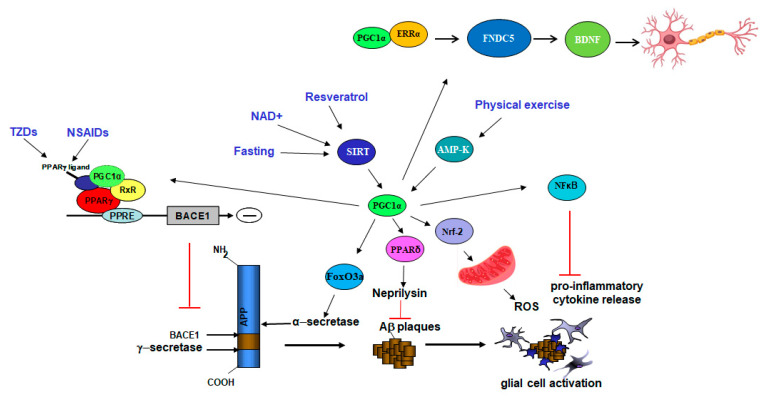
The peroxisome proliferator-activated receptor co-activator-1α (PGC1α) belongs to a family of transcriptional regulators, which act as co-activators for a number of transcription factors, including PPARs, NRFs, oestrogen receptors, etc. PGC1α has been implicated in the control of mitochondrial biogenesis, the regulation of the synthesis of ROS and inflammatory cytokines, as well as genes controlling metabolic processes. The levels of PGC1α have been shown to be altered in neurodegenerative disorders. In the brains of Alzheimer's disease (AD) patients and animal models of amyloidosis, PGC1α expression was reduced compared with healthy individuals. Recently, it was shown that overexpression of PGC1α resulted in reduced amyloid-β (Aβ) generation, particularly by regulating the expression of BACE1, the rate-limiting enzyme involved in the production of Aβ. These results provide evidence pointing toward PGC1α activation as a new therapeutic avenue for AD, which has been supported by the promising observations of treatments with drugs that enhance the expression of PGC1α and gene therapy studies in animal models of AD. This review summarizes the different ways and mechanisms whereby PGC1α can be neuroprotective in AD and the pre-clinical treatments that have been explored so far.
过氧化物酶体增殖物激活受体共激活因子-1α(PGC1α)属于转录调控因子家族,可作为包括过氧化物酶体增殖物激活受体(PPARs)、核呼吸因子(NRFs)、雌激素受体等在内的多种转录因子的共激活因子。PGC1α 参与了线粒体生物发生的控制、ROS 和炎性细胞因子的合成调节以及控制代谢过程的基因的调节。研究表明,PGC1α 的水平在神经退行性疾病中发生了改变。在阿尔茨海默病(AD)患者和淀粉样变性的动物模型的大脑中,与健康个体相比,PGC1α 的表达减少。最近的研究表明,PGC1α 的过表达导致 Aβ 生成减少,特别是通过调节 BACE1 的表达,BACE1 是 Aβ 生成过程中的限速酶。这些结果为 PGC1α 激活作为 AD 的新治疗途径提供了证据,这一观点得到了增强 PGC1α 表达的药物治疗和 AD 动物模型中的基因治疗研究的有前景的观察结果的支持。本文综述了 PGC1α 在 AD 中发挥神经保护作用的不同方式和机制,以及迄今为止探索的临床前治疗方法。