Institute of Pharmaceutical Biology and Phytochemistry (IPBP), University of Münster, PharmaCampus, Corrensstr. 48, D-48149 Münster, Germany.
Swiss Tropical and Public Health Institute (Swiss TPH), Socinstrasse 57, CH-4051 Basel, Switzerland.
Molecules. 2021 May 27;26(11):3226. doi: 10.3390/molecules26113226.
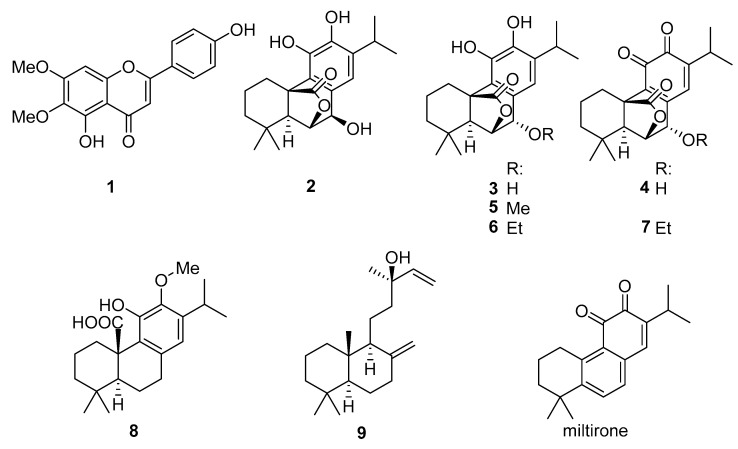
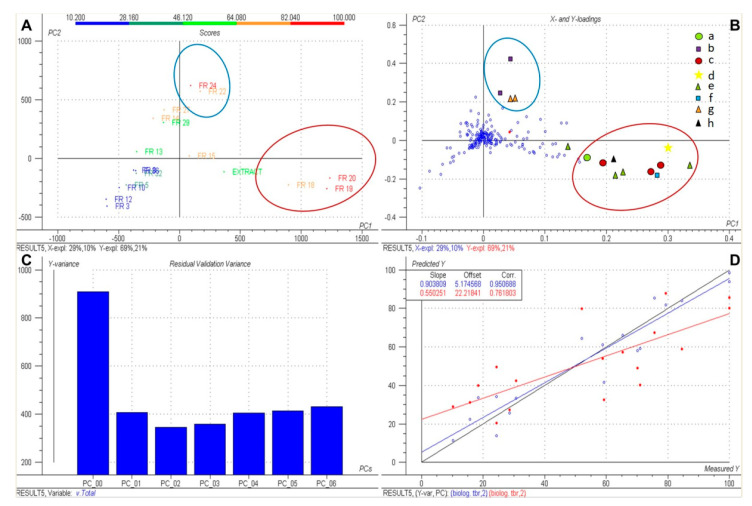
As part of our studies on antiprotozoal activity of approved herbal medicinal products, we previously found that a commercial tincture from L. (common Sage, Lamiaceae) possesses high activity against , causative agent of East African Human Trypanosomiasis. We have now investigated in detail the antitrypanosomal constituents of this preparation. A variety of fractions were tested for antitrypanosomal activity and analyzed by UHPLC/+ESI QqTOF MS. The resulting data were used to generate a partial least squares (PLS) regression model that highlighted eight particular constituents that were likely to account for the major part of the bioactivity. These compounds were then purified and identified and their activity against the pathogen tested. All identified compounds (one flavonoid and eight diterpenes) displayed significant activity against , in some cases higher than that of the total tincture. From the overall results, it can be concluded that the antitrypanosomal activity of L. is, for the major part, caused by abietane-type diterpenes of the rosmanol/rosmaquinone group.
作为我们对已批准草药抗原生动物活性研究的一部分,我们之前发现一种来自 L.(普通鼠尾草,唇形科)的商业酊剂对 具有高活性, 是东非人类锥虫病的病原体。我们现在已经详细研究了该制剂的抗锥虫成分。测试了多种馏分的抗锥虫活性,并通过 UHPLC/+ESI QqTOF MS 进行分析。所得数据用于生成偏最小二乘(PLS)回归模型,突出了可能占大部分生物活性的八个特定成分。然后对这些化合物进行了纯化和鉴定,并测试了它们对病原体的活性。所有鉴定的化合物(一种类黄酮和八种二萜)对 均显示出显著的活性,在某些情况下高于总酊剂的活性。从整体结果可以得出结论, L. 的抗锥虫活性主要是由罗莎醇/罗莎醌组的土木香烷型二萜引起的。