Bolletta Elena, Coassin Marco, Iannetta Danilo, Mastrofilippo Valentina, Aldigeri Raffaella, Invernizzi Alessandro, de Simone Luca, Gozzi Fabrizio, De Fanti Alessandro, Cappella Michela, Adani Chantal, Neri Alberto, Moramarco Antonio, De Maria Michele, Salvarani Carlo, Fontana Luigi, Cimino Luca
Ocular Immunology Unit, Azienda USL-IRCCS di Reggio Emilia, 42121 Reggio Emilia, Italy.
Ophthalmology, University Campus Bio-Medico, 00128 Rome, Italy.
J Clin Med. 2021 May 31;10(11):2437. doi: 10.3390/jcm10112437.
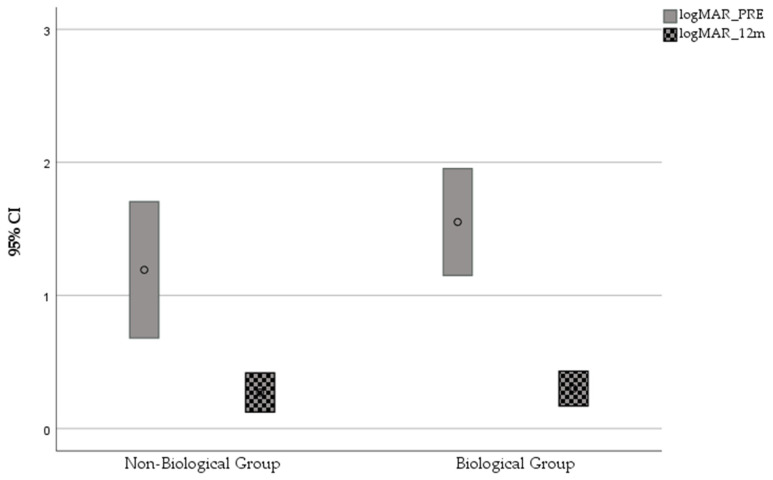
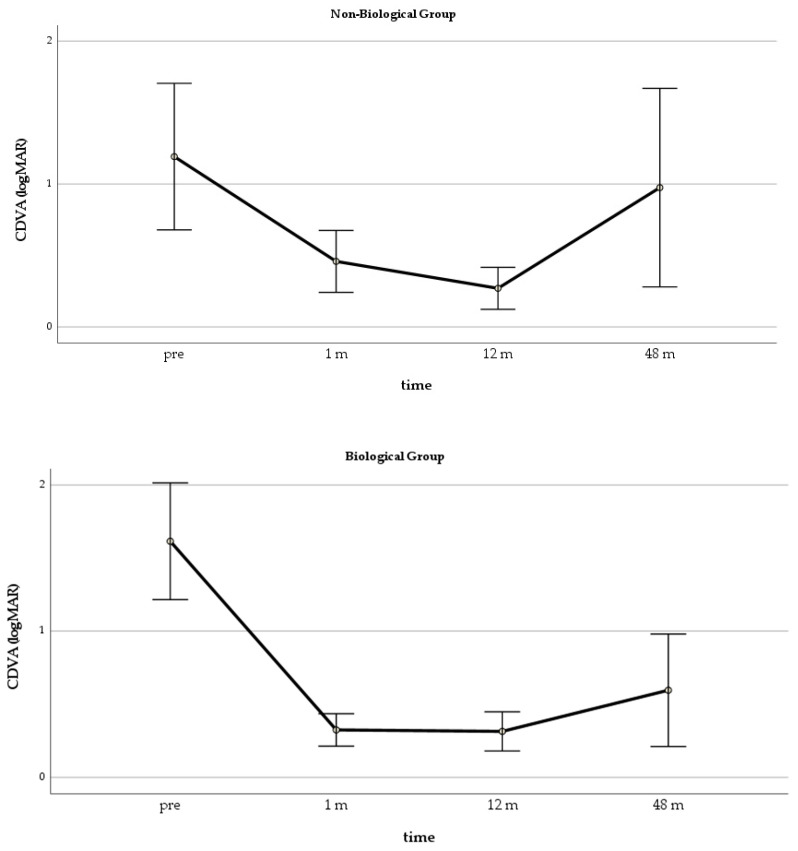
This study compared the outcomes of cataract surgery with intraocular lens (IOL) implantation in patients with juvenile idiopathic arthritis (JIA)-associated chronic anterior uveitis treated with antimetabolite drugs and systemic corticosteroids (Non-Biological Group) versus patients treated with antimetabolites and biological drugs (Biological Group). A cohort of patients with cataract in JIA-associated uveitis undergoing phacoemulsification with IOL implantation was retrospectively evaluated. The main outcome was a change in corrected distance visual acuity (CDVA) in the two groups. Ocular and systemic complications were also recorded. The data were collected preoperatively and at 1, 12, and 48 months after surgery. Thirty-two eyes of 24 children were included: 10 eyes in the Non-Biological Group and 22 eyes in the Biological Group. The mean CDVA improved from 1.19 ± 0.72 logMAR preoperatively to 0.98 ± 0.97 logMAR at 48 months ( = 0.45) in the Non-Biological Group and from 1.55 ± 0.91 logMAR preoperatively to 0.57 ± 0.83 logMAR at 48 months ( = 0.001) in the Biological Group. The postoperative complications, including synechiae, cyclitic membrane, IOL explantation, glaucoma, and macular edema, were not statistically different between the two groups. An immunosuppressive treatment with biological drugs can improve the visual outcome after cataract surgery in patients with JIA-associated uveitis, but it does not significantly reduce postoperative ocular complications.
本研究比较了在接受抗代谢药物和全身用皮质类固醇治疗的幼年特发性关节炎(JIA)相关慢性前葡萄膜炎患者(非生物制剂组)与接受抗代谢药物和生物制剂治疗的患者(生物制剂组)中,白内障手术联合人工晶状体(IOL)植入的效果。对一组患有JIA相关葡萄膜炎且正在接受白内障超声乳化联合IOL植入的患者进行了回顾性评估。主要结局是两组矫正远视力(CDVA)的变化。还记录了眼部和全身并发症。在术前以及术后1个月、12个月和48个月收集数据。纳入了24名儿童的32只眼:非生物制剂组10只眼,生物制剂组22只眼。非生物制剂组的平均CDVA从术前的1.19±0.72 logMAR提高到48个月时的0.98±0.97 logMAR(P = 0.45),生物制剂组从术前的1.55±0.91 logMAR提高到48个月时的0.57±0.83 logMAR(P = 0.001)。两组术后并发症,包括粘连、睫状体膜、IOL取出、青光眼和黄斑水肿,在统计学上无差异。使用生物制剂进行免疫抑制治疗可改善JIA相关葡萄膜炎患者白内障手术后的视力结局,但并不能显著降低术后眼部并发症。