Yang Guanghua, Li Jing, Wang Yu, Ding Minxia, Zhong Lina
Institute of Microelectronics, Chinese Academy of Sciences, Beijing 100029, China.
University of Chinese Academy of Sciences, Beijing 100049, China.
Sensors (Basel). 2021 May 31;21(11):3805. doi: 10.3390/s21113805.
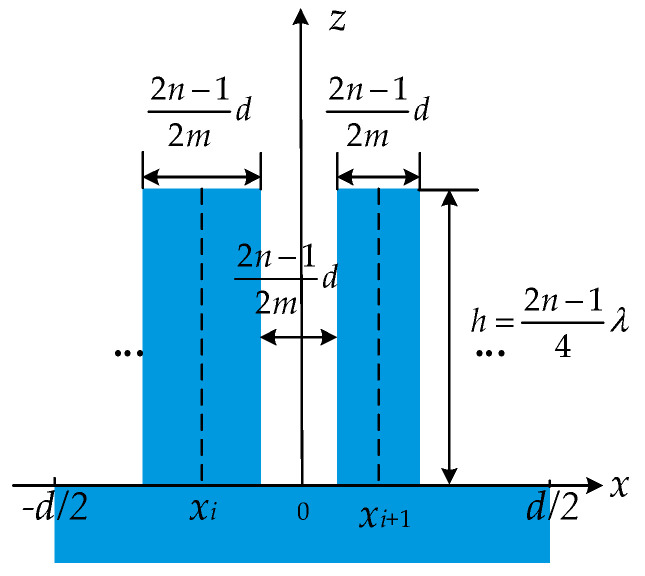
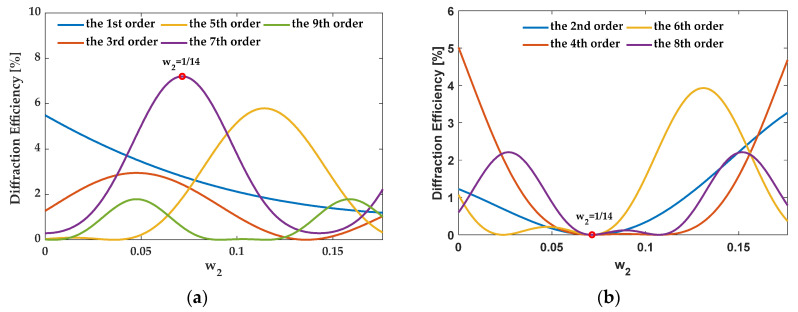
Ultra-precision measurement systems are important for semiconductor manufacturing processes. In a phase grating sensing alignment (PGA) system, the measurement accuracy largely depends on the intensity of the diffraction signal and its signal-to-noise ratio (SNR), both of which are associated with the grating structure. Although an equally segmented grating structure could increase the signal of a high odd order, it could also strengthen the signals at the zeroth and even orders which are the main contributors of stray light. This paper focuses on the practical problem of differently responding diffraction orders but in one grating structure. An analytical relationship has been established between the diffraction efficiency and the segment structure of phase grating. According to this analytic model, we then propose a design method to increase the diffraction signal at high odd orders and, meanwhile, to decrease it at the zeroth and even orders. The proposed method provides a fast and effective way to obtain the globally optimal grating structure in the valid scope. Furthermore, the design examples are also verified by means of numerical simulation tool-rigorous coupled-wave analysis (RCWA) software. As a result, the proposed method gives insight into the diffraction theory of segmented grating and the practical value to greatly improve the design efficiency.
超精密测量系统对半导体制造工艺至关重要。在相位光栅传感对准(PGA)系统中,测量精度在很大程度上取决于衍射信号的强度及其信噪比(SNR),这两者都与光栅结构有关。尽管等分段光栅结构可以增加高奇数阶的信号,但它也会增强零阶和偶数阶的信号,而这些信号是杂散光的主要来源。本文关注的是在一种光栅结构中不同衍射阶次响应不同的实际问题。已经建立了相位光栅的衍射效率与段结构之间的解析关系。根据这个解析模型,我们进而提出一种设计方法,以增加高奇数阶的衍射信号,同时降低零阶和偶数阶的衍射信号。所提出的方法提供了一种在有效范围内快速有效地获得全局最优光栅结构的途径。此外,还通过数值模拟工具——严格耦合波分析(RCWA)软件对设计实例进行了验证。结果表明,所提出的方法深入揭示了分段光栅的衍射理论,具有极大提高设计效率的实用价值。