Department of Hospitality Management, Mingdao University, Changhua 523, Taiwan.
Department of Cosmeceutics, China Medical University, Taichung 406, Taiwan.
Molecules. 2021 May 31;26(11):3306. doi: 10.3390/molecules26113306.
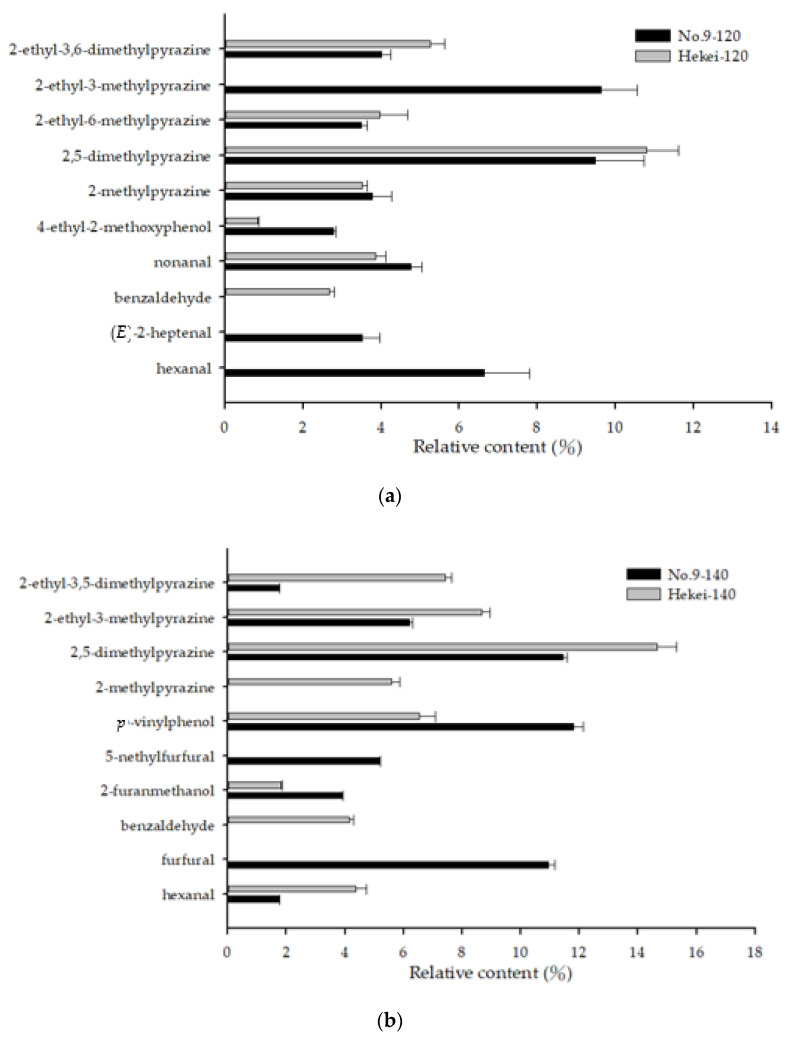
Peanut oil is favored by consumers due to its rich nutritional value and unique flavor. This study used headspace solid-phase microextraction (HS-SPME) combined with gas chromatography (GC) and gas chromatography-mass spectrometry (GC-MS) to examine the differences in the peanut oil aroma on the basis of variety, roasting temperatures, and pressing components. The results revealed that the optimal conditions for extracting peanut oil were achieved through the use of 50/30 μm DVB/CAR/PDMS fibers at 60 °C for 50 min. The primary compounds present in peanut oil were pyrazines. When peanuts were roasted, the temperature raised from 120 °C to 140 °C and the content of aldehydes in peanut oil increased; however, the content of aldehydes in No. 9 oil at 160 °C decreased. The components of peanut shell oil varied depending on the peanut variety. The most marked difference was observed in terms of the main compound at the two roasting temperatures. This compound was a pyrazine, and the content increased with the roasting temperature in hekei oils. When the roasting temperature was lower, No. 9 oil contained more fatty acid oxidation products such as hexanal, heptanal, and nonanal. When the roasting temperature increased, No. 9 oil contained more furfural and 5-methylfurfural. Heren oil was easier to oxidize and produced nonanal that possessed a fatty aroma.
花生油因其丰富的营养价值和独特的风味而受到消费者的青睐。本研究采用顶空固相微萃取(HS-SPME)结合气相色谱(GC)和气相色谱-质谱(GC-MS),在品种、炒制温度和压榨成分的基础上研究了花生油香气的差异。结果表明,采用 50/30μm DVB/CAR/PDMS 纤维在 60℃下萃取 50min,可得到最佳的花生油提取条件。花生油中的主要化合物为吡嗪类。当花生炒制时,温度从 120℃升高到 140℃,花生油中醛类的含量增加;而 160℃时 9 号油中醛类的含量降低。花生壳油的成分因花生品种而异。在两个炒制温度下,主要化合物的差异最为显著。该化合物为吡嗪,在和科油中,其含量随炒制温度的升高而增加。当炒制温度较低时,9 号油中含有更多的脂肪酸氧化产物,如己醛、庚醛和壬醛。当炒制温度升高时,9 号油中糠醛和 5-甲基糠醛的含量增加。核仁油更容易氧化,产生具有脂肪香气的壬醛。