Stein Claudia, Lange Isabel, Rödel Jürgen, Pletz Mathias W, Kipp Frank
Institute for Infectious Diseases and Infection Control, Jena University Hospital, Am Klinikum 1, 07747 Jena, Germany.
Institute of Medical Microbiology, Jena University Hospital, Am Klinikum 1, 07747 Jena, Germany.
Microorganisms. 2021 May 31;9(6):1190. doi: 10.3390/microorganisms9061190.
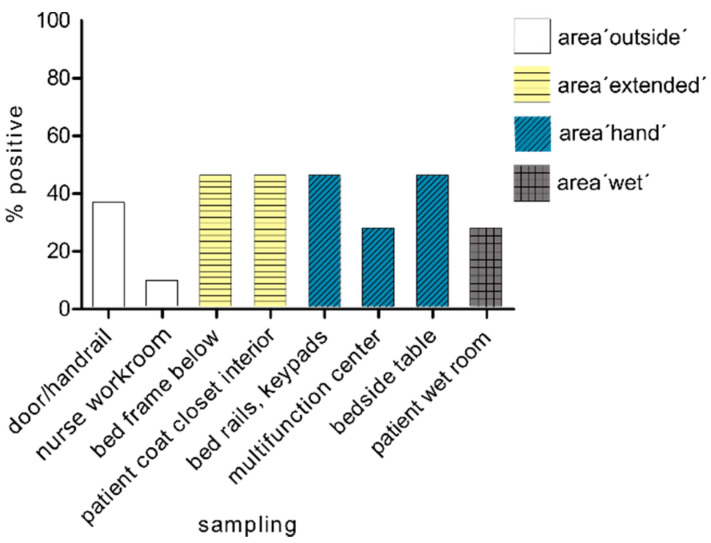
Here, we describe an integrative method to detect carbapenemase-producing Gram-negative bacteria (gn-Cp) on surfaces/fomites in the patient environment. We examined environmental samples from 28 patient rooms occupied with patients who were proven to be colonised with gn-Cp by rectal screening.
We took samples after 24 h, 72 h and one week. For sampling, we divided the patient environment into four parts and took samples from near- and extended patient areas. To obtain a representative bacterial swab from a larger surface, such as the patient cabinet, we used Polywipes. Bacterial DNA was isolated. Carbapenemase was detected with specific qPCR primers.
With this culture- and molecular-based approach, we could control the effectiveness of cleaning and disinfection in everyday clinical practice. Therefore, we could track the spread of gn-Cp within the patient room. The number of positive detections fluctuated between 30.5% (mean value positive results after 72 h) and 35.2% (after 24 h and one week).
The method used to detect multidrug-resistant bacteria in the environment of patients by using Polywipes is reliable and can therefore be used as an effective, new tool in hygiene and infection control.
在此,我们描述了一种综合方法,用于检测患者环境中表面/污染物上产碳青霉烯酶的革兰氏阴性菌(gn-Cp)。我们检查了28个病房的环境样本,这些病房住着经直肠筛查证实感染gn-Cp的患者。
我们在24小时、72小时和一周后采集样本。采样时,我们将患者环境分为四个部分,并从患者附近区域和扩展区域采集样本。为了从较大的表面(如患者橱柜)获取具有代表性的细菌拭子,我们使用了聚酯擦拭布。分离细菌DNA。用特异性qPCR引物检测碳青霉烯酶。
通过这种基于培养和分子的方法,我们可以在日常临床实践中控制清洁和消毒的效果。因此,我们可以追踪gn-Cp在病房内的传播情况。阳性检测数在30.5%(72小时后的平均阳性结果)至35.2%(24小时和一周后)之间波动。
使用聚酯擦拭布检测患者环境中多重耐药菌的方法可靠,因此可作为卫生和感染控制的一种有效新工具。