Department of Epidemiology and Health Statistics, School of Public Health, Capital Medical University and Beijing Municipal Key Laboratory of Clinical Epidemiology, No 10 Xitoutiao, You'anmenwai, Fengtai, Beijing, 100069, P. R. China.
Lipids Health Dis. 2021 Jun 1;20(1):57. doi: 10.1186/s12944-021-01482-0.
There is a well-documented empirical relationship between lipoprotein (a) [Lp(a)] and cardiovascular disease (CVD); however, causal evidence, especially from the Chinese population, is lacking. Therefore, this study aims to estimate the causal association between variants in genes affecting Lp(a) concentrations and CVD in people of Han Chinese ethnicity.
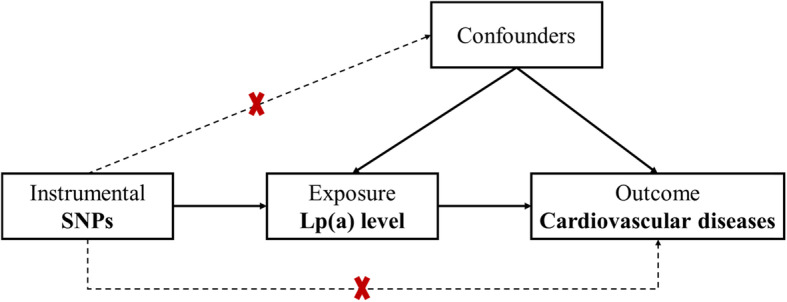
Two-sample Mendelian randomization analysis was used to assess the causal effect of Lp(a) concentrations on the risk of CVD. Summary statistics for Lp(a) variants were obtained from 1256 individuals in the Cohort Study on Chronic Disease of Communities Natural Population in Beijing, Tianjin and Hebei. Data on associations between single-nucleotide polymorphisms (SNPs) and CVD were obtained from recently published genome-wide association studies.
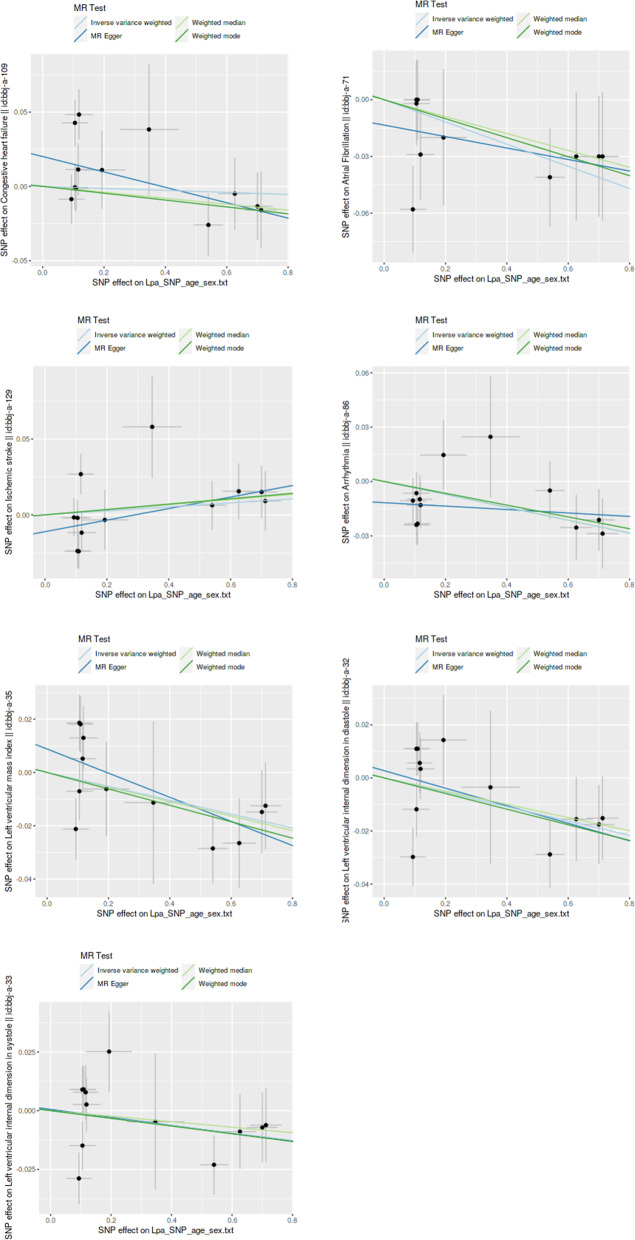
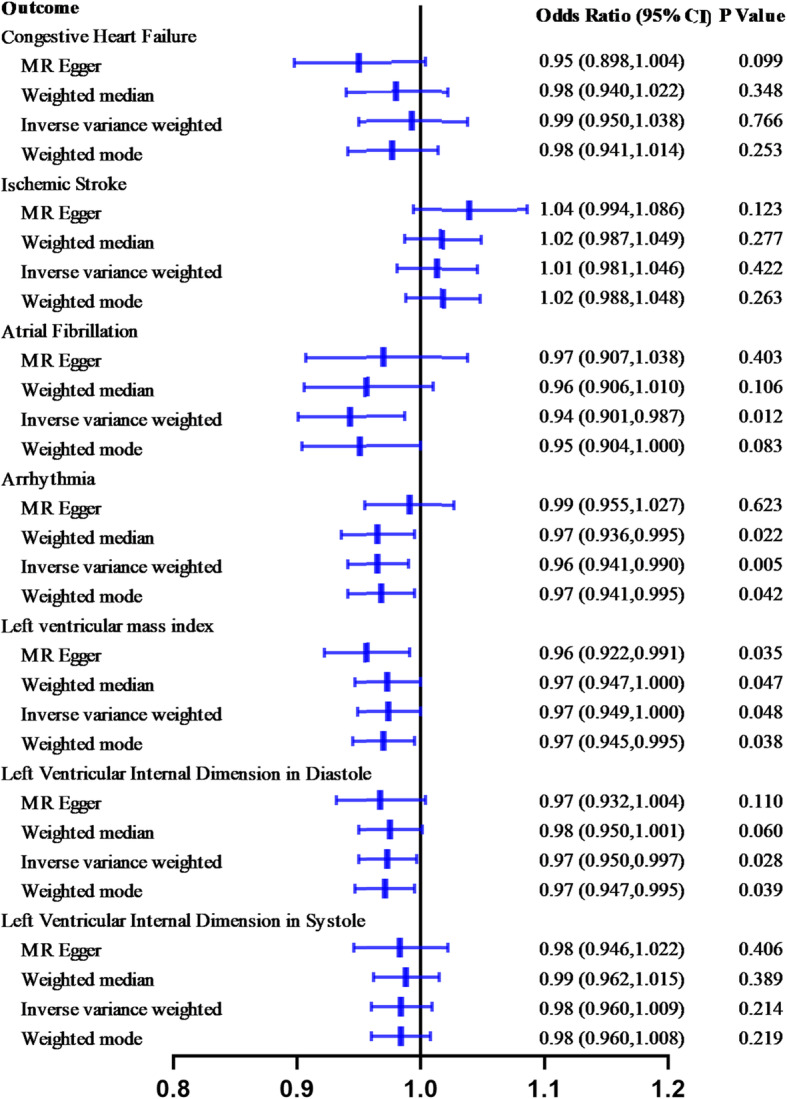
Thirteen SNPs associated with Lp(a) levels in the Han Chinese population were used as instrumental variables. Genetically elevated Lp(a) was inversely associated with the risk of atrial fibrillation [odds ratio (OR), 0.94; 95% confidence interval (95%CI), 0.901-0.987; P = 0.012)], the risk of arrhythmia (OR, 0.96; 95%CI, 0.941-0.990; P = 0.005), the left ventricular mass index (OR, 0.97; 95%CI, 0.949-1.000; P = 0.048), and the left ventricular internal dimension in diastole (OR, 0.97; 95%CI, 0.950-0.997; P = 0.028) according to the inverse-variance weighted method. No significant association was observed for congestive heart failure (OR, 0.99; 95% CI, 0.950-1.038; P = 0.766), ischemic stroke (OR, 1.01; 95%CI, 0.981-1.046; P = 0.422), and left ventricular internal dimension in systole (OR, 0.98; 95%CI, 0.960-1.009; P = 0.214).
This study provided evidence that genetically elevated Lp(a) was inversely associated with atrial fibrillation, arrhythmia, the left ventricular mass index and the left ventricular internal dimension in diastole, but not with congestive heart failure, ischemic stroke, and the left ventricular internal dimension in systole in the Han Chinese population. Further research is needed to identify the mechanism underlying these results and determine whether genetically elevated Lp(a) increases the risk of coronary heart disease or other CVD subtypes.
脂蛋白(a)[Lp(a)]与心血管疾病(CVD)之间存在着有充分文献记载的实证关系;然而,因果关系的证据,特别是来自中国人群的证据,仍然缺乏。因此,本研究旨在估计影响 Lp(a)浓度的基因变异与汉族人群 CVD 之间的因果关联。
采用两样本 Mendelian 随机化分析来评估 Lp(a)浓度对 CVD 风险的因果效应。Lp(a)变异的汇总统计数据来自北京、天津和河北的社区自然人群慢性疾病队列研究中的 1256 个人。单核苷酸多态性(SNP)与 CVD 之间关联的数据来自最近发表的全基因组关联研究。
13 个与汉族人群 Lp(a)水平相关的 SNP 被用作工具变量。遗传上升高的 Lp(a)与心房颤动的风险呈负相关[比值比(OR),0.94;95%置信区间(95%CI),0.901-0.987;P=0.012]、心律失常的风险(OR,0.96;95%CI,0.941-0.990;P=0.005)、左心室质量指数(OR,0.97;95%CI,0.949-1.000;P=0.048)和左心室舒张末期内径(OR,0.97;95%CI,0.950-0.997;P=0.028),根据逆方差加权法。对于充血性心力衰竭(OR,0.99;95%CI,0.950-1.038;P=0.766)、缺血性卒中(OR,1.01;95%CI,0.981-1.046;P=0.422)和左心室收缩末期内径(OR,0.98;95%CI,0.960-1.009;P=0.214),没有观察到显著的相关性。
本研究提供了证据表明,遗传上升高的 Lp(a)与心房颤动、心律失常、左心室质量指数和舒张末期左心室内径呈负相关,但与充血性心力衰竭、缺血性卒中和收缩末期左心室内径无关汉族人群中的指数。需要进一步研究以确定这些结果背后的机制,并确定遗传上升高的 Lp(a)是否会增加冠心病或其他 CVD 亚型的风险。