Department of Earth System Science, Stanford University, Stanford, CA 94305;
Department of Experimental Limnology, Leibniz-Institute of Freshwater Ecology and Inland Fisheries, 12587 Berlin, Germany.
Proc Natl Acad Sci U S A. 2021 Jun 8;118(23). doi: 10.1073/pnas.2102225118.
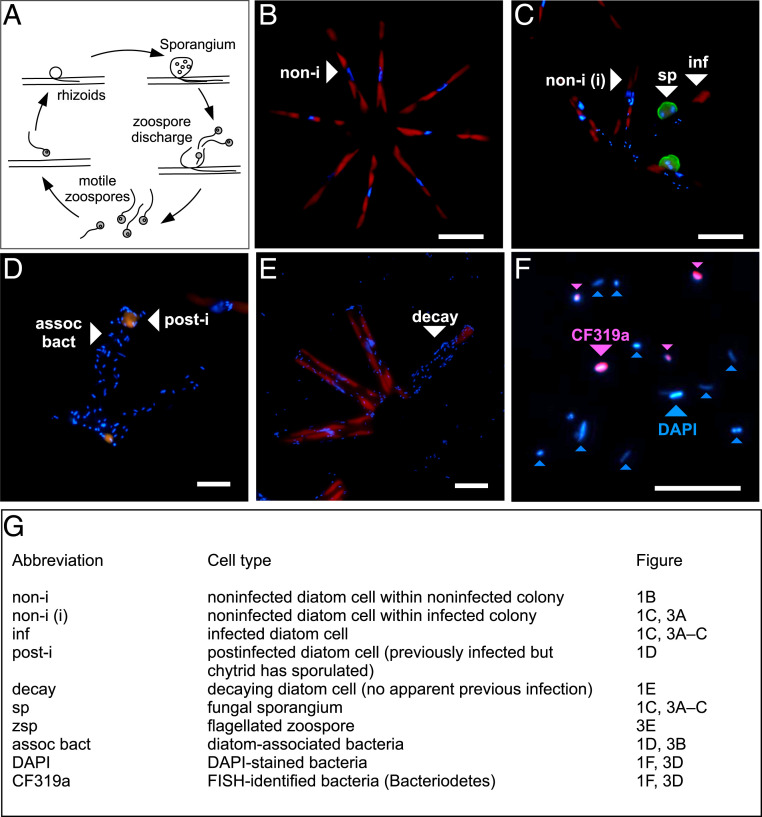
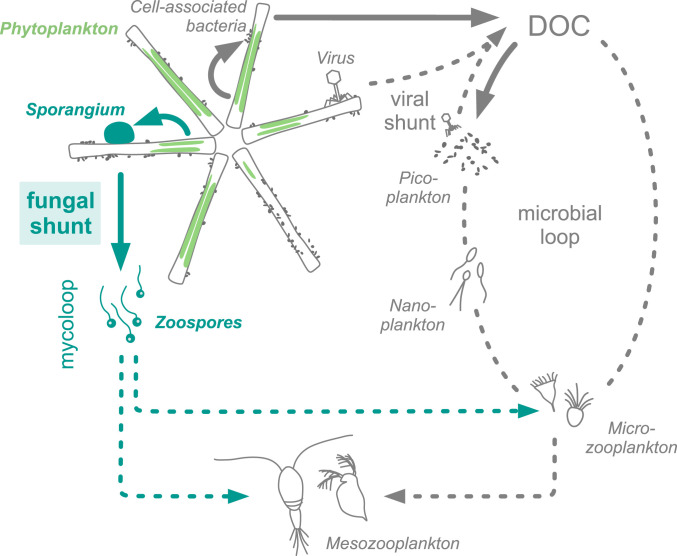
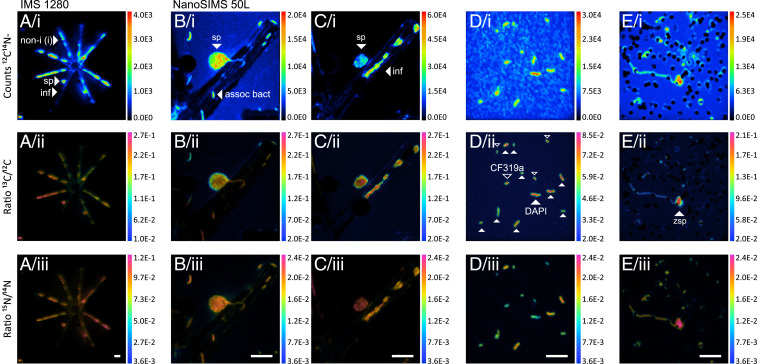
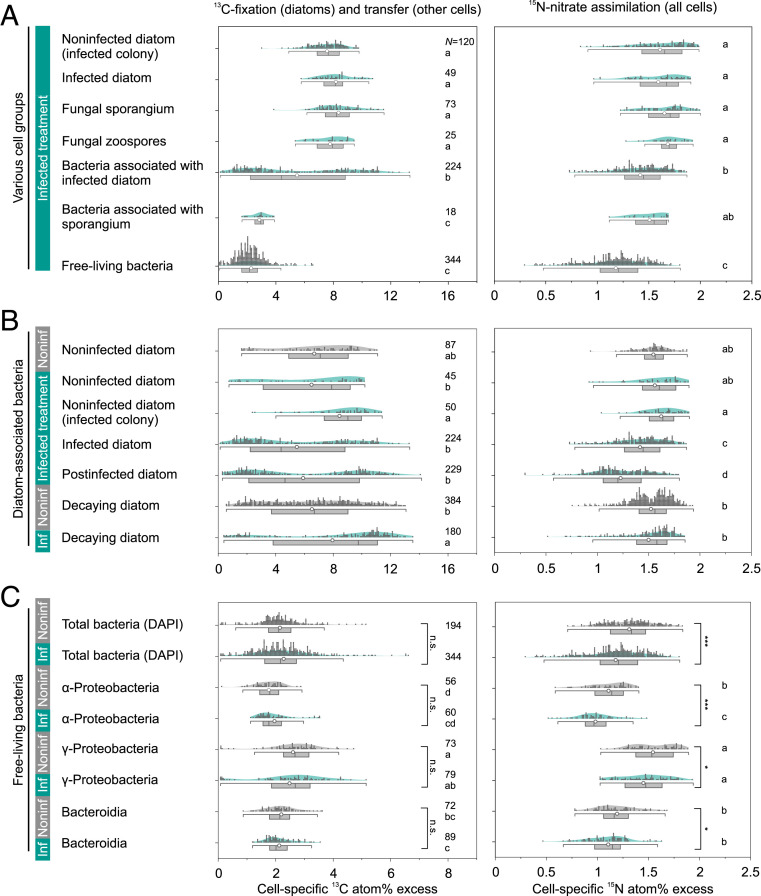
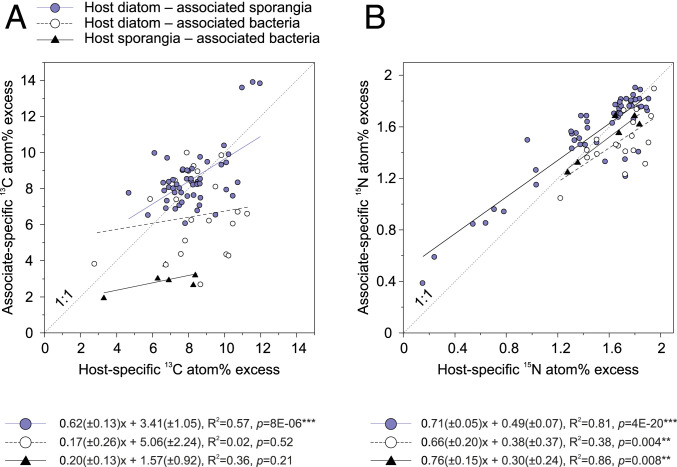
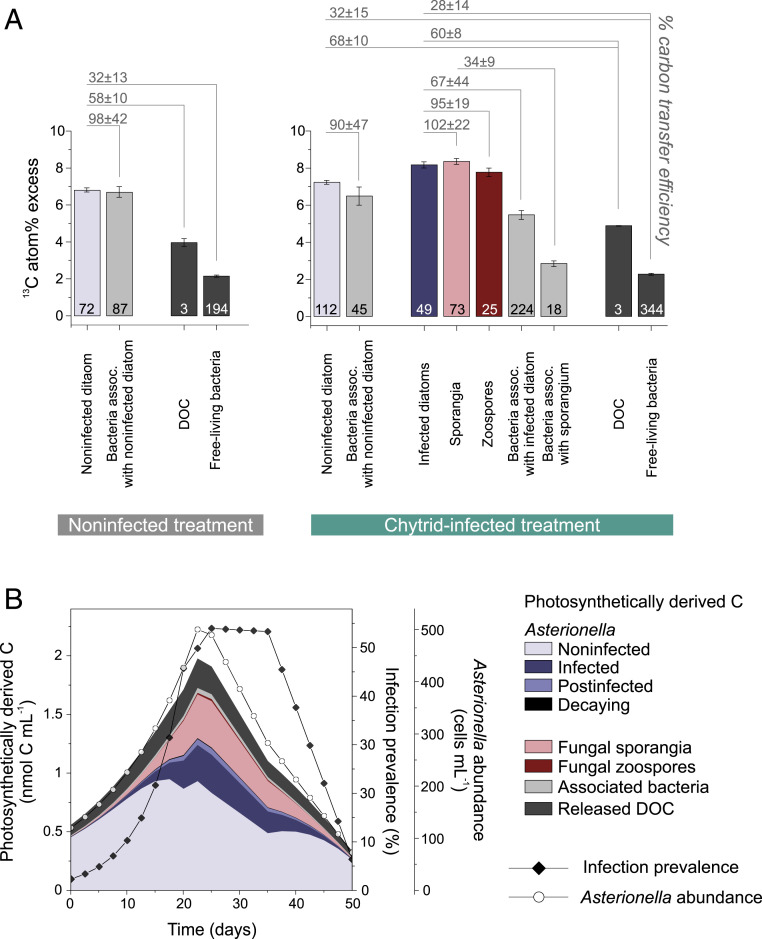
Microbial interactions in aquatic environments profoundly affect global biogeochemical cycles, but the role of microparasites has been largely overlooked. Using a model pathosystem, we studied hitherto cryptic interactions between microparasitic fungi (chytrid ), their diatom host and cell-associated and free-living bacteria. We analyzed the effect of fungal infections on microbial abundances, bacterial taxonomy, cell-to-cell carbon transfer, and cell-specific nitrate-based growth using microscopy (e.g., fluorescence in situ hybridization), 16S rRNA gene amplicon sequencing, and secondary ion mass spectrometry. Bacterial abundances were 2 to 4 times higher on individual fungal-infected diatoms compared to healthy diatoms, particularly involving Burkholderiales. Furthermore, taxonomic compositions of both diatom-associated and free-living bacteria were significantly different between noninfected and fungal-infected cocultures. The fungal microparasite, including diatom-associated sporangia and free-swimming zoospores, derived ∼100% of their carbon content from the diatom. By comparison, transfer efficiencies of photosynthetic carbon were lower to diatom-associated bacteria (67 to 98%), with a high cell-to-cell variability, and even lower to free-living bacteria (32%). Likewise, nitrate-based growth for the diatom and fungi was synchronized and faster than for diatom-associated and free-living bacteria. In a natural lacustrine system, where infection prevalence reached 54%, we calculated that 20% of the total diatom-derived photosynthetic carbon was shunted to the parasitic fungi, which can be grazed by zooplankton, thereby accelerating carbon transfer to higher trophic levels and bypassing the microbial loop. The herein termed "fungal shunt" can thus significantly modify the fate of photosynthetic carbon and the nature of phytoplankton-bacteria interactions, with implications for diverse pelagic food webs and global biogeochemical cycles.
水生环境中的微生物相互作用深刻影响着全球生物地球化学循环,但微寄生生物的作用在很大程度上被忽视了。本研究使用模式病理系统,研究了微寄生真菌(水霉)与其硅藻宿主以及细胞相关和自由生活细菌之间迄今隐蔽的相互作用。我们分析了真菌感染对微生物丰度、细菌分类、细胞间碳转移以及基于细胞特异性硝酸盐的生长的影响,使用显微镜(例如荧光原位杂交)、16S rRNA 基因扩增子测序和二次离子质谱法进行了分析。与健康硅藻相比,个体真菌感染硅藻上的细菌丰度高 2 到 4 倍,特别是涉及伯克霍尔德氏菌。此外,非感染和真菌感染共培养物中,硅藻相关细菌和自由生活细菌的分类组成也有显著差异。真菌微寄生生物,包括硅藻相关的孢子囊和自由游动的游动孢子,从硅藻中获得了其碳含量的 100%。相比之下,光合作用碳的转移效率对硅藻相关细菌(67 到 98%)较低,具有较高的细胞间变异性,对自由生活细菌(32%)更低。同样,硅藻和真菌的硝酸盐基生长比硅藻相关细菌和自由生活细菌更快。在感染率达到 54%的天然湖泊系统中,我们计算出 20%的总硅藻光合作用碳被转移到寄生真菌中,这些真菌可被浮游动物摄食,从而加速了碳向更高营养级的转移,绕过了微生物环。因此,这里所称的“真菌分流”可以显著改变光合作用碳的命运和浮游植物-细菌相互作用的性质,对各种浮游食物网和全球生物地球化学循环都有影响。