Department of Molecular, Cell and Developmental Biology, University of California, Los Angeles, CA 90095.
Eli and Edythe Broad Center of Regenerative Medicine and Stem Cell Research, University of California, Los Angeles, CA 90095.
Proc Natl Acad Sci U S A. 2021 Jun 8;118(23). doi: 10.1073/pnas.2125016118.
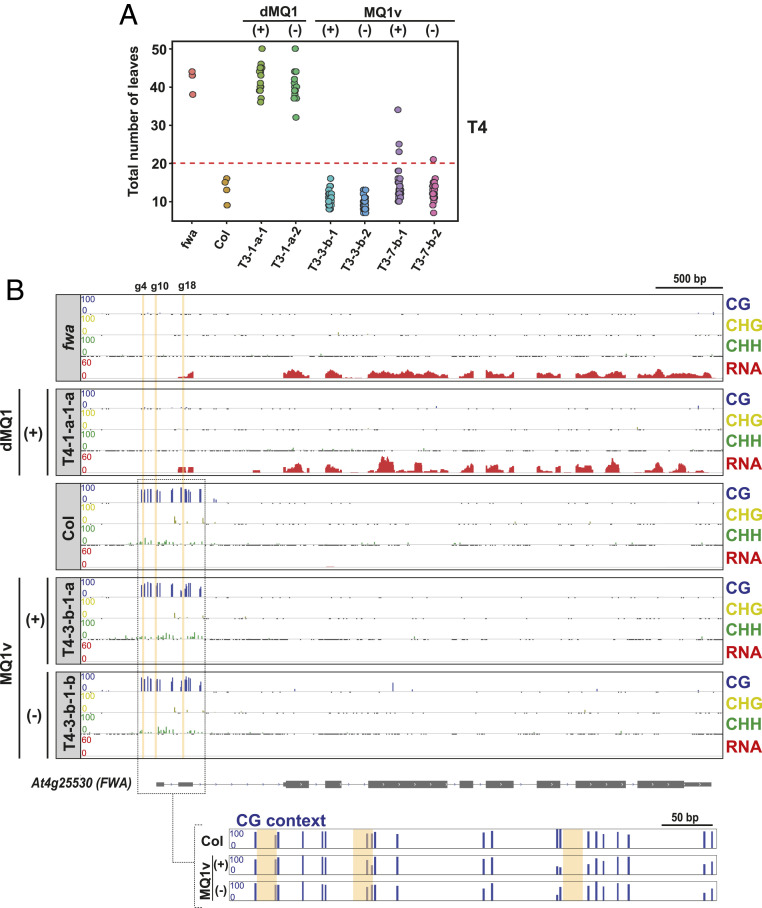
CRISPR-based targeted modification of epigenetic marks such as DNA cytosine methylation is an important strategy to regulate the expression of genes and their associated phenotypes. Although plants have DNA methylation in all sequence contexts (CG, CHG, CHH, where H = A, T, C), methylation in the symmetric CG context is particularly important for gene silencing and is very efficiently maintained through mitotic and meiotic cell divisions. Tools that can directly add CG methylation to specific loci are therefore highly desirable but are currently lacking in plants. Here we have developed two CRISPR-based CG-specific targeted DNA methylation systems for plants using a variant of the bacterial CG-specific DNA methyltransferase MQ1 with reduced activity but high specificity. We demonstrate that the methylation added by MQ1 is highly target specific and can be heritably maintained in the absence of the effector. These tools should be valuable both in crop engineering and in plant genetic research.
基于 CRISPR 的靶向修饰表观遗传标记,如 DNA 胞嘧啶甲基化,是调控基因表达及其相关表型的重要策略。尽管植物在所有序列环境(CG、CHG、CHH,其中 H = A、T、C)中都有 DNA 甲基化,但对称 CG 环境中的甲基化对于基因沉默尤为重要,并且通过有丝分裂和减数分裂细胞分裂非常有效地维持。因此,能够直接将 CG 甲基化添加到特定基因座的工具是非常需要的,但目前在植物中还缺乏这种工具。在这里,我们开发了两种基于 CRISPR 的植物 CG 特异性靶向 DNA 甲基化系统,使用一种活性降低但特异性高的细菌 CG 特异性 DNA 甲基转移酶 MQ1 的变体。我们证明,由 MQ1 添加的甲基化具有高度的靶向特异性,并且可以在没有效应物的情况下遗传下去。这些工具在作物工程和植物遗传研究中都将具有重要价值。