. Multimagem Diagnósticos e Hospital Órion, Goiânia (GO) Brasil.
. Departamento de Clínica Médica, Faculdade de Medicina, Universidade Federal de Goiás, Goiânia (GO) Brasil.
J Bras Pneumol. 2021 May 31;47(3):e20200096. doi: 10.36416/1806-3756/e20200096. eCollection 2021.
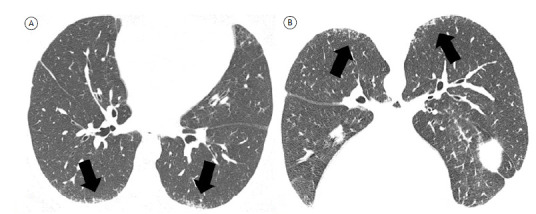
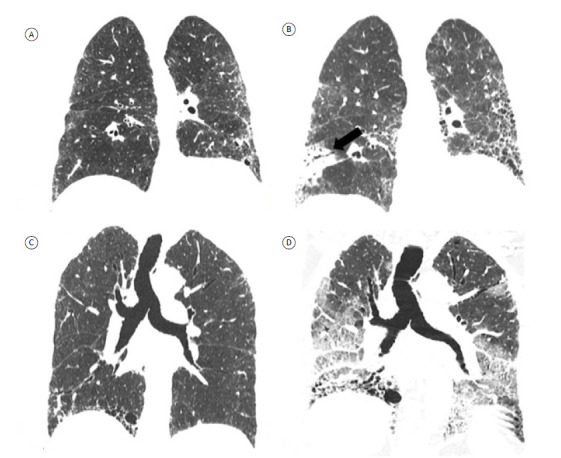
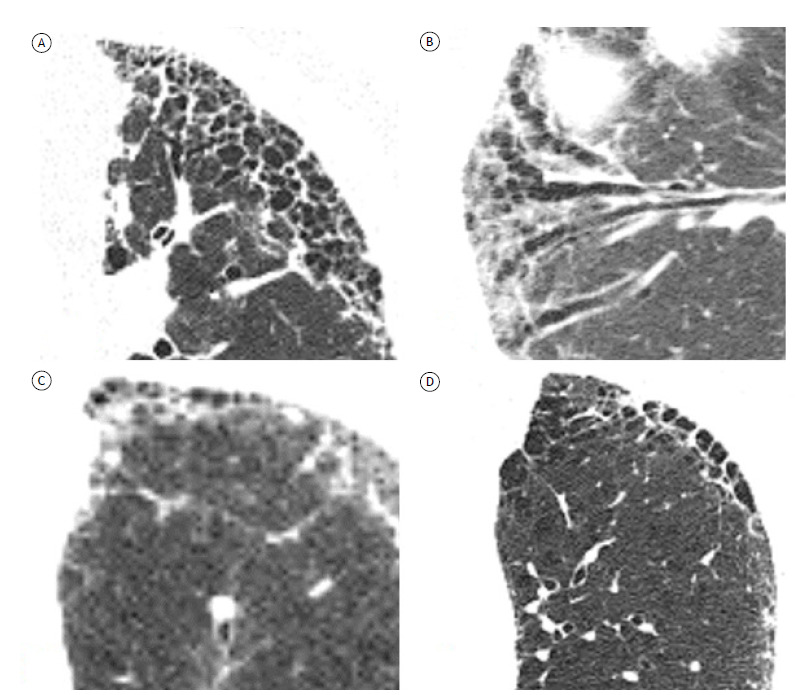
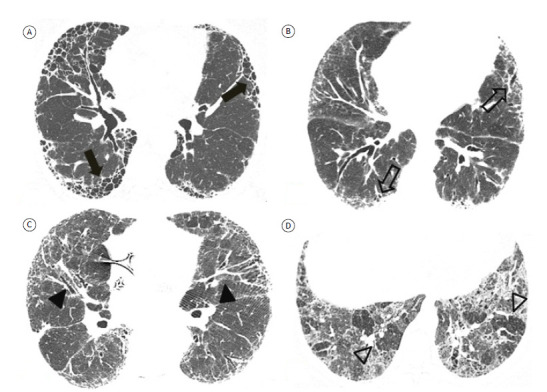
Many conditions result in chronic interstitial lung disease (ILD), being classified as fibrosing ILDs, including idiopathic pulmonary fibrosis, connective tissue diseases, sarcoidosis, and fibrotic hypersensitivity pneumonitis. HRCT plays an important role in the clinical evaluation of fibrosing ILDs. Current treatment perspectives are encouraging and reinforce the need for HRCT scans of adequate technical quality for early detection of fibrosing ILD. Despite efforts in this regard, the significance and management of imaging findings of early interstitial lung abnormalities have yet to be clarified. After identification of CT findings consistent with fibrosing ILD, radiologists must be able to identify characteristic morphological patterns and, in some cases, features of specific clinical entities. In cases in which HRCT features are not sufficiently specific for a definitive diagnosis, HRCT can aid in selecting the best site for surgical lung biopsy. CT follow-up is useful for identifying progressive fibrosing ILDs and detecting complications unrelated to the underlying disease, including infections, acute exacerbations, and neoplasms. Automated quantification tools have clinical applicability and are likely to be available for use in imaging analysis in the near future. In addition, incorporation of CT evaluation into scoring systems based on clinical and functional parameters for staging fibrosing disease is likely to become valuable in determining prognosis. Knowledge of the clinical applications of CT evaluation is essential for specialists managing patients with fibrosing ILD and can have a positive impact on the clinical course of the disease.
许多疾病都会导致慢性间质性肺病(ILD),包括特发性肺纤维化、结缔组织疾病、结节病和纤维性过敏性肺炎等,这些疾病被归类为纤维性ILD。高分辨率 CT(HRCT)在纤维性ILD 的临床评估中发挥着重要作用。目前的治疗观点令人鼓舞,这进一步强调了需要进行具有足够技术质量的 HRCT 扫描,以便早期发现纤维性 ILD。尽管在这方面做出了努力,但早期肺间质异常的影像学表现的意义和管理仍有待阐明。在识别出与纤维性 ILD 一致的 CT 表现后,放射科医生必须能够识别出特征性的形态模式,在某些情况下,还需要识别出特定临床实体的特征。在 HRCT 特征不足以明确诊断的情况下,HRCT 可以帮助选择进行外科肺活检的最佳部位。CT 随访有助于识别进行性纤维性 ILD,并检测与基础疾病无关的并发症,包括感染、急性加重和肿瘤。自动量化工具具有临床适用性,并且可能在不久的将来可用于影像学分析。此外,将 CT 评估纳入基于临床和功能参数的纤维性疾病分期评分系统中,可能有助于确定预后。了解 CT 评估的临床应用对于管理纤维性 ILD 患者的专家至关重要,并且可以对疾病的临床过程产生积极影响。