Wei Jingjing, Zhao Qiuyan, Yang Guo, Huang Ruoxuan, Li Chao, Qi Yuanmeng, Hao Changfu, Yao Wu
School of Public Health, Zhengzhou University, Zhengzhou, China.
J Cell Mol Med. 2021 Jun 2;25(13):6417-28. doi: 10.1111/jcmm.16621.
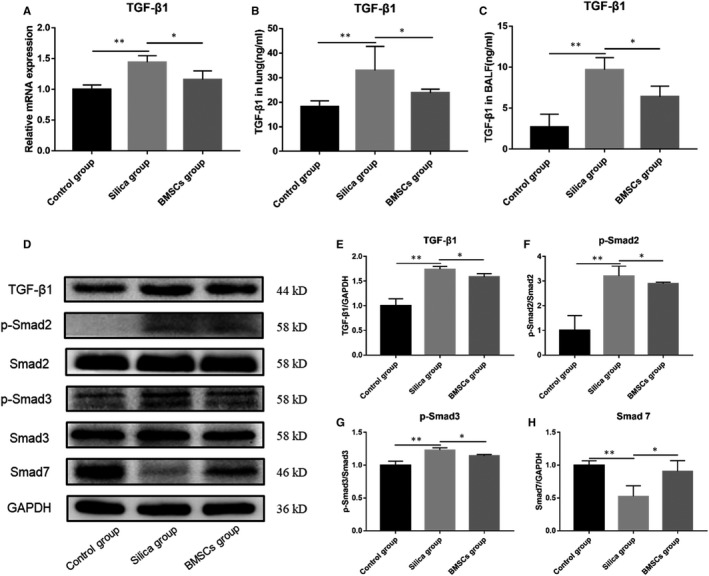
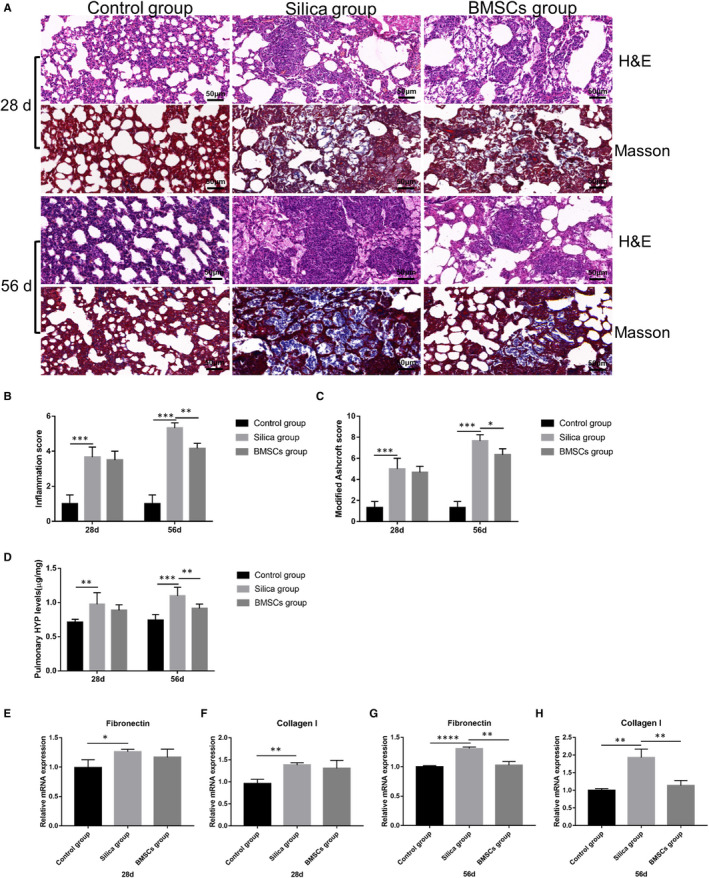
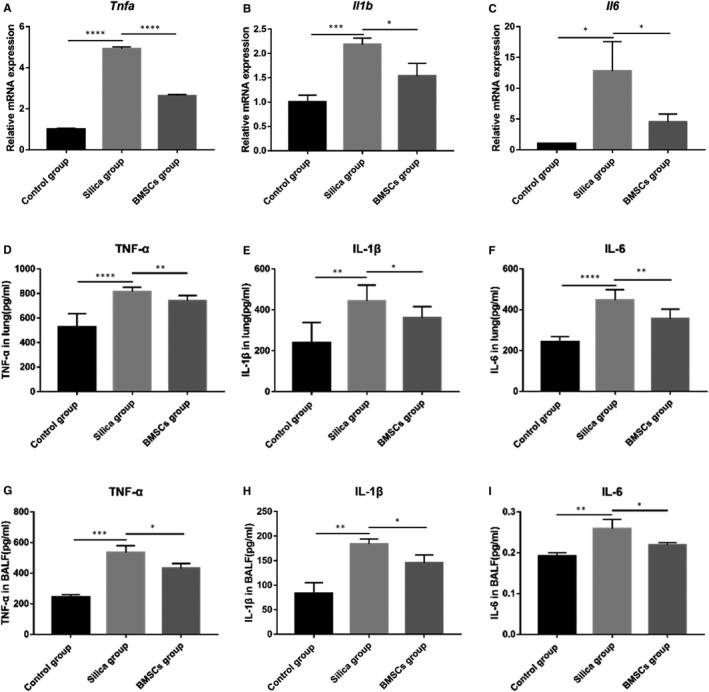
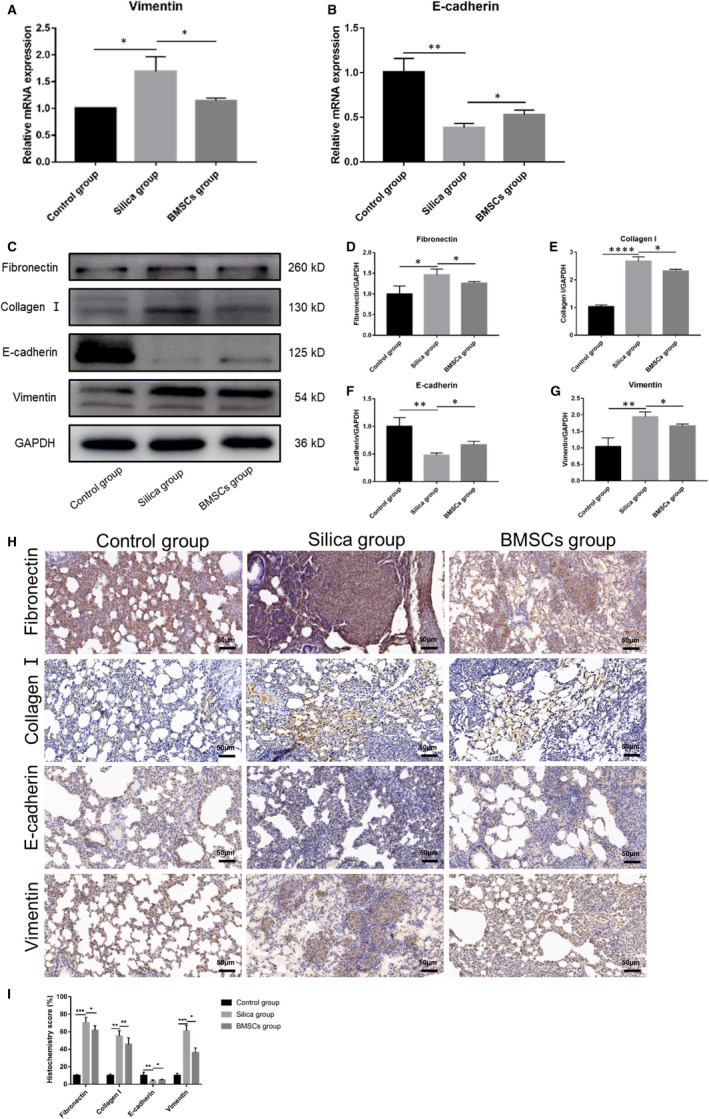
Silicosis is a devastating occupational disease caused by long-term inhalation of silica particles, inducing irreversible lung damage and affecting lung function, without effective treatment. Mesenchymal stem cells (MSCs) are a heterogeneous subset of adult stem cells that exhibit excellent self-renewal capacity, multi-lineage differentiation potential and immunomodulatory properties. The aim of this study was to explore the effect of bone marrow-derived mesenchymal stem cells (BMSCs) in a silica-induced rat model of pulmonary fibrosis. The rats were treated with BMSCs on days 14, 28 and 42 after perfusion with silica. Histological examination and hydroxyproline assays showed that BMSCs alleviated silica-induced pulmonary fibrosis in rats. Results from ELISA and qRT-PCR indicated that BMSCs inhibited the expression of inflammatory cytokines TNF-α, IL-1β and IL-6 in lung tissues and bronchoalveolar lavage fluid of rats exposed to silica particles. We also performed qRT-PCR, Western blot and immunohistochemistry to examine epithelial-mesenchymal transition (EMT)-related indicators and demonstrated that BMSCs up-regulate E-cadherin and down-regulate vimentin and extracellular matrix (ECM) components such as fibronectin and collagen Ⅰ. Additionally, BMSCs inhibited the silica-induced increase in TGF-β1, p-Smad2 and p-Smad3 and decrease in Smad7. These results suggested that BMSCs can inhibit inflammation and reverse EMT through the inhibition of the TGF-β/Smad signalling pathway to exhibit an anti-fibrotic effect in the rat silicosis model. Our study provides a new and meaningful perspective for silicosis treatment strategies.
矽肺是一种由长期吸入二氧化硅颗粒引起的毁灭性职业病,会导致不可逆转的肺损伤并影响肺功能,且尚无有效治疗方法。间充质干细胞(MSCs)是成体干细胞的一个异质性亚群,具有出色的自我更新能力、多向分化潜能和免疫调节特性。本研究旨在探讨骨髓间充质干细胞(BMSCs)在二氧化硅诱导的大鼠肺纤维化模型中的作用。在给大鼠灌注二氧化硅后的第14、28和42天用BMSCs进行治疗。组织学检查和羟脯氨酸测定表明,BMSCs减轻了二氧化硅诱导的大鼠肺纤维化。ELISA和qRT-PCR结果表明,BMSCs抑制了暴露于二氧化硅颗粒的大鼠肺组织和支气管肺泡灌洗液中炎性细胞因子TNF-α、IL-1β和IL-6的表达。我们还进行了qRT-PCR、蛋白质免疫印迹和免疫组织化学以检测上皮-间质转化(EMT)相关指标,并证明BMSCs上调E-钙黏蛋白,下调波形蛋白以及细胞外基质(ECM)成分如纤连蛋白和Ⅰ型胶原。此外,BMSCs抑制了二氧化硅诱导的TGF-β1、p-Smad2和p-Smad3的增加以及Smad-7的减少。这些结果表明,BMSCs可通过抑制TGF-β/Smad信号通路来抑制炎症并逆转EMT,从而在大鼠矽肺模型中发挥抗纤维化作用。我们的研究为矽肺治疗策略提供了一个新的且有意义的视角。