Department of Hematology, Aarhus University Hospital, Aarhus N, Denmark.
Department of Clinical Epidemiology, Aarhus University Hospital, Aarhus N, Denmark.
Cancer Med. 2021 Jul;10(14):4885-4895. doi: 10.1002/cam4.4027. Epub 2021 Jun 2.
The incidence of cardiovascular events among cancer patients with bone metastases is poorly understood. We examined rates of cardiovascular events among cancer patients with bone metastases and mortality following such events.
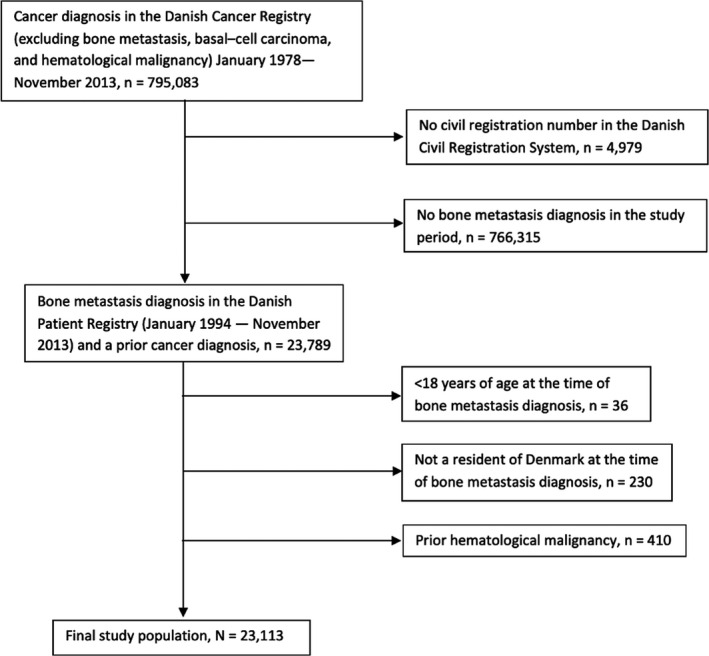
Using Danish health registries, we identified all Danish cancer patients diagnosed with bone metastases (1994-2013) and followed them from bone metastasis diagnosis. We computed incidence rates (IR) per 100 person-years and cumulative incidence for first-time inpatient hospitalization or outpatient clinic visit for cardiovascular events, defined as myocardial infarction, ischemic stroke, or venous thromboembolism (VTE). We also analyzed all-cause mortality rates including cardiovascular events as time-varying exposure with adjustment for age, sex, and Charlson Comorbidity Index score. All analyses were performed overall and stratified by cancer type (prostate, breast, lung, and other).
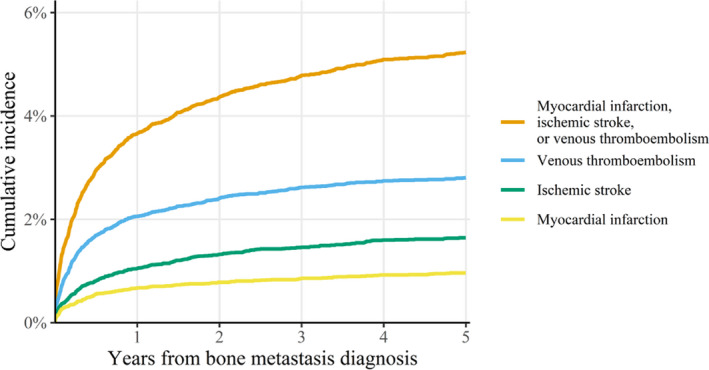
We included 23,113 cancer patients with bone metastases. The cumulative incidence of cardiovascular events was 1.3% at 30 days, 3.7% at 1 year, and 5.2% at 5 years of follow-up. The highest IR was observed for VTE, followed by ischemic stroke and myocardial infarction, both overall and by cancer types. Lung cancer patients with bone metastases had the highest incidence of cardiovascular events followed by prostate and breast cancer. Occurrence of any cardiovascular event was a strong predictor of death (5 years following the event, the adjusted hazard ratio was 1.8 [95% confidence interval: 1.7-1.9]).
Cancer patients with bone metastases had a substantial risk of developing cardiovascular events, and these events were associated with a subsequent increased mortality. Our findings underscore the importance of continuous optimized prevention of and care for cardiovascular disease among cancer patients with bone metastases.
癌症伴骨转移患者发生心血管事件的发生率尚不清楚。我们研究了癌症伴骨转移患者发生心血管事件的发生率和此类事件后的死亡率。
我们使用丹麦健康登记系统,确定了所有在丹麦被诊断为骨转移(1994-2013 年)的癌症患者,并对其进行了随访。我们计算了首次住院或门诊心血管事件(心肌梗死、缺血性卒中和静脉血栓栓塞症)的发生率(IR),每 100 人年 1 次。我们还分析了所有原因死亡率,包括作为时变暴露的心血管事件,同时调整年龄、性别和 Charlson 合并症指数评分。所有分析均在总体水平上进行,并按癌症类型(前列腺癌、乳腺癌、肺癌和其他)进行分层。
我们纳入了 23113 例癌症伴骨转移患者。30 天、1 年和 5 年随访时心血管事件的累积发生率分别为 1.3%、3.7%和 5.2%。总的来说,VTE 的 IR 最高,其次是缺血性卒中和心肌梗死,按癌症类型也是如此。肺癌伴骨转移患者的心血管事件发生率最高,其次是前列腺癌和乳腺癌。任何心血管事件的发生都是死亡的强烈预测因素(事件发生后 5 年,调整后的危险比为 1.8[95%置信区间:1.7-1.9])。
癌症伴骨转移患者发生心血管事件的风险较高,且这些事件与随后死亡率的增加相关。我们的研究结果强调了在癌症伴骨转移患者中持续优化心血管疾病预防和治疗的重要性。