van Heuckelum Milou, van den Ende Cornelia H M, van Dulmen Sandra, van den Bemt Bart J F
Department of Rheumatology, Sint Maartenskliniek, Nijmegen, the Netherlands.
Department of Pharmacy, Sint Maartenskliniek, Nijmegen, the Netherlands.
Patient Prefer Adherence. 2021 May 25;15:1107-1119. doi: 10.2147/PPA.S297170. eCollection 2021.
Non-adherence to medication (range 30-107%) is a major issue in patients with rheumatoid arthritis (RA). Previous research has shown that electronic monitoring feedback (EMF) might be an effective strategy to improve medication adherence in chronic conditions. Therefore, this study investigated the effectiveness of electronic monitoring feedback in patients with early RA to improve medication adherence and clinical outcomes compared to usual care.
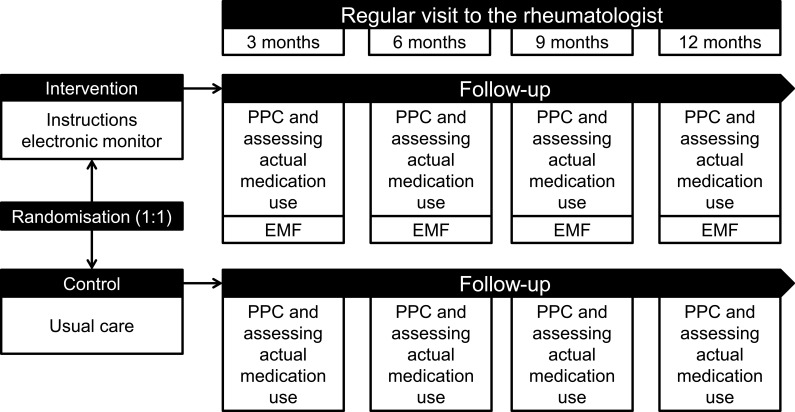
An open-label randomized clinical trial was performed to compare EMF with standard care during a 12-month follow-up period on two sites of the Sint Maartenskliniek (Nijmegen and Boxmeer) in the Netherlands. Patients were eligible if they: (1) had a (working) diagnosis of early RA, (2) were currently using methotrexate, (3) were aged ≥18 years, and (4) had a life expectancy of ≥12 months. Primary outcome was the difference in proportion of non-adherent patients measured with the Compliance Questionnaire on Rheumatology after 12 months. Secondary outcomes were beliefs about medicines, medication adherence measured with the MMAS-8, patients' health status, prescription of biologic DMARDs, and disease activity after 12 months.
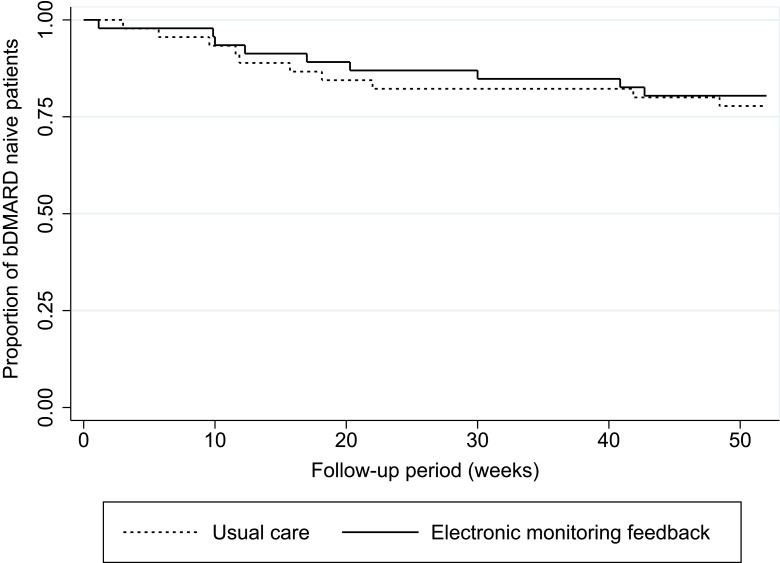
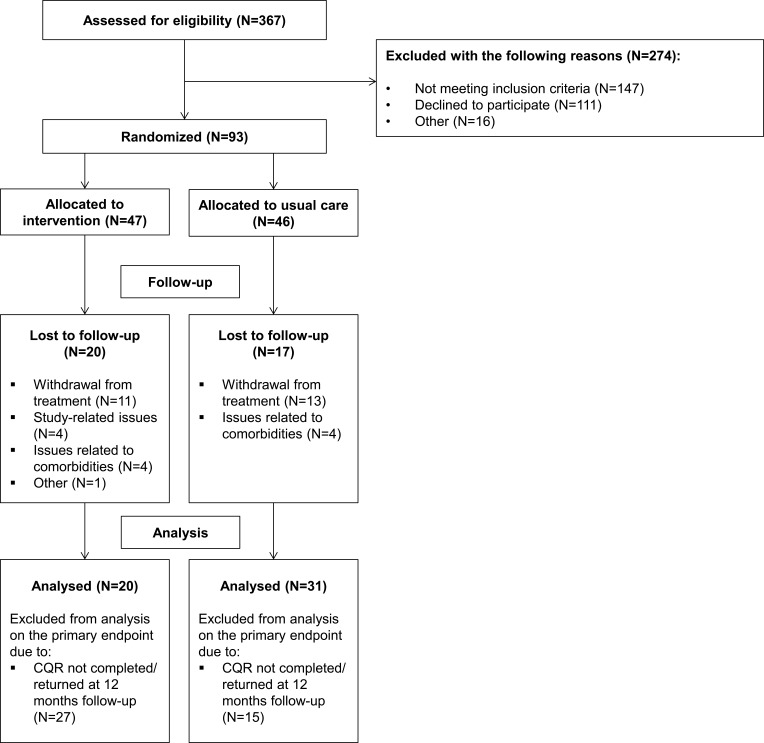
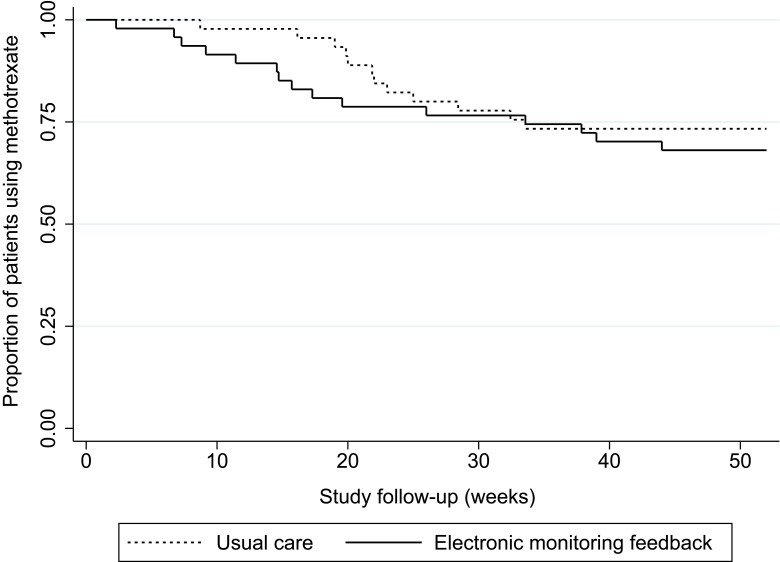
Of the 367 initially-invited patients, 93 patients with early RA agreed to participate in this study. No significant difference was found in the proportion of non-adherent patients between the intervention arm and the usual care arm after 12 months follow-up (60.0% and 61.3%, p=0.93, respectively). Patients in the intervention arm tended to discontinue methotrexate earlier than patients in the usual care arm (median time in weeks: 15.7 (9.1-33.6) and 21.9 (19-28.4), respectively, p=0.31), whereas patients in the usual care arm tended to initiate biologic DMARDs earlier than those in the intervention arm (median time in weeks: 11.9 (5.7-22) and 17 (9.9-40.9), respectively, p=0.55).
This study illustrates the challenge of targeting non-adherence with EMF in patients with early RA and shares important lessons learned about designing adherence intervention trials with respect to study attrition, accounting for drug survival, intervention fidelity, intervention uptake, and technical aspects.
类风湿关节炎(RA)患者中药物治疗依从性差(范围为30%-107%)是一个主要问题。先前的研究表明,电子监测反馈(EMF)可能是改善慢性病患者药物治疗依从性的有效策略。因此,本研究调查了与常规护理相比,电子监测反馈对早期RA患者改善药物治疗依从性和临床结局的有效性。
在荷兰圣马丁诊所(奈梅亨和博克斯梅尔)的两个地点进行了一项开放标签随机临床试验,在12个月的随访期内将EMF与标准护理进行比较。符合以下条件的患者 eligible:(1)有早期RA的(有效)诊断;(2)目前正在使用甲氨蝶呤;(3)年龄≥18岁;(4)预期寿命≥12个月。主要结局是12个月后用风湿病依从性问卷测量的非依从患者比例的差异。次要结局是对药物的信念、用MMAS-8测量的药物治疗依从性、患者的健康状况、生物性DMARDs的处方以及12个月后的疾病活动度。
在最初邀请的367名患者中,93名早期RA患者同意参加本研究。随访12个月后,干预组和常规护理组之间非依从患者的比例没有显著差异(分别为60.0%和61.3%,p=0.93)。干预组患者比常规护理组患者更早停用甲氨蝶呤(中位时间:分别为15.7周(9.1-33.6)和21.9周(19-28.4),p=0.31),而常规护理组患者比干预组患者更早开始使用生物性DMARDs(中位时间:分别为11.9周(5.7-22)和17周(9.9-40.9),p=0.55)。
本研究说明了在早期RA患者中针对不依从性进行电子监测反馈的挑战,并分享了在设计依从性干预试验方面关于研究损耗、药物留存率、干预保真度、干预接受度和技术方面的重要经验教训。