Kireeva Galina, Gubareva Ekaterina, Maydin Mikhail, Osetnik Vladislav, Kruglov Stepan, Panchenko Andrey, Dorofeeva Anastasia, Tyndyk Margarita, Fedoros Elena, Anisimov Vladimir
Department of Carcinogenesis and Aging, N.N. Petrov National Medical Research Center of Oncology, Saint-Petersburg, Russia.
Surgical Department, Saint-Petersburg State University Hospital, Saint-Petersburg, Russia.
Onco Targets Ther. 2021 May 24;14:3373-3381. doi: 10.2147/OTT.S309285. eCollection 2021.
Alterations in circadian rhythms caused by tumor growth are thought to be clinically relevant as they affect the prognosis and treatment response. We aimed to evaluate the chronotherapeutic approach in rats with ovarian cancer receiving cisplatin intravenously (IV) or with hyperthermic intraperitoneal chemoperfusion (HIPEC) and to assess daily variations in tumor and intestinal epithelium proliferation.
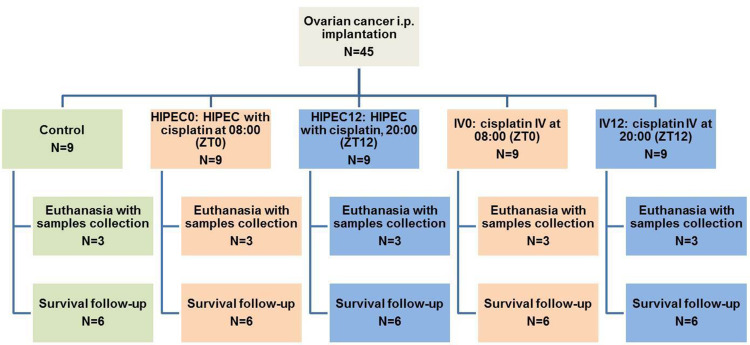
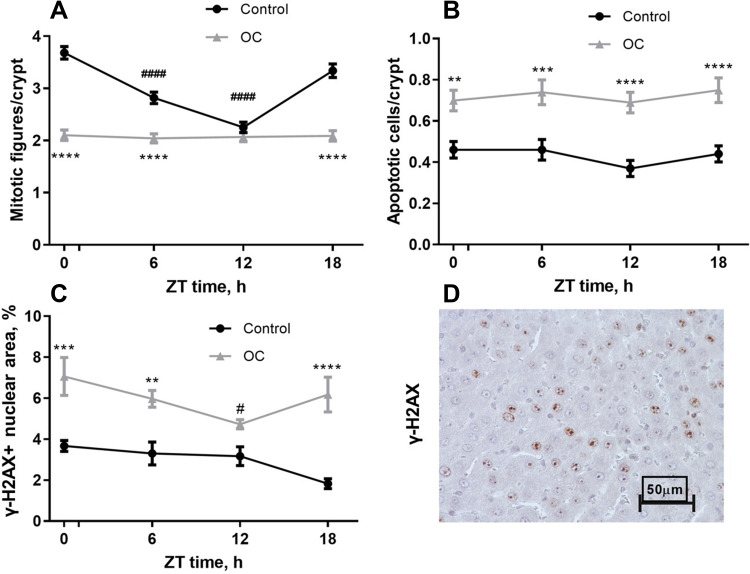
In the pilot study, we used 12 intact rats and 12 rats with transplantable ovarian cancer, which were euthanized at ZT0 (08:00, lights on), ZT6, ZT12 and ZT18. In the main study, we used 45 rats with transplantable ovarian cancer. Animals were randomized into five groups: control, HIPEC with cisplatin at ZT0 (08:00), HIPEC with cisplatin at ZT12 (20:00), IV cisplatin at ZT0 and IV cisplatin at ZT12. We assessed the proliferation rate of tumor and small intestinal epithelium, apoptosis in small intestinal epithelium, and levels of γ-H2AX (DNA damage/repair marker) in kidneys and liver. Survival was calculated in each group.
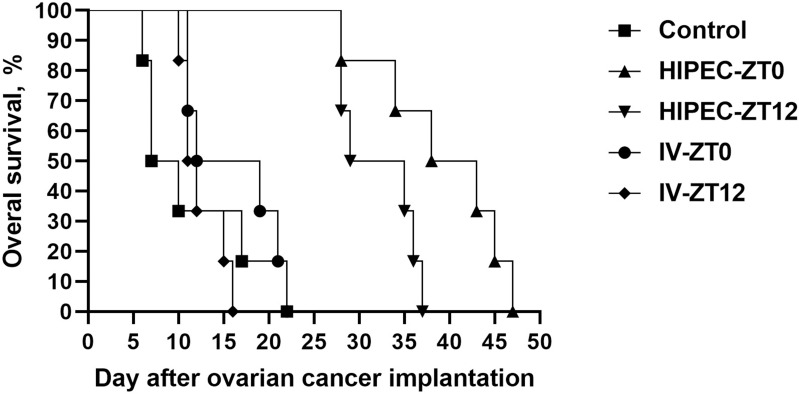
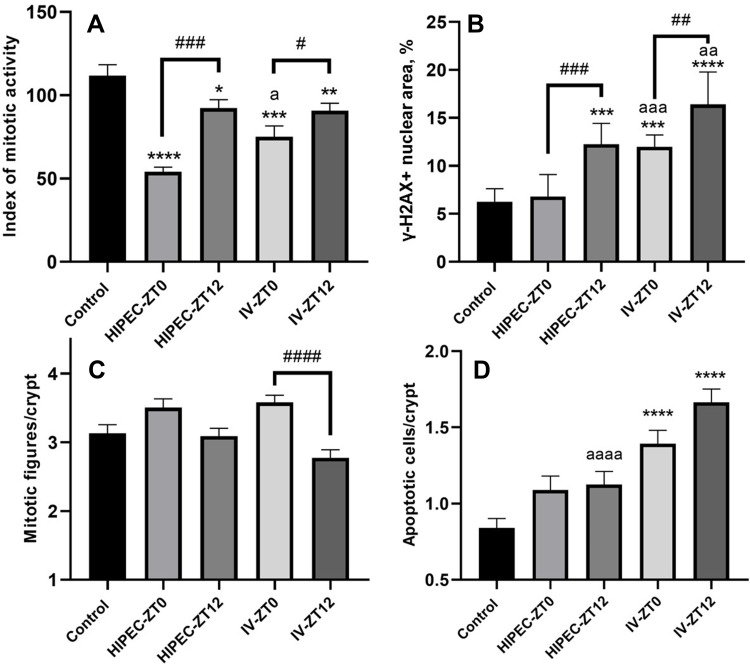
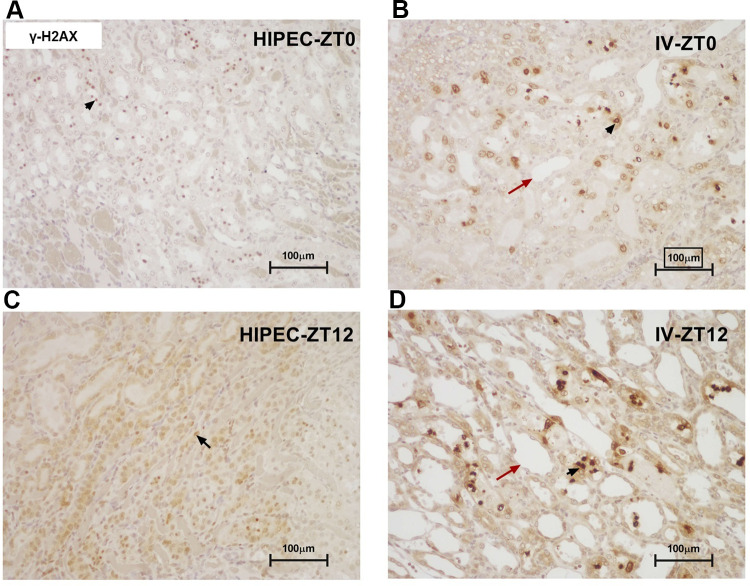
Ascitic ovarian cancer disrupted daily variations in intestinal epithelium proliferation and DNA damage/repair in rats. Ovarian carcinoma exhibited no daily variation in mitotic activity. In animals receiving IV cisplatin, massive cell damage in the renal medulla and cystic changes within renal tubules were observed, unlike in rats receiving HIPEC. Tumor mitotic activity was lower in morning-treated groups. The median survival of rats in the control group was 8.5 days (95% CI 6.0-22.0), in HIPEC at ZT0 40.5 days (95% CI 28.0-47.0, <0.001) and in HIPEC at ZT12 32.0 days (95% CI 28.0-37.0, <0.001).
In a rat model, ovarian tumor growth disrupted daily variations in intestinal epithelium proliferation and caused genotoxic stress in tumor-free tissues. HIPEC with cisplatin at ZT0 had a better efficacy/toxicity profile than HIPEC with cisplatin at ZT12 and IV administration at both time points.
肿瘤生长引起的昼夜节律改变被认为具有临床相关性,因为它们会影响预后和治疗反应。我们旨在评估接受静脉注射(IV)顺铂或热灌注腹腔化疗(HIPEC)的卵巢癌大鼠的时辰治疗方法,并评估肿瘤和肠上皮增殖的每日变化。
在预实验中,我们使用了12只完整大鼠和12只可移植性卵巢癌大鼠,分别在ZT0(08:00,开灯)、ZT6、ZT12和ZT18时实施安乐死。在主要研究中,我们使用了45只可移植性卵巢癌大鼠。动物被随机分为五组:对照组、ZT0(08:00)接受顺铂的HIPEC组、ZT12(20:00)接受顺铂的HIPEC组、ZT0接受静脉注射顺铂组和ZT12接受静脉注射顺铂组。我们评估了肿瘤和小肠上皮的增殖率、小肠上皮的凋亡以及肾脏和肝脏中γ-H2AX(DNA损伤/修复标志物)的水平。计算每组的生存率。
腹水型卵巢癌扰乱了大鼠肠上皮增殖和DNA损伤/修复的每日变化。卵巢癌的有丝分裂活性没有每日变化。与接受HIPEC的大鼠不同,接受静脉注射顺铂的动物出现了肾髓质大量细胞损伤和肾小管囊性变化。早晨治疗组的肿瘤有丝分裂活性较低。对照组大鼠的中位生存期为8.5天(95%CI 6.0-22.0),ZT0接受HIPEC的大鼠为40.5天(95%CI 28.0-47.0,<0.001),ZT12接受HIPEC的大鼠为32.0天(95%CI 28.0-37.0,<0.001)。
在大鼠模型中,卵巢肿瘤生长扰乱了肠上皮增殖的每日变化,并在无肿瘤组织中引起遗传毒性应激。ZT0接受顺铂的HIPEC组比ZT12接受顺铂的HIPEC组以及两个时间点静脉给药组具有更好的疗效/毒性特征。