• 文献检索
  • 文档翻译
  • 深度研究
  • 学术资讯
  • Suppr Zotero 插件Zotero 插件
  • 邀请有礼
  • 套餐&价格
  • 历史记录
应用&插件
Suppr Zotero 插件Zotero 插件浏览器插件Mac 客户端Windows 客户端微信小程序
定价
高级版会员购买积分包购买API积分包
服务
文献检索文档翻译深度研究API 文档MCP 服务
关于我们
关于 Suppr公司介绍联系我们用户协议隐私条款
关注我们

Suppr 超能文献

核心技术专利:CN118964589B侵权必究
粤ICP备2023148730 号-1Suppr @ 2026

文献检索

告别复杂PubMed语法,用中文像聊天一样搜索,搜遍4000万医学文献。AI智能推荐,让科研检索更轻松。

立即免费搜索

文件翻译

保留排版,准确专业,支持PDF/Word/PPT等文件格式,支持 12+语言互译。

免费翻译文档

深度研究

AI帮你快速写综述,25分钟生成高质量综述,智能提取关键信息,辅助科研写作。

立即免费体验

住院COVID-19患者的继发性感染:印度经验

Secondary Infections in Hospitalized COVID-19 Patients: Indian Experience.

作者信息

Vijay Sonam, Bansal Nitin, Rao Brijendra Kumar, Veeraraghavan Balaji, Rodrigues Camilla, Wattal Chand, Goyal Jagdish Prasad, Tadepalli Karuna, Mathur Purva, Venkateswaran Ramanathan, Venkatasubramanian Ramasubramanian, Khadanga Sagar, Bhattacharya Sanjay, Mukherjee Sudipta, Baveja Sujata, Sistla Sujatha, Panda Samiran, Walia Kamini

机构信息

Division of Epidemiology and Communicable Diseases, Indian Council of Medical Research, New Delhi, India.

Institute of Critical Medicine, Sir Ganga Ram Hospital, New Delhi, India.

出版信息

Infect Drug Resist. 2021 May 24;14:1893-1903. doi: 10.2147/IDR.S299774. eCollection 2021.

DOI:10.2147/IDR.S299774
PMID:34079300
原文链接:https://pmc.ncbi.nlm.nih.gov/articles/PMC8164345/
Abstract

PURPOSE

Critically ill coronavirus disease 2019 (COVID-19) patients need hospitalization which increases their risk of acquiring secondary bacterial and fungal infections. The practice of empiric antimicrobial prescription, due to limited diagnostic capabilities of many hospitals, has the potential to escalate an already worrisome antimicrobial resistance (AMR) situation in India. This study reports the prevalence and profiles of secondary infections (SIs) and clinical outcomes in hospitalized COVID-19 patients in India.

PATIENTS AND METHODS

A retrospective study of secondary infections in patients admitted in intensive care units (ICUs) and wards of ten hospitals of the Indian Council of Medical Research (ICMR) AMR surveillance network, between June and August 2020, was undertaken. The demographic data, time of infection after admission, microbiological and antimicrobial resistance data of secondary infections, and clinical outcome data of the admitted COVID-19 patients were collated.

RESULTS

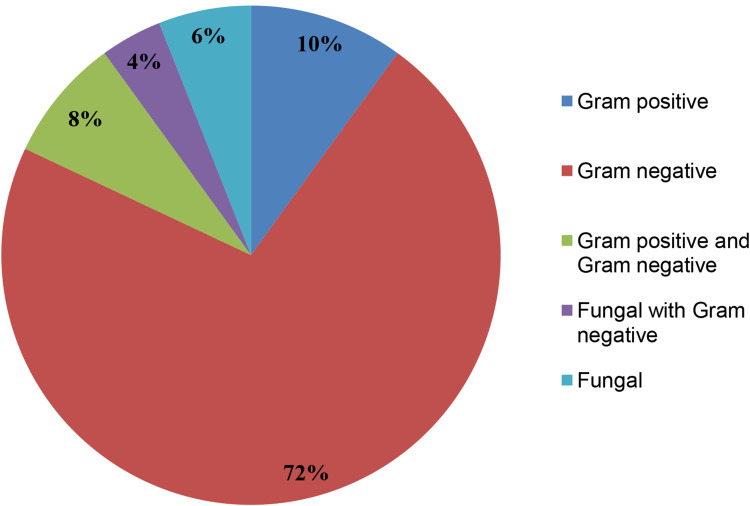
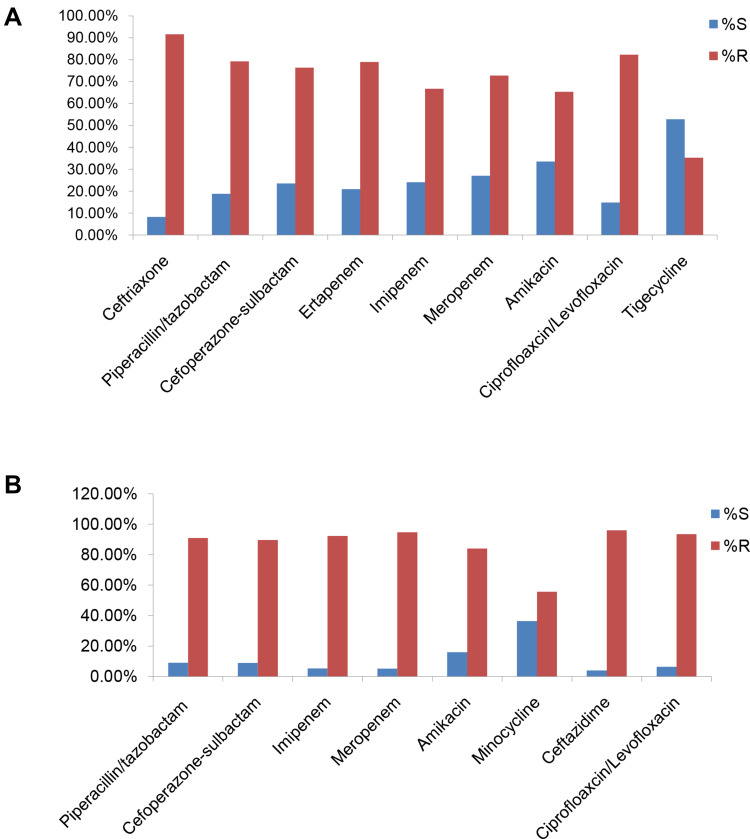
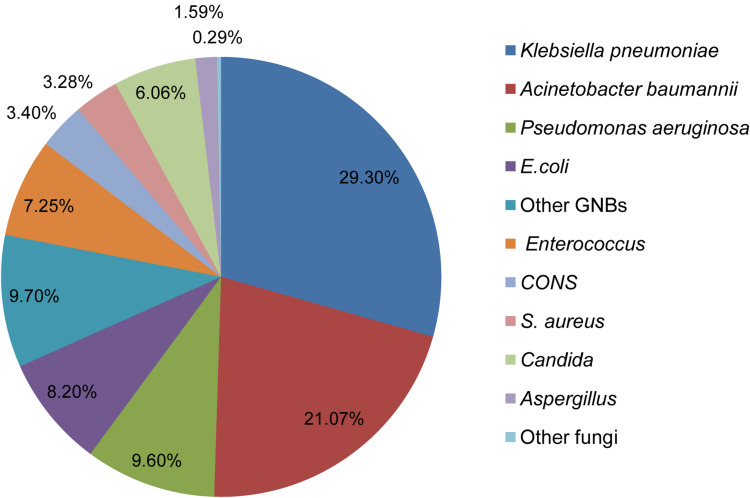
Out of 17,534 admitted patients, 3.6% of patients developed secondary bacterial or fungal infections. The mortality among patients who developed secondary infections was 56.7% against an overall mortality of 10.6% in total admitted COVID-19 patients. Gram-negative bacteria were isolated from 78% of patients. (29%) was the predominant pathogen, followed by (21%). Thirty-five percent of patients reported polymicrobial infections, including fungal infections. High levels of carbapenem resistance was seen in (92.6%) followed by (72.8%).

CONCLUSION

Predominance of Gram-negative pathogens in COVID-19 patients coupled with high rates of resistance to higher generation antimicrobials is an alarming finding. A high rate of mortality in patients with secondary infections warrants extra caution to improve the infection control practices and practice of antimicrobial stewardship interventions not only to save patient lives but also prevent selection of drug-resistant infections, to which the current situation is very conducive.

摘要

目的

2019年冠状病毒病(COVID-19)重症患者需要住院治疗,这增加了他们获得继发性细菌和真菌感染的风险。由于许多医院诊断能力有限,经验性抗菌药物处方的做法有可能使印度本已令人担忧的抗菌药物耐药性(AMR)情况进一步恶化。本研究报告了印度住院COVID-19患者继发性感染(SIs)的患病率、特征及临床结局。

患者与方法

对2020年6月至8月期间在印度医学研究理事会(ICMR)AMR监测网络的10家医院的重症监护病房(ICU)和病房收治的患者的继发性感染进行了回顾性研究。整理了COVID-19住院患者的人口统计学数据、入院后感染时间、继发性感染的微生物学和抗菌药物耐药性数据以及临床结局数据。

结果

在17534名入院患者中,3.6%的患者发生了继发性细菌或真菌感染。发生继发性感染的患者死亡率为56.7%,而COVID-19住院患者的总体死亡率为10.6%。78%的患者分离出革兰氏阴性菌。(29%)是主要病原体,其次是(21%)。35%的患者报告有多重微生物感染,包括真菌感染。(92.6%)对碳青霉烯类药物的耐药率较高其次是(72.8%)。

结论

COVID-19患者中革兰氏阴性病原体占主导地位,以及对新一代抗菌药物的高耐药率是一个令人担忧的发现。继发性感染患者的高死亡率值得格外谨慎,以改善感染控制措施和抗菌药物管理干预措施的实施,这不仅是为了挽救患者生命,也是为了防止选择耐药性感染,目前的情况非常有利于耐药性感染的发生。
https://cdn.ncbi.nlm.nih.gov/pmc/blobs/dce2/8164345/326a57be20fe/IDR-14-1893-g0004.jpg
https://cdn.ncbi.nlm.nih.gov/pmc/blobs/dce2/8164345/cf9790111f2d/IDR-14-1893-g0001.jpg
https://cdn.ncbi.nlm.nih.gov/pmc/blobs/dce2/8164345/c7c1926eef83/IDR-14-1893-g0002.jpg
https://cdn.ncbi.nlm.nih.gov/pmc/blobs/dce2/8164345/693a009b2d58/IDR-14-1893-g0003.jpg
https://cdn.ncbi.nlm.nih.gov/pmc/blobs/dce2/8164345/326a57be20fe/IDR-14-1893-g0004.jpg
https://cdn.ncbi.nlm.nih.gov/pmc/blobs/dce2/8164345/cf9790111f2d/IDR-14-1893-g0001.jpg
https://cdn.ncbi.nlm.nih.gov/pmc/blobs/dce2/8164345/c7c1926eef83/IDR-14-1893-g0002.jpg
https://cdn.ncbi.nlm.nih.gov/pmc/blobs/dce2/8164345/693a009b2d58/IDR-14-1893-g0003.jpg
https://cdn.ncbi.nlm.nih.gov/pmc/blobs/dce2/8164345/326a57be20fe/IDR-14-1893-g0004.jpg

相似文献

1
Secondary Infections in Hospitalized COVID-19 Patients: Indian Experience.住院COVID-19患者的继发性感染:印度经验
Infect Drug Resist. 2021 May 24;14:1893-1903. doi: 10.2147/IDR.S299774. eCollection 2021.
2
Secondary infections modify the overall course of hospitalized patients with COVID-19: a retrospective study from a network of hospitals across North India.继发性感染改变了新冠肺炎住院患者的总体病程:一项来自印度北部多家医院网络的回顾性研究。
IJID Reg. 2022 Jun;3:44-53. doi: 10.1016/j.ijregi.2022.02.008. Epub 2022 Feb 23.
3
Secondary Bacterial Infection and Clinical Characteristics in Patients With COVID-19 Admitted to Two Intensive Care Units of an Academic Hospital in Iran During the First Wave of the Pandemic.伊朗一所学术医院的两个重症监护病房在大流行第一波期间收治的 COVID-19 患者中的继发性细菌感染和临床特征。
Front Cell Infect Microbiol. 2022 Feb 23;12:784130. doi: 10.3389/fcimb.2022.784130. eCollection 2022.
4
Profile of co-infections & secondary infections in COVID-19 patients at a dedicated COVID-19 facility of a tertiary care Indian hospital: Implication on antimicrobial resistance.在一家印度三级护理医院的专门 COVID-19 病房中 COVID-19 患者的合并感染和继发感染情况简介:对抗菌药物耐药性的影响。
Indian J Med Microbiol. 2021 Apr;39(2):147-153. doi: 10.1016/j.ijmmb.2020.10.014. Epub 2020 Nov 2.
5
Bacterial Epidemiology and Antimicrobial Resistance Profiles in Children Reported by the ISPED Program in China, 2016 to 2020.中国 ISPED 项目报告的 2016 至 2020 年儿童细菌流行病学和抗菌药物耐药性特征。
Microbiol Spectr. 2021 Dec 22;9(3):e0028321. doi: 10.1128/Spectrum.00283-21. Epub 2021 Nov 3.
6
An Update on Secondary Bacterial and Fungal Infections and Their Antimicrobial Resistance Pattern (AMR) in COVID-19 Confirmed Patients.2019冠状病毒病确诊患者继发性细菌和真菌感染及其抗菌药物耐药模式(AMR)的最新情况
J Lab Physicians. 2022 Jan 10;14(3):260-264. doi: 10.1055/s-0041-1741438. eCollection 2022 Sep.
7
[Surveillance of resistance in the intensive care units using a cumulative antibiogram].[使用累积抗菌谱监测重症监护病房的耐药情况]
Mikrobiyol Bul. 2018 Oct;52(4):329-339. doi: 10.5578/mb.67408.
8
Phenotypic and molecular characterization of Acinetobacter baumannii isolates causing lower respiratory infections among ICU patients.分析 ICU 患者下呼吸道感染的鲍曼不动杆菌分离株的表型和分子特征。
Microb Pathog. 2019 Mar;128:75-81. doi: 10.1016/j.micpath.2018.12.023. Epub 2018 Dec 15.
9
A 2-Year Single-Centre Audit on Antibiotic Resistance of , and Strains from an Intensive Care Unit and Other Wards in a General Public Hospital in Greece.希腊一家综合公立医院重症监护病房及其他病房中、和菌株抗生素耐药性的两年单中心审计
Antibiotics (Basel). 2019 May 15;8(2):62. doi: 10.3390/antibiotics8020062.
10
Clinical profile of bloodstream infections in COVID-19 patients: a retrospective cohort study.COVID-19患者血流感染的临床特征:一项回顾性队列研究。
BMC Infect Dis. 2021 Sep 8;21(1):933. doi: 10.1186/s12879-021-06647-x.

引用本文的文献

1
Procalcitonin Level and Antimicrobial Resistance among Microbial Coinfection in Hospitalized COVID-19 Patients.住院COVID-19患者微生物合并感染中的降钙素原水平与抗菌药物耐药性
Rep Biochem Mol Biol. 2025 Jan;13(4):474-483. doi: 10.61186/rbmb.13.4.474.
2
Evaluation of the longer-term impacts on working practices of veterinarians in India after attending a canine surgical neutering training programme.评估印度兽医参加犬类绝育手术培训项目后对其工作实践的长期影响。
Anim Welf. 2025 May 30;34:e32. doi: 10.1017/awf.2025.30. eCollection 2025.
3
The Novel "RISC" Score as a Risk-prediction Model of Carbapenem-resistant Hospital-acquired Infections in Adult Sepsis Patients - A Prospective Observational Study.

本文引用的文献

1
COVID-19 mortality risk for older men and women.COVID-19 对老年男性和女性的死亡率风险。
BMC Public Health. 2020 Nov 19;20(1):1742. doi: 10.1186/s12889-020-09826-8.
2
Etiology and antimicrobial resistance of secondary bacterial infections in patients hospitalized with COVID-19 in Wuhan, China: a retrospective analysis.中国武汉 COVID-19 住院患者继发细菌性感染的病因和抗菌药物耐药性:一项回顾性分析。
Antimicrob Resist Infect Control. 2020 Sep 22;9(1):153. doi: 10.1186/s13756-020-00819-1.
3
Diagnosing COVID-19-associated pulmonary aspergillosis.
新型“RISC”评分作为成人脓毒症患者耐碳青霉烯类医院获得性感染的风险预测模型——一项前瞻性观察研究。
Indian J Crit Care Med. 2025 Apr;29(4):352-362. doi: 10.5005/jp-journals-10071-24953.
4
Direct medical cost of adult Covid-19 ınpatients and ıts determinants at a university hospital.某大学医院成人新冠住院患者的直接医疗费用及其影响因素
PLoS One. 2025 Apr 7;20(4):e0319762. doi: 10.1371/journal.pone.0319762. eCollection 2025.
5
Colistin Treatment Outcomes in Gram-Negative Bacterial Infections in the Northeast of Romania: A Decade of Change Through Pandemic Challenges.罗马尼亚东北部革兰氏阴性菌感染的黏菌素治疗结果:大流行挑战下十年的变化
Antibiotics (Basel). 2025 Mar 7;14(3):275. doi: 10.3390/antibiotics14030275.
6
Geographical mapping and temporal trends of Acinetobacter baumannii carbapenem resistance: A comprehensive meta-analysis.鲍曼不动杆菌对碳青霉烯类耐药的地理分布及时间趋势:一项综合荟萃分析。
PLoS One. 2024 Dec 16;19(12):e0311124. doi: 10.1371/journal.pone.0311124. eCollection 2024.
7
Associated Risk Factors and Clinical Outcomes of Bloodstream Infections among COVID-19 Intensive Care Unit Patients in a Tertiary Care Hospital.三级医院新冠肺炎重症监护病房患者血流感染的相关危险因素及临床结局
J Glob Infect Dis. 2024 Jun 26;16(2):60-67. doi: 10.4103/jgid.jgid_108_23. eCollection 2024 Apr-Jun.
8
Identification of Yeast and Yeast-Like Fungi at a Tertiary Care Center: A Retrospective Study.三级医疗中心酵母菌和酵母样真菌的鉴定:一项回顾性研究
Cureus. 2024 Jun 19;16(6):e62680. doi: 10.7759/cureus.62680. eCollection 2024 Jun.
9
Incidence of secondary bacterial infections and risk factors for in-hospital mortality among coronavirus disease 2019 subjects admitted to secondary care hospital: A single-center cross-sectional retrospective study.2019冠状病毒病患者入住二级护理医院后发生继发性细菌感染的发生率及院内死亡的危险因素:一项单中心横断面回顾性研究。
Int J Crit Illn Inj Sci. 2024 Apr-Jun;14(2):94-100. doi: 10.4103/ijciis.ijciis_71_23. Epub 2024 Jun 21.
10
Bacterial co-infections and secondary infections and their antimicrobial resistance in Covid-19 patients during the second pandemic wave.第二波疫情期间新冠患者的细菌合并感染、继发感染及其抗菌药物耐药性
GMS Hyg Infect Control. 2024 Mar 5;19:Doc10. doi: 10.3205/dgkh000465. eCollection 2024.
诊断新型冠状病毒肺炎相关肺曲霉病
Lancet Microbe. 2020 Jun;1(2):e53-e55. doi: 10.1016/S2666-5247(20)30027-6. Epub 2020 May 10.
4
Bacterial co-infections with SARS-CoV-2.细菌合并感染 SARS-CoV-2。
IUBMB Life. 2020 Oct;72(10):2097-2111. doi: 10.1002/iub.2356. Epub 2020 Aug 8.
5
Incidence of co-infections and superinfections in hospitalized patients with COVID-19: a retrospective cohort study.COVID-19 住院患者合并感染和再感染的发生率:一项回顾性队列研究。
Clin Microbiol Infect. 2021 Jan;27(1):83-88. doi: 10.1016/j.cmi.2020.07.041. Epub 2020 Jul 31.
6
Bacterial co-infection and secondary infection in patients with COVID-19: a living rapid review and meta-analysis.COVID-19 患者的细菌合并感染和继发感染:一项实时快速综述和荟萃分析。
Clin Microbiol Infect. 2020 Dec;26(12):1622-1629. doi: 10.1016/j.cmi.2020.07.016. Epub 2020 Jul 22.
7
Co-infections in people with COVID-19: a systematic review and meta-analysis.COVID-19 患者合并感染:系统评价和荟萃分析。
J Infect. 2020 Aug;81(2):266-275. doi: 10.1016/j.jinf.2020.05.046. Epub 2020 May 27.
8
Gender Differences in Patients With COVID-19: Focus on Severity and Mortality.COVID-19 患者的性别差异:关注严重程度和死亡率。
Front Public Health. 2020 Apr 29;8:152. doi: 10.3389/fpubh.2020.00152. eCollection 2020.
9
Recognition and management of respiratory co-infection and secondary bacterial pneumonia in patients with COVID-19.识别和管理 COVID-19 患者的呼吸道合并感染和继发性细菌性肺炎。
Cleve Clin J Med. 2020 Nov 2;87(11):659-663. doi: 10.3949/ccjm.87a.ccc015.
10
Bacterial and Fungal Coinfection in Individuals With Coronavirus: A Rapid Review To Support COVID-19 Antimicrobial Prescribing.细菌和真菌合并感染冠状病毒的个体:一项支持 COVID-19 抗菌药物处方的快速综述。
Clin Infect Dis. 2020 Dec 3;71(9):2459-2468. doi: 10.1093/cid/ciaa530.