Barss Trevor S, Collins David F, Miller Dylan, Pujari Amit N
Human Neurophysiology Laboratory, Faculty of Kinesiology, Sport, and Recreation, University of Alberta, Edmonton, AB, Canada.
Neuroscience and Mental Health Institute, University of Alberta, Edmonton, AB, Canada.
Front Hum Neurosci. 2021 May 17;15:617669. doi: 10.3389/fnhum.2021.617669. eCollection 2021.
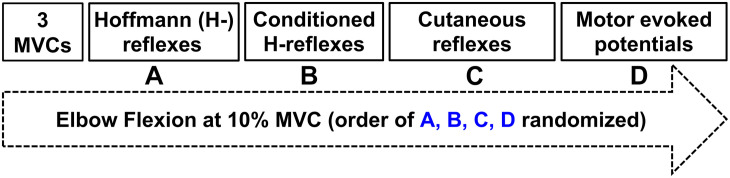
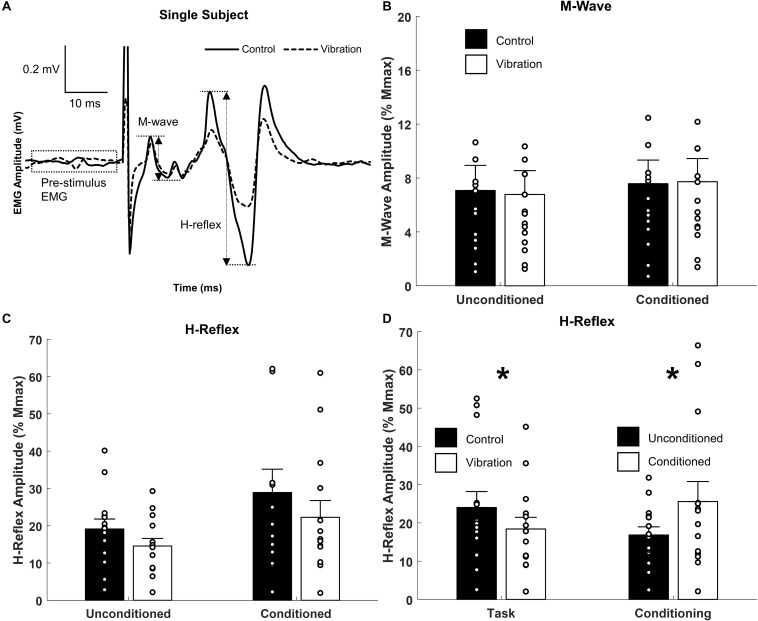
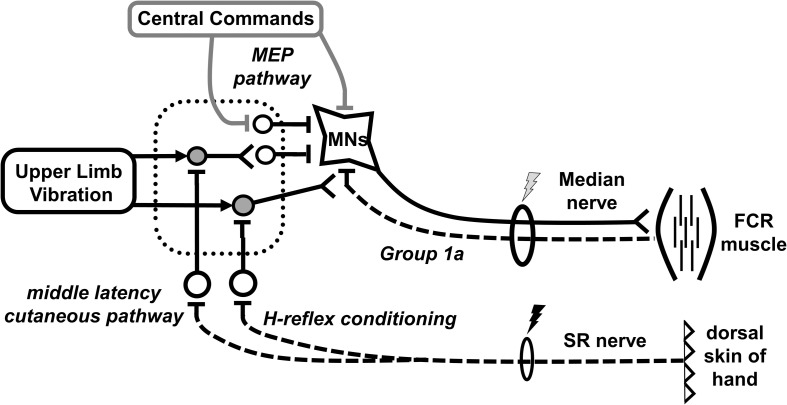
The use of upper limb vibration (ULV) during exercise and rehabilitation continues to gain popularity as a modality to improve function and performance. Currently, a lack of knowledge of the pathways being altered during ULV limits its effective implementation. Therefore, the aim of this study was to investigate whether indirect ULV modulates transmission along spinal and corticospinal pathways that control the human forearm. All measures were assessed under CONTROL (no vibration) and ULV (30 Hz; 0.4 mm displacement) conditions while participants maintained a small contraction of the right flexor carpi radialis (FCR) muscle. To assess spinal pathways, Hoffmann reflexes (H-reflexes) elicited by stimulation of the median nerve were recorded from FCR with motor response (M-wave) amplitudes matched between conditions. An H-reflex conditioning paradigm was also used to assess changes in presynaptic inhibition by stimulating the superficial radial (SR) nerve (5 pulses at 300Hz) 37 ms prior to median nerve stimulation. Cutaneous reflexes in FCR elicited by stimulation of the SR nerve at the wrist were also recorded. To assess corticospinal pathways, motor evoked potentials (MEPs) elicited by transcranial magnetic stimulation of the contralateral motor cortex were recorded from the right FCR and biceps brachii (BB). ULV significantly reduced H-reflex amplitude by 15.7% for both conditioned and unconditioned reflexes (24.0 ± 15.7 vs. 18.4 ± 11.2% M ; < 0.05). Middle latency cutaneous reflexes were also significantly reduced by 20.0% from CONTROL (-1.50 ± 2.1% Mmax) to ULV (-1.73 ± 2.2% Mmax; < 0.05). There was no significant effect of ULV on MEP amplitude ( > 0.05). Therefore, ULV inhibits cutaneous and H-reflex transmission without influencing corticospinal excitability of the forearm flexors suggesting increased presynaptic inhibition of afferent transmission as a likely mechanism. A general increase in inhibition of spinal pathways with ULV may have important implications for improving rehabilitation for individuals with spasticity (SCI, stroke, MS, etc.).
在运动和康复过程中使用上肢振动(ULV)作为一种改善功能和表现的方式,越来越受到欢迎。目前,对于ULV过程中被改变的通路缺乏了解,这限制了其有效应用。因此,本研究的目的是调查间接ULV是否调节沿控制人类前臂的脊髓和皮质脊髓通路的传导。所有测量均在对照(无振动)和ULV(30Hz;0.4mm位移)条件下进行,同时参与者保持右桡侧腕屈肌(FCR)的轻微收缩。为了评估脊髓通路,通过刺激正中神经引出的霍夫曼反射(H反射)从FCR记录,运动反应(M波)幅度在各条件下匹配。还使用H反射条件范式,通过在正中神经刺激前37毫秒刺激桡浅神经(SR)(300Hz下5个脉冲)来评估突触前抑制的变化。还记录了在腕部刺激SR神经引起的FCR中的皮肤反射。为了评估皮质脊髓通路,从右FCR和肱二头肌(BB)记录经颅磁刺激对侧运动皮层引出的运动诱发电位(MEP)。ULV使条件反射和非条件反射的H反射幅度显著降低15.7%(24.0±15.7对18.4±11.2%M;<0.05)。中潜伏期皮肤反射也从对照(-1.50±2.1%Mmax)到ULV(-1.73±2.2%Mmax;<0.05)显著降低20.0%。ULV对MEP幅度没有显著影响(>0.05)。因此,ULV抑制皮肤和H反射传导,而不影响前臂屈肌的皮质脊髓兴奋性,提示传入传导的突触前抑制增加是一种可能的机制。ULV对脊髓通路抑制的普遍增加可能对改善痉挛患者(脊髓损伤、中风、多发性硬化症等)的康复具有重要意义。