Department of Rheumatology and Immunology, Second Affiliated Hospital of Chongqing Medical University, Chongqing, China.
Department of Cardiovascular, Second Affiliated Hospital of Chongqing Medical University, Chongqing, China.
Front Immunol. 2021 May 17;12:655614. doi: 10.3389/fimmu.2021.655614. eCollection 2021.
Rheumatoid arthritis (RA) is a disabling disease with a high incidence that is regularly accompanied by cardiovascular complications. Several studies have suggested that renin-angiotensin-aldosterone system (RAAS) is closely associated with RA. The aim of this study was to investigate the mechanisms underlying Angiotensin-(1-7) [Ang-(1-7)] and its Mas receptor agonist (AVE0991) on joint inflammation and cardiac complications in a collagen-induced arthritis (CIA) model.
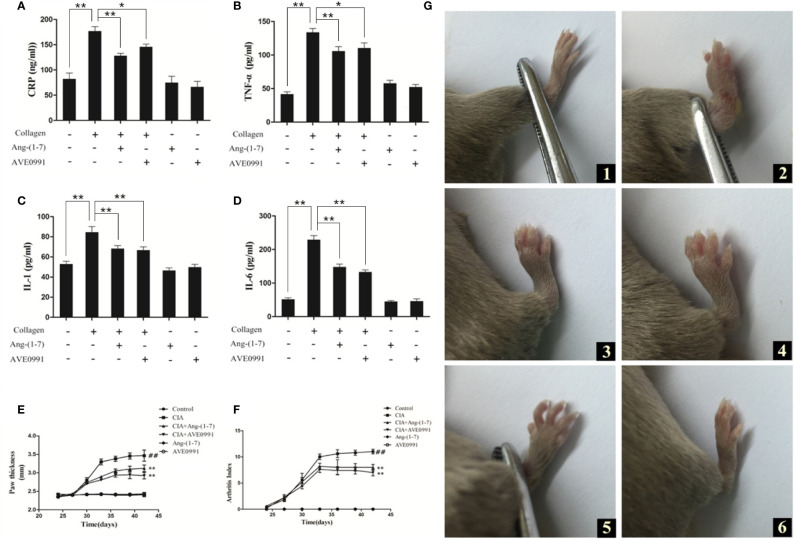
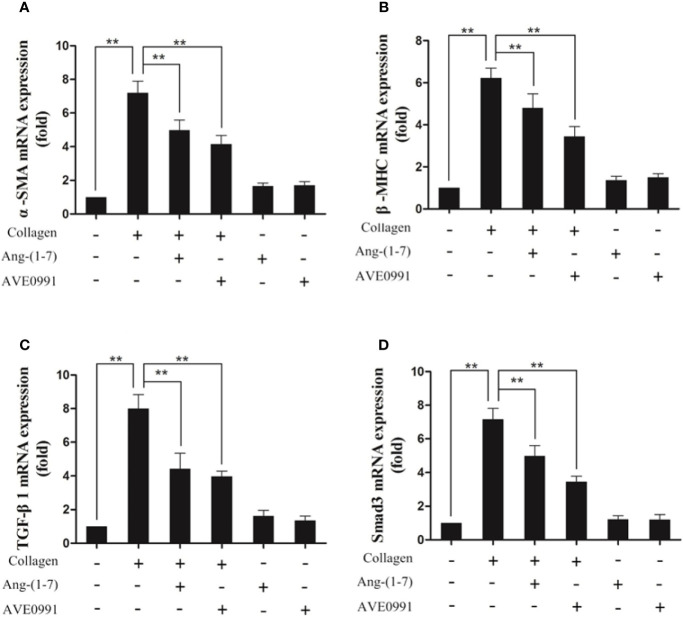
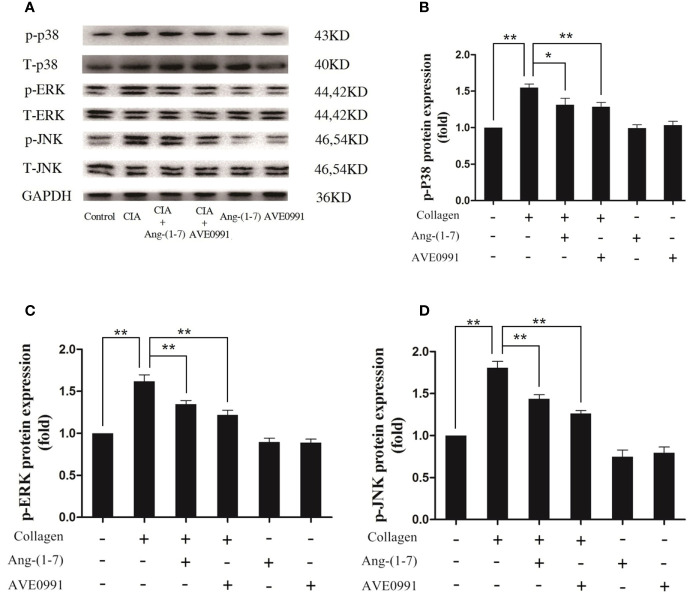
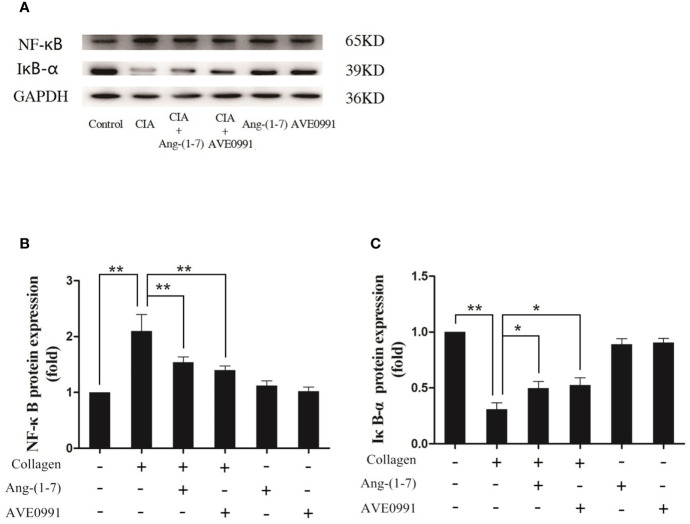
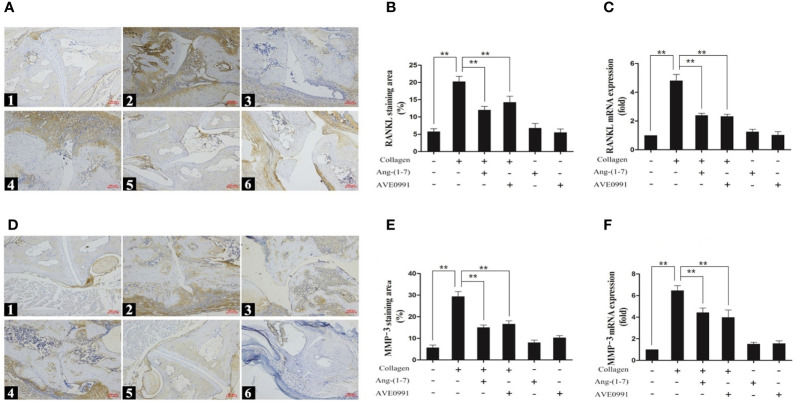
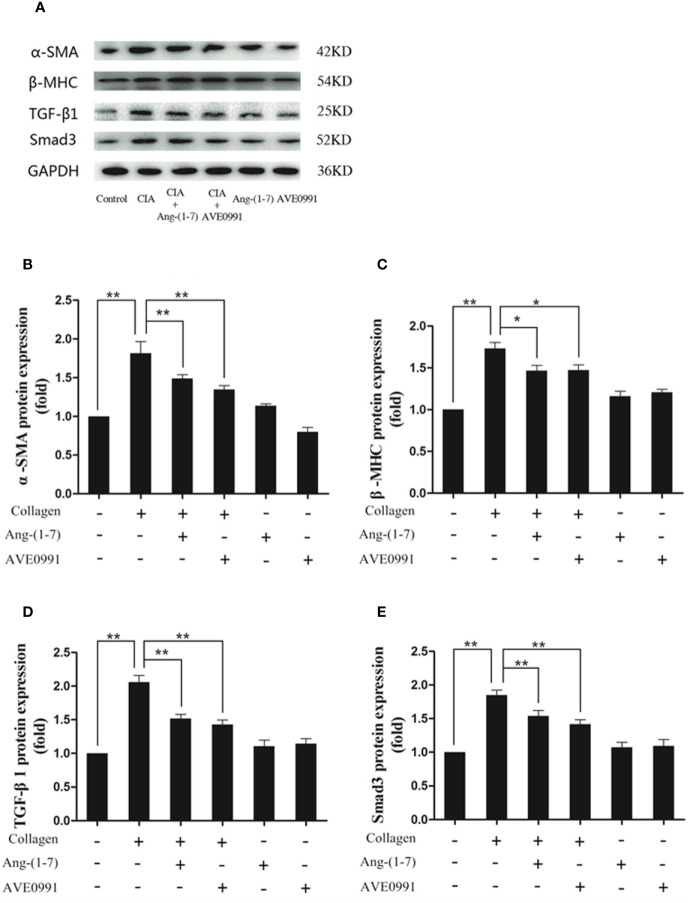
Collagen type II was injected into DBA/1 mice to construct an arthritis model. CIA mice were treated with Ang-(1-7) (2.0 mg/kg intraperitoneally) and AVE0991 (3.0 mg/kg intraperitoneally). The serum levels of inflammatory cytokines [tumor necrosis factor-alpha (TNF-α), interleukin (IL)-1 β, IL-6, and C-reactive protein (CRP)] were determined by ELISA. The mitogen-activated protein kinase (MAPK) and nuclear factor-kappaB (NF-B) signaling pathways in joint tissues and the transforming growth factor (TGF)-/Smad pathway and levels of -Smooth muscle action (SMA) and -myosin heavy chain (MHC) protein expression in cardiac tissues were assessed by western blots. The levels of TGF-/Smad pathway, -SMA, and -MHC RNA in cardiac tissues were analyzed by real time-PCR. The levels of receptor activator of nuclear factor kappa ligand (RANKL) and promoting matrix metalloproteinase (MMP)-3 expression in the ankle joints were detected by immunohistochemistry and real time-PCR.
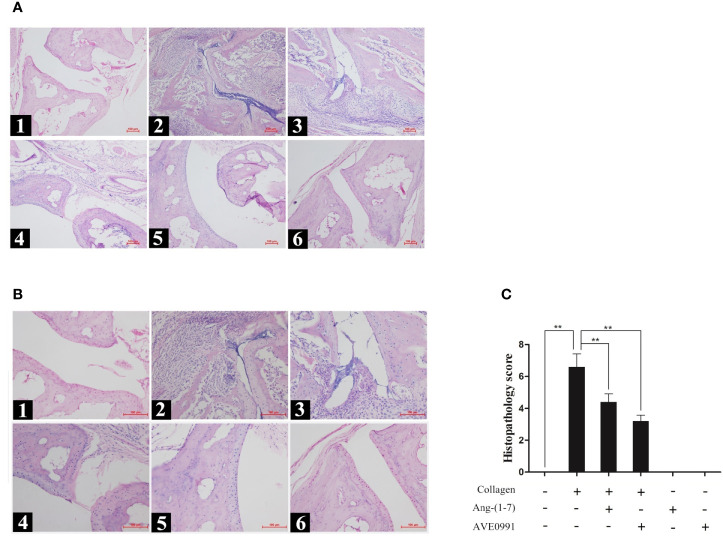
Ang-(1-7) and AVE0991 reduced the levels of inflammatory cytokines and inhibited the MAPKs and NF-B signaling pathways in ankle joint tissues, reduced RANKL and MMP3 expression, and ameliorated local joint inflammation and bone destruction compared with the control group. In addition, Ang-(1-7) and AVE0991 attenuated the TGF-/Smad signaling pathway, reduced the levels of -SMA and -MHC expression, and diminished inflammatory cell infiltration into the myocardial interstitium and myocardial interstitial fibrosis in the hearts of CIA mice.
Ang-(1-7) alleviated joint damage caused by inflammation likely through the attenuation of NF-B and MAPK pathways and ameliorated inflammation-induced cardiac fibrosis and activation of the TGF-/Smad pathway. Moreover, Ang-(1-7) was likely mediated through the Mas receptor. This study provides theoretical evidence for exploring novel clinical therapeutic approaches for RA and its cardiac complications.
类风湿关节炎(RA)是一种发病率高且致残性疾病,常伴有心血管并发症。多项研究表明肾素-血管紧张素-醛固酮系统(RAAS)与 RA 密切相关。本研究旨在探讨血管紧张素-(1-7)[Ang-(1-7)]及其 Mas 受体激动剂(AVE0991)对胶原诱导性关节炎(CIA)模型中关节炎症和心脏并发症的作用机制。
将 II 型胶原注入 DBA/1 小鼠以构建关节炎模型。用 Ang-(1-7)(2.0mg/kg 腹腔注射)和 AVE0991(3.0mg/kg 腹腔注射)处理 CIA 小鼠。通过 ELISA 测定血清中炎症细胞因子[肿瘤坏死因子-α(TNF-α)、白细胞介素(IL)-1β、IL-6 和 C 反应蛋白(CRP)]水平。通过 Western blot 检测关节组织中丝裂原激活蛋白激酶(MAPK)和核因子-κB(NF-κB)信号通路,以及心脏组织中转化生长因子(TGF)-/Smad 通路和 -平滑肌肌动蛋白(SMA)和 -肌球蛋白重链(MHC)蛋白表达水平。通过实时 PCR 分析心脏组织中 TGF-/Smad 通路、-SMA 和 -MHC RNA 水平。通过免疫组化和实时 PCR 检测踝关节中核因子κB 配体(RANKL)的表达和促进基质金属蛋白酶(MMP)-3 的表达。
与对照组相比,Ang-(1-7)和 AVE0991 降低了炎性细胞因子水平,并抑制了踝关节组织中 MAPKs 和 NF-κB 信号通路,降低了 RANKL 和 MMP3 的表达,改善了局部关节炎症和骨破坏。此外,Ang-(1-7)和 AVE0991 减弱了 TGF-/Smad 信号通路,降低了 -SMA 和 -MHC 表达水平,减轻了 CIA 小鼠心肌间质炎症细胞浸润和心肌间质纤维化。
Ang-(1-7)可能通过减轻 NF-κB 和 MAPK 通路缓解炎症引起的关节损伤,改善炎症诱导的心脏纤维化和 TGF-/Smad 通路激活。此外,Ang-(1-7)可能通过 Mas 受体介导。本研究为探索 RA 及其心脏并发症的新型临床治疗方法提供了理论依据。