Malik Shafi, Bhanji Amir, Abuleiss Husham, Hamer Rizwan, Shah Shahzad H, Rashad Rafaqat, Junglee Naushad, Waqar Salman, Ghouri Nazim
University Hospitals of Coventry and Warwickshire NHS Trust, Coventry, UK.
University of Leicester, Leicester, UK.
Clin Kidney J. 2021 Feb 5;14(6):1524-1534. doi: 10.1093/ckj/sfab032. eCollection 2021 Jun.
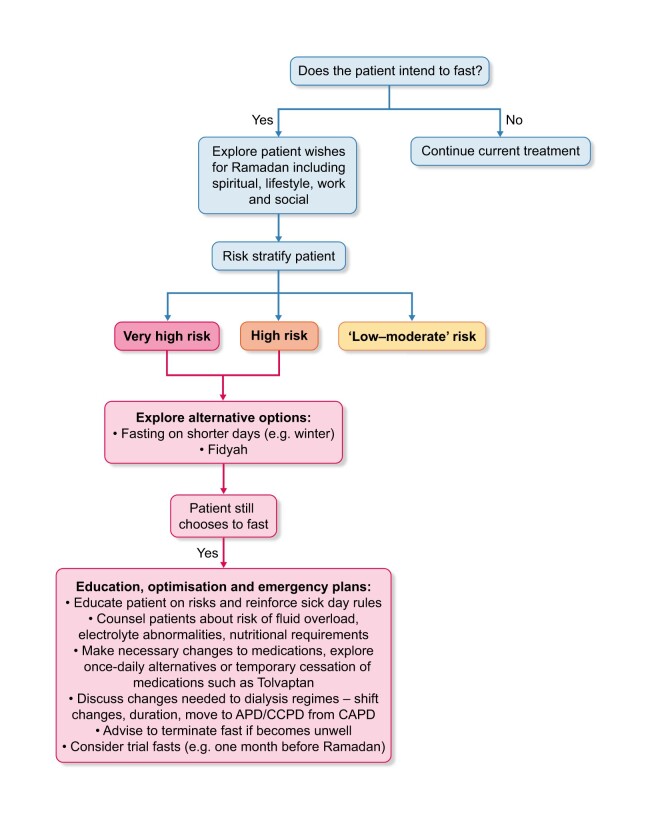
There are an estimated 1.8 billion Muslims worldwide, with the majority of them choosing to fast during the month of Ramadan. Fasting, which requires abstinence from food and drink from dawn to sunset can be up to 20 h per day during the summer months in temperate regions. Fasting can be especially challenging in patients on haemodialysis and peritoneal dialysis. Moreover, there is concern that those with chronic kidney disease (CKD) can experience electrolyte imbalance and worsening of renal function. In this article, current literature is reviewed and a decision-making management tool has been developed to assist clinicians in discussing the risks of fasting in patients with CKD, with consideration also given to circumstances such as the coronavirus disease 2019 pandemic. Our review highlights that patients with CKD wishing to fast should undergo a thorough risk assessment ideally within a month before Ramadan, as they may require medication changes and a plan for regular monitoring of renal function and electrolytes in order to fast safely. Recommendations have been based on risk tiers (very high risk, high risk and low-moderate risk) established by the International Diabetes Federation and the Diabetes and Ramadan International Alliance. Patients in the very high risk and high risk categories should be encouraged to explore alternative options to fasting, while those in the low-moderate category may be able to fast safely with guidance from their clinician. Prior to the commencement of Ramadan, all patients must receive up-to-date education on sick-day rules and instructions on when to terminate their fast or abstain from fasting.
据估计,全球有18亿穆斯林,其中大多数人选择在斋月期间禁食。禁食要求从黎明到日落期间禁食禁水,在温带地区的夏季,每天禁食时间可达20小时。对于接受血液透析和腹膜透析的患者来说,禁食尤其具有挑战性。此外,人们担心慢性肾脏病(CKD)患者会出现电解质失衡和肾功能恶化。在本文中,我们回顾了当前的文献,并开发了一种决策管理工具,以帮助临床医生讨论CKD患者禁食的风险,同时也考虑了诸如2019冠状病毒病大流行等情况。我们的综述强调,希望禁食的CKD患者理想情况下应在斋月前一个月内接受全面的风险评估,因为他们可能需要调整药物治疗,并制定定期监测肾功能和电解质的计划,以便安全禁食。建议是基于国际糖尿病联合会和糖尿病与斋月国际联盟制定的风险等级(极高风险、高风险和低-中度风险)。应鼓励极高风险和高风险类别的患者探索替代禁食的方法,而低-中度类别的患者在临床医生的指导下可能能够安全禁食。在斋月开始前,所有患者必须接受关于患病日规则的最新教育,以及关于何时终止禁食或避免禁食的指导。