Ahmed Syed H, Chowdhury Tahseen A, Hussain Sufyan, Syed Ateeq, Karamat Ali, Helmy Ahmed, Waqar Salman, Ali Samina, Dabhad Ammarah, Seal Susan T, Hodgkinson Anna, Azmi Shazli, Ghouri Nazim
Department of Endocrinology and Metabolic Medicine, Countess of Chester Hospital NHS Foundation Trust, Chester, UK.
School of Medicine, University of Liverpool, Liverpool, UK.
Diabetes Ther. 2020 Nov;11(11):2477-2520. doi: 10.1007/s13300-020-00886-y. Epub 2020 Sep 9.
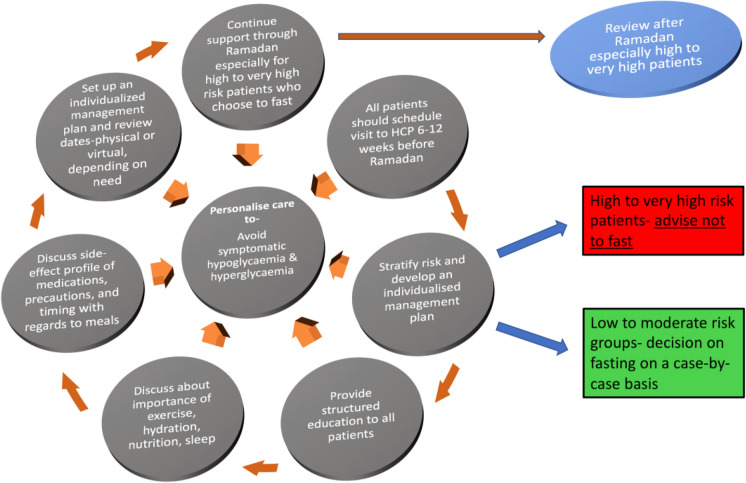
Fasting in the Islamic month of Ramadan is obligatory for all sane, healthy adult Muslims. The length of the day varies significantly in temperate regions-typically lasting ≥ 18 h during peak summer in the UK. The synodic nature of the Islamic calendar means that Ramadan migrates across all four seasons over an approximately 33-year cycle. Despite valid exemptions, there is an intense desire to fast during this month, even among those who are considered to be at high risk, including many individuals with diabetes mellitus. In this review we explore the current scientific and clinical evidence on fasting in patients with diabetes mellitus, focussing on type 2 diabetes mellitus and type 1 diabetes mellitus, with brief reviews on pregnancy, pancreatic diabetes, bariatric surgery, the elderly population and current practice guidelines. We also make recommendations on the management of diabetes patients during the month of Ramadan. Many patients admit to a do-it-yourself approach to diabetes mellitus management during Ramadan, largely due to an under-appreciation of the risks and implications of the rigors of fasting on their health. Part of the issue may also lie with a healthcare professional's perceived inability to grasp the religious sensitivities of Muslims in relation to disease management. Thus, the pre-Ramadan assessment is crucial to ensure a safe Ramadan experience. Diabetes patients can be risk-stratified from low, medium to high or very high risk during the pre-Ramadan assessment and counselled accordingly. Those who are assessed to be at high to very high risk are advised not to fast. The current COVID-19 pandemic upgrades those in the high-risk category to very high risk; hence a significant number of diabetes patients may fall under the penumbra of the 'not to fast' advisory. We recognize that fasting is a personal choice and if a person chooses to fast despite advice to the contrary, he/she should be adequately supported and monitored closely during Ramadan and for a brief period thereafter. Current advancements in insulin delivery and glucose monitoring technologies are useful adjuncts to strategies for supporting type 1 diabetes patients considered to be high risk as well as 'high-risk' type 2 patients manage their diabetes during Ramadan. Although there is a lack of formal trial data, there is sufficient evidence across the different classes of therapeutic hypoglycaemic agents in terms of safety and efficacy to enable informed decision-making and provide a breadth of therapeutic options for the patient and the healthcare professional, even if the professional advice is to abstain. Thus, Ramadan provides an excellent opportunity for patient engagement to discuss important aspects of management, to improve control in the short term during Ramadan and to help the observants understand that the metabolic gains achieved during Ramadan are also sustainable in the other months of the year by maintaining a dietary and behavioural discipline. The application of this understanding can potentially prevent long-term complications.
在伊斯兰历的斋月期间,所有心智健全、身体健康的成年穆斯林都必须禁食。在温带地区,白昼时长变化显著——在英国,夏季高峰期白昼通常持续≥18小时。伊斯兰历的朔望月性质意味着斋月会在大约33年的周期内跨越所有四个季节。尽管有合理的豁免情况,但即使是那些被认为属于高风险人群,包括许多糖尿病患者,在这个月也强烈渴望禁食。在这篇综述中,我们探讨了糖尿病患者禁食的当前科学和临床证据,重点关注2型糖尿病和1型糖尿病,并简要回顾了妊娠糖尿病、胰腺性糖尿病、减肥手术、老年人群以及当前的实践指南。我们还就斋月期间糖尿病患者的管理提出建议。许多患者承认在斋月期间采用自行管理糖尿病的方法,这主要是因为他们没有充分认识到严格禁食对其健康的风险和影响。部分问题可能还在于医疗保健专业人员被认为无法理解穆斯林在疾病管理方面的宗教敏感性。因此,斋月前的评估对于确保安全度过斋月至关重要。在斋月前的评估中,可以将糖尿病患者按低、中、高或极高风险进行分层,并据此提供咨询。那些被评估为高风险或极高风险的患者建议不要禁食。当前的新冠疫情使高风险类别中的患者升级为极高风险;因此,大量糖尿病患者可能属于“不要禁食”建议的范围。我们认识到禁食是个人选择,如果一个人不顾相反的建议选择禁食,在斋月期间及之后的短时间内,他/她应该得到充分的支持并受到密切监测。胰岛素给药和血糖监测技术的当前进展对于支持被认为是高风险的1型糖尿病患者以及“高风险”2型患者在斋月期间管理糖尿病的策略是有用的辅助手段。尽管缺乏正式的试验数据,但就安全性和有效性而言,不同类别的治疗性降糖药物有足够的证据,能够做出明智的决策,并为患者和医疗保健专业人员提供广泛的治疗选择,即使专业建议是禁食。因此,斋月为患者参与讨论管理的重要方面提供了绝佳机会,以在斋月期间短期内改善控制,并帮助遵守者明白通过保持饮食和行为规范,在斋月期间实现的代谢改善在一年中的其他月份也是可持续的。这种认识的应用有可能预防长期并发症。