Department of Pharmacy, Uppsala University, Box 580, 751 23, Uppsala, Sweden.
Clinical Pharmacology Modelling and Simulation, GlaxoSmithKline plc, London, UK.
AAPS J. 2021 Jun 2;23(4):79. doi: 10.1208/s12248-021-00600-1.
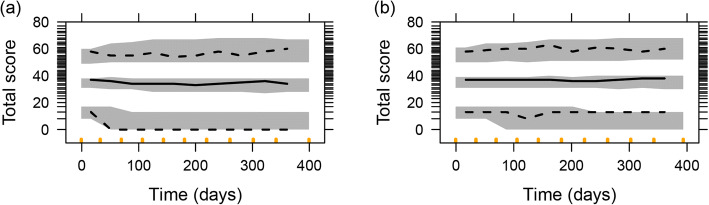
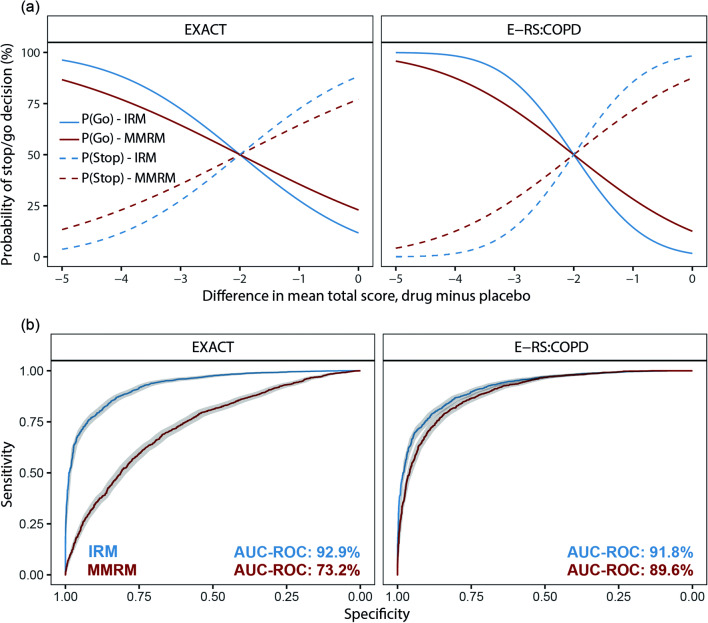
This study aimed to illustrate how a new methodology to assess clinical trial outcome measures using a longitudinal item response theory-based model (IRM) could serve as an alternative to mixed model repeated measures (MMRM). Data from the EXACT (Exacerbation of chronic pulmonary disease tool) which is used to capture frequency, severity, and duration of exacerbations in COPD were analyzed using an IRM. The IRM included a graded response model characterizing item parameters and functions describing symptom-time course. Total scores were simulated (month 12) using uncertainty in parameter estimates. The 50th (2.5th, 97.5th) percentiles of the resulting simulated differences in average total score (drug minus placebo) represented the estimated drug effect (95%CI), which was compared with published MMRM results. Furthermore, differences in sample size, sensitivity, specificity, and type I and II errors between approaches were explored. Patients received either oral danirixin 75 mg twice daily (n = 45) or placebo (n = 48) on top of standard of care over 52 weeks. A step function best described the COPD symptoms-time course in both trial arms. The IRM improved precision of the estimated drug effect compared to MMRM, resulting in a sample size of 2.5 times larger for the MMRM analysis to achieve the IRM precision. The IRM showed a higher probability of a positive predictive value (34%) than MMRM (22%). An item model-based analysis data gave more precise estimates of drug effect than MMRM analysis for the same endpoint in this one case study.
本研究旨在说明如何使用基于纵向项目反应理论的新方法(IRM)评估临床试验结局测量,作为混合模型重复测量(MMRM)的替代方法。使用 EXACT(慢性肺部疾病工具的加重)的数据,该工具用于捕获 COPD 加重的频率、严重程度和持续时间,通过 IRM 进行分析。IRM 包括一个等级反应模型,用于描述项目参数和功能,以描述症状随时间的变化。使用参数估计的不确定性模拟总评分(第 12 个月)。模拟的平均总评分(药物减去安慰剂)差异的第 50 个(第 2.5 个,第 97.5 个)百分位数代表估计的药物效应(95%CI),并与已发表的 MMRM 结果进行比较。此外,还探讨了两种方法之间的样本量、敏感性、特异性以及 I 类和 II 类错误的差异。在 52 周的时间内,患者在标准治疗的基础上接受每日两次口服达尼利昔林 75mg(n=45)或安慰剂(n=48)治疗。在两个试验臂中,阶跃函数最能描述 COPD 症状随时间的变化。与 MMRM 相比,IRM 提高了估计药物效应的精度,导致 MMRM 分析的样本量增加了 2.5 倍,以达到 IRM 的精度。IRM 显示出比 MMRM(22%)更高的阳性预测值(34%)的概率。在这项单病例研究中,对于相同的终点,基于项目模型的分析数据比 MMRM 分析提供了更精确的药物效应估计。