Institute for Clinical Chemistry and Pathobiochemistry, Department for Diagnostic Laboratory Medicine, University Hospital Tübingen, Germany; Institute for Diabetes Research and Metabolic Diseases of the Helmholtz Center Munich at the University of Tübingen, Germany; German Center for Diabetes Research (DZD), Neuherberg, Germany.
Institute for Clinical Chemistry and Pathobiochemistry, Department for Diagnostic Laboratory Medicine, University Hospital Tübingen, Germany; Institute for Diabetes Research and Metabolic Diseases of the Helmholtz Center Munich at the University of Tübingen, Germany; German Center for Diabetes Research (DZD), Neuherberg, Germany.
Mol Metab. 2021 Nov;53:101262. doi: 10.1016/j.molmet.2021.101262. Epub 2021 May 31.
Obesity, in particular visceral obesity, and insulin resistance emerged as major risk factors for severe coronavirus disease 2019 (COVID-19), which is strongly associated with hemostatic alterations. Because obesity and insulin resistance predispose to thrombotic diseases, we investigated the relationship between hemostatic alterations and body fat distribution in participants at risk for type 2 diabetes.
Body fat distribution (visceral and subcutaneous abdominal adipose tissue) and liver fat content of 150 participants - with impaired glucose tolerance and/or impaired fasting glucose - were determined using magnetic resonance imaging and spectroscopy. Participants underwent precise metabolic characterization and major hemostasis parameters were analyzed.
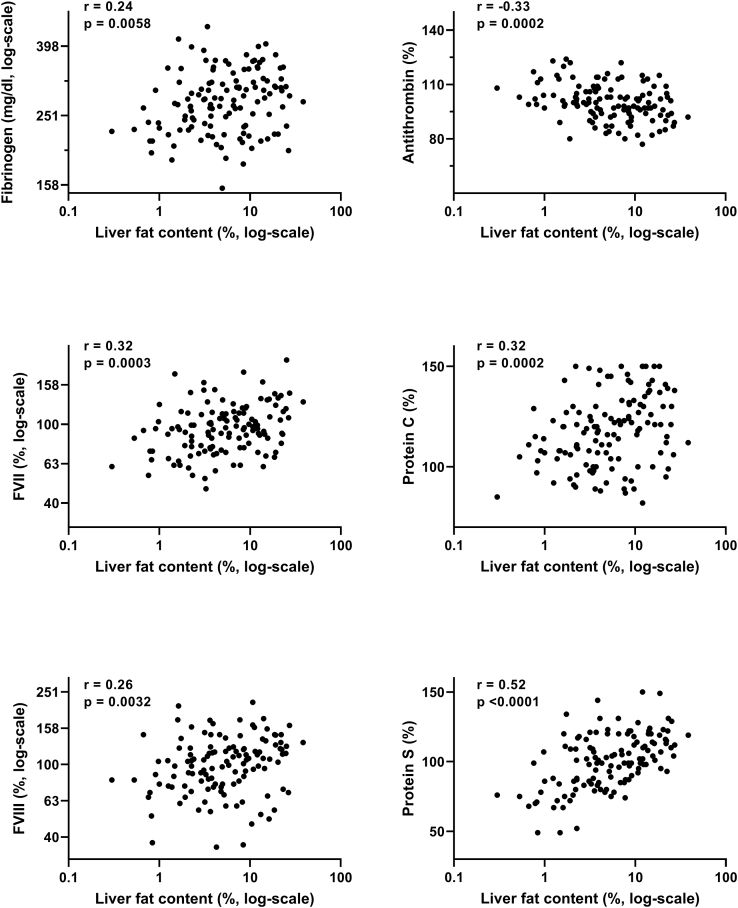
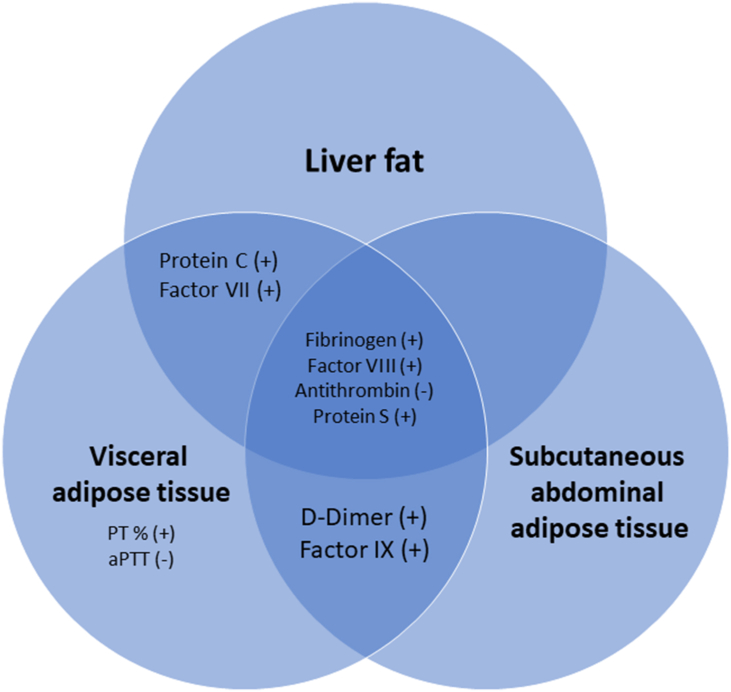
Procoagulant factors (FII, FVII, FVIII, and FIX) and anticoagulant proteins (antithrombin, protein C, and protein S) were significantly associated with body fat distribution. In patients with fatty liver, fibrinogen (298 mg/dl vs. 264 mg/dl, p = 0.0182), FVII (99% vs. 90%, p = 0.0049), FVIII (114% vs. 90%, p = 0.0098), protein C (124% vs. 111%, p = 0.0006), and protein S (109% vs. 89%, p < 0.0001) were higher than in controls. In contrast, antithrombin (97% vs. 102%, p = 0.0025) was higher in control patients. In multivariate analyses controlling for insulin sensitivity, body fat compartments, and genotype variants (PNPLA3/TM6SF2), only protein C and protein S remained significantly increased in fatty liver.
Body fat distribution is significantly associated with alterations of procoagulant and anticoagulant parameters. Liver fat plays a key role in the regulation of protein C and protein S, suggesting a potential counteracting mechanism to the prothrombotic state in subjects with prediabetes and fatty liver.
肥胖,尤其是内脏肥胖和胰岛素抵抗,已成为严重 2019 年冠状病毒病(COVID-19)的主要危险因素,而 COVID-19 与止血改变密切相关。由于肥胖和胰岛素抵抗易导致血栓性疾病,我们研究了有 2 型糖尿病风险的参与者中止血改变与体脂分布之间的关系。
使用磁共振成像和光谱法确定了 150 名参与者的体脂分布(腹部内脏和皮下脂肪组织)和肝脏脂肪含量。这些参与者糖耐量受损和/或空腹血糖受损。参与者接受了精确的代谢特征分析,并分析了主要的止血参数。
促凝因子(FII、FVII、FVIII 和 FIX)和抗凝蛋白(抗凝血酶、蛋白 C 和蛋白 S)与体脂分布显著相关。在脂肪肝患者中,纤维蛋白原(298mg/dl 比 264mg/dl,p=0.0182)、FVII(99%比 90%,p=0.0049)、FVIII(114%比 90%,p=0.0098)、蛋白 C(124%比 111%,p=0.0006)和蛋白 S(109%比 89%,p<0.0001)均高于对照组。相反,对照组的抗凝血酶(97%比 102%,p=0.0025)更高。在控制胰岛素敏感性、体脂成分和基因型变异(PNPLA3/TM6SF2)的多变量分析中,只有蛋白 C 和蛋白 S 在脂肪肝中仍显著增加。
体脂分布与促凝和抗凝参数的改变显著相关。肝脏脂肪在蛋白 C 和蛋白 S 的调节中起关键作用,这表明在有糖尿病前期和脂肪肝的患者中存在一种潜在的对抗血栓形成状态的机制。