Milne Alice E, Zhao Sijia, Tampakaki Christina, Bury Gabriela, Chait Maria
Ear Institute, University College London, London WC1X 8EE, United Kingdom
Ear Institute, University College London, London WC1X 8EE, United Kingdom.
J Neurosci. 2021 Jul 14;41(28):6116-6127. doi: 10.1523/JNEUROSCI.2879-20.2021.
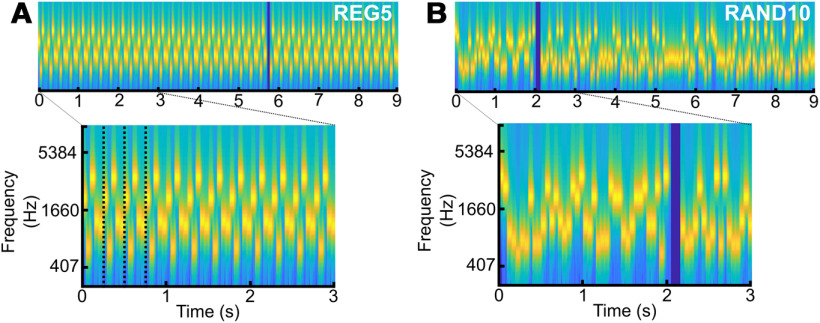
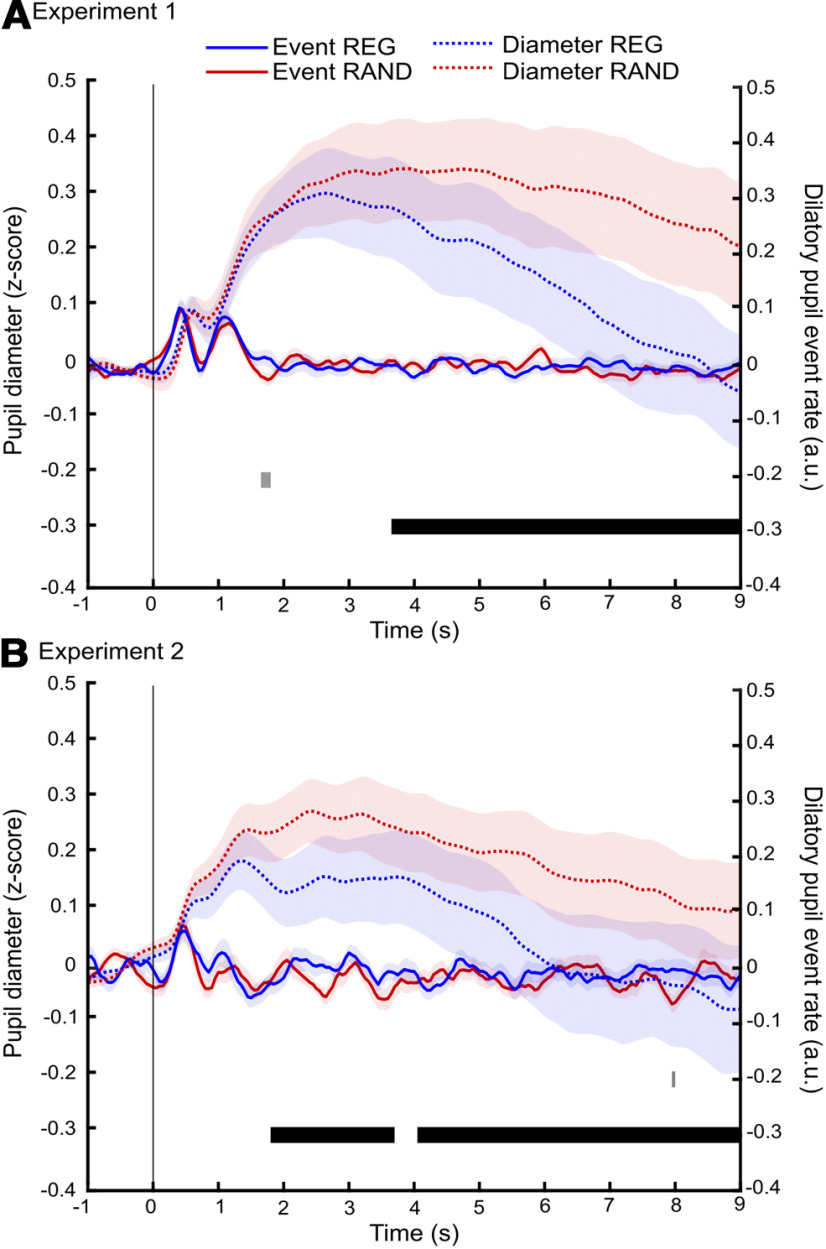
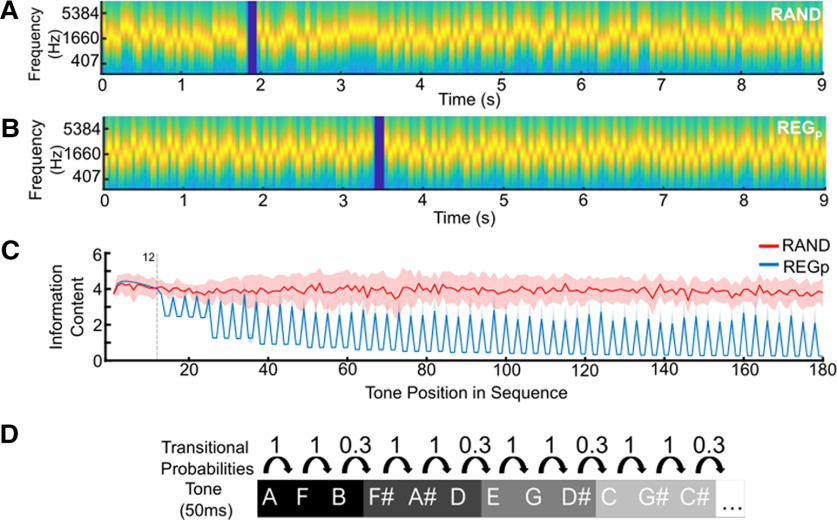
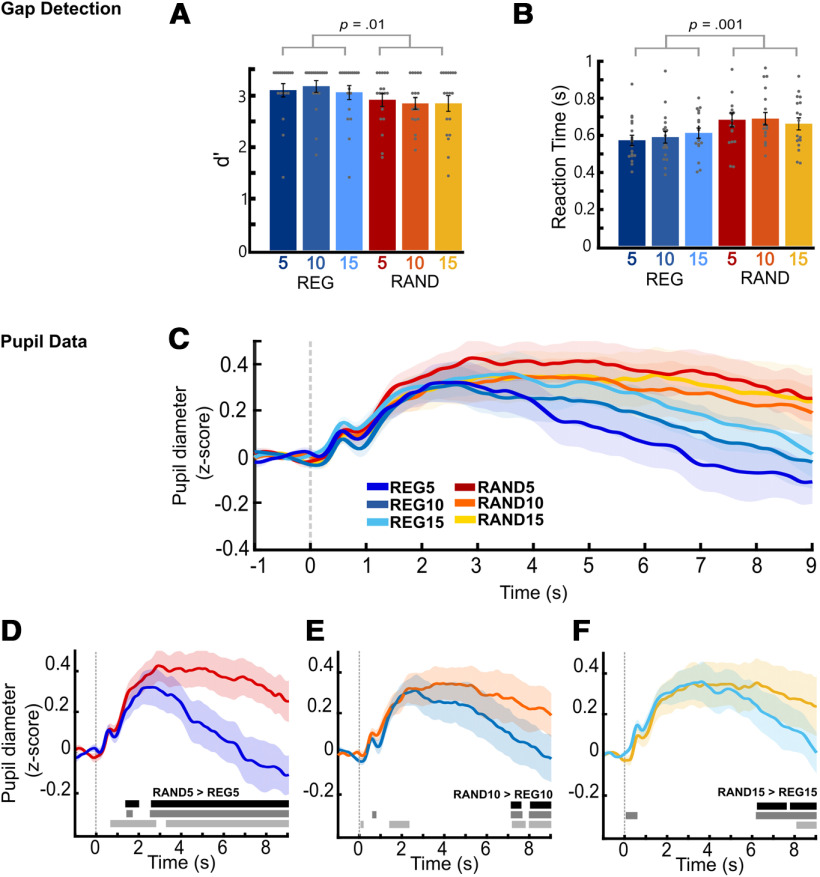
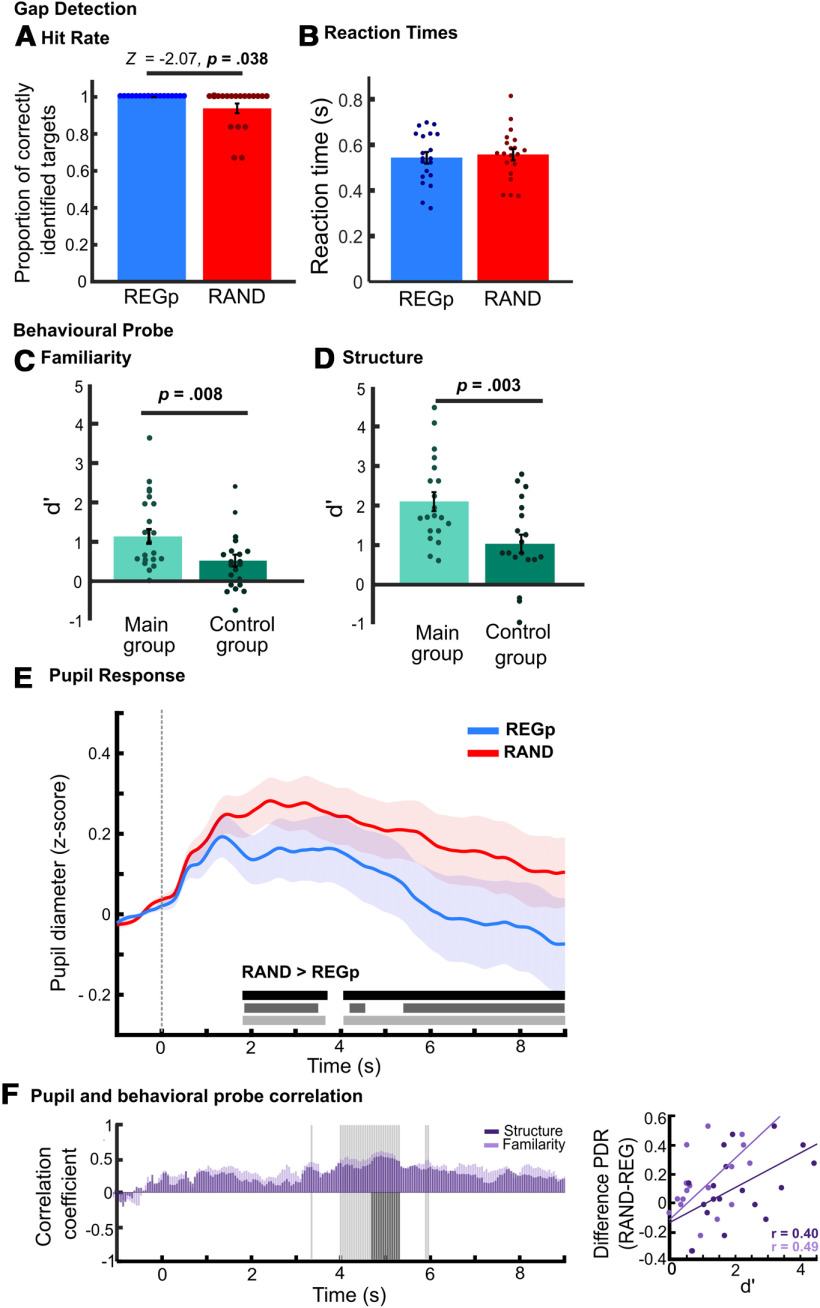
The brain is highly sensitive to auditory regularities and exploits the predictable order of sounds in many situations, from parsing complex auditory scenes, to the acquisition of language. To understand the impact of stimulus predictability on perception, it is important to determine how the detection of predictable structure influences processing and attention. Here, we use pupillometry to gain insight into the effect of sensory regularity on arousal. Pupillometry is a commonly used measure of salience and processing effort, with more perceptually salient or perceptually demanding stimuli consistently associated with larger pupil diameters. In two experiments we tracked human listeners' pupil dynamics while they listened to sequences of 50-ms tone pips of different frequencies. The order of the tone pips was either random, contained deterministic (fully predictable) regularities (experiment 1, = 18, 11 female) or had a probabilistic regularity structure (experiment 2, = 20, 17 female). The sequences were rapid, preventing conscious tracking of sequence structure thus allowing us to focus on the automatic extraction of different types of regularities. We hypothesized that if regularity facilitates processing by reducing processing demands, a smaller pupil diameter would be seen in response to regular relative to random patterns. Conversely, if regularity is associated with heightened arousal and attention (i.e., engages processing resources) the opposite pattern would be expected. In both experiments we observed a smaller sustained (tonic) pupil diameter for regular compared with random sequences, consistent with the former hypothesis and confirming that predictability facilitates sequence processing. The brain is highly sensitive to auditory regularities. To appreciate the impact that the presence of predictability has on perception, we need to better understand how a predictable structure influences processing and attention. We recorded listeners' pupil responses to sequences of tones that followed either a predictable or unpredictable pattern, as the pupil can be used to implicitly tap into these different cognitive processes. We found that the pupil showed a smaller sustained diameter to predictable sequences, indicating that predictability eased processing rather than boosted attention. The findings suggest that the pupil response can be used to study the automatic extraction of regularities, and that the effects are most consistent with predictability helping the listener to efficiently process upcoming sounds.
大脑对听觉规律高度敏感,并在许多情况下利用声音的可预测顺序,从解析复杂的听觉场景到语言习得。为了理解刺激可预测性对感知的影响,确定可预测结构的检测如何影响处理和注意力很重要。在这里,我们使用瞳孔测量法来深入了解感觉规律对唤醒的影响。瞳孔测量法是一种常用的显著性和处理努力程度的测量方法,在感知上更显著或要求更高的刺激通常与更大的瞳孔直径相关。在两个实验中,我们跟踪了人类听众在听不同频率的50毫秒音调序列时的瞳孔动态。音调序列要么是随机的,包含确定性(完全可预测)规律(实验1,n = 18,11名女性),要么具有概率性规律结构(实验2,n = 20,17名女性)。序列速度很快,防止了对序列结构的有意识跟踪,从而使我们能够专注于不同类型规律的自动提取。我们假设,如果规律通过减少处理需求来促进处理,那么相对于随机模式,对规律的反应将出现较小的瞳孔直径。相反,如果规律与更高的唤醒和注意力相关(即占用处理资源),则会出现相反的模式。在两个实验中,我们都观察到与随机序列相比,规律序列的持续(紧张性)瞳孔直径更小,这与前一个假设一致,并证实了可预测性促进序列处理。大脑对听觉规律高度敏感。为了理解可预测性的存在对感知的影响,我们需要更好地理解可预测结构如何影响处理和注意力。我们记录了听众对遵循可预测或不可预测模式的音调序列的瞳孔反应,因为瞳孔可用于隐式地探究这些不同的认知过程。我们发现,瞳孔对可预测序列的持续直径较小,这表明可预测性减轻了处理负担,而不是增强了注意力。研究结果表明,瞳孔反应可用于研究规律的自动提取,并且这些效应与可预测性帮助听众有效处理即将到来的声音最为一致。