Sonawane Shweta Kishor, Chinnathambi Subashchandrabose
Neurobiology Group, Biochemical Sciences Division, CSIR-National Chemical Laboratory, Pune 411008, India.
Academy of Scientific and Innovative Research (AcSIR), Ghaziabad 201002, India.
Oncotarget. 2021 May 25;12(11):1083-1099. doi: 10.18632/oncotarget.27963.
Alzheimer's disease is a type of dementia denoted by progressive neuronal death due to the accumulation of proteinaceous aggregates of Tau. Post-translational modifications like hyperphosphorylation, truncation, glycation, . play a pivotal role in Tau pathogenesis. Glycation of Tau aids in paired helical filament formation and abates its microtubule-binding function. The chemical modulators of Tau PTMs, such as kinase inhibitors and antibody-based therapeutics, have been developed, but natural compounds, as modulators of Tau PTMs are not much explored.
We applied biophysical and biochemical techniques like fluorescence kinetics, oligomerization analysis and transmission electron microscopy to investigate the impact of EGCG on Tau glycation . The effect of glycation on cytoskeleton instability and its EGCG-mediated rescue were studied by immunofluorescence microscopy in neuroblastoma cells.
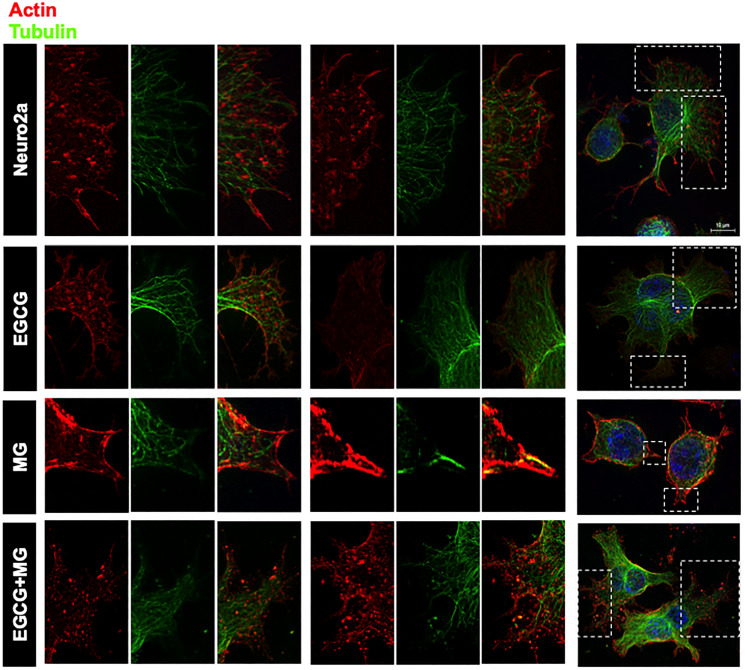
EGCG inhibited methyl glyoxal (MG)-induced Tau glycation . EGCG potently inhibited MG-induced advanced glycation endproducts formation in neuroblastoma cells as well modulated the localization of AT100 phosphorylated Tau in the cells. In addition to preventing the glycation, EGCG enhanced actin-rich neuritic extensions and rescued actin and tubulin cytoskeleton severely disrupted by MG. EGCG maintained the integrity of the Microtubule Organizing Center (MTOC) stabilized microtubules by Microtubule-associated protein RP/EB family member 1 (EB1).
We report EGCG, a green tea polyphenol, as a modulator of methylglyoxal-induced Tau glycation and its impact on reducing advanced glycation end products in neuroblastoma cells. We unravel unprecedented function of EGCG in remodeling neuronal cytoskeletal integrity.
阿尔茨海默病是一种痴呆症,其特征是由于 Tau 蛋白聚集体的积累导致神经元进行性死亡。翻译后修饰如过度磷酸化、截短、糖基化等在 Tau 蛋白发病机制中起关键作用。Tau 蛋白的糖基化有助于双螺旋丝的形成并减弱其微管结合功能。虽然已经开发了 Tau 蛋白翻译后修饰的化学调节剂,如激酶抑制剂和基于抗体的疗法,但作为 Tau 蛋白翻译后修饰调节剂的天然化合物尚未得到充分探索。
我们应用了生物物理和生化技术,如荧光动力学、寡聚化分析和透射电子显微镜,来研究表没食子儿茶素没食子酸酯(EGCG)对 Tau 蛋白糖基化的影响。通过免疫荧光显微镜在神经母细胞瘤细胞中研究了糖基化对细胞骨架不稳定性的影响及其 EGCG 介导的挽救作用。
EGCG 抑制了甲基乙二醛(MG)诱导的 Tau 蛋白糖基化。EGCG 有效抑制了神经母细胞瘤细胞中 MG 诱导的晚期糖基化终产物的形成,并调节了细胞中 AT100 磷酸化 Tau 的定位。除了防止糖基化外,EGCG 还增强了富含肌动蛋白的神经突延伸,并挽救了被 MG 严重破坏的肌动蛋白和微管细胞骨架。EGCG 通过微管相关蛋白 RP/EB 家族成员 1(EB1)维持微管组织中心(MTOC)的完整性并稳定微管。
我们报道了绿茶多酚 EGCG 作为甲基乙二醛诱导的 Tau 蛋白糖基化的调节剂及其对减少神经母细胞瘤细胞中晚期糖基化终产物的影响。我们揭示了 EGCG 在重塑神经元细胞骨架完整性方面前所未有的功能。