Tollitt James, Odudu Aghogho, Montaldi Daniela, Kalra Philip A
Renal Department, Salford Royal NHS Trust, Salford, UK.
Institute of Cardiovascular Sciences, University of Manchester, Oxford Road, Manchester, UK.
Clin Kidney J. 2020 Nov 3;14(6):1639-1648. doi: 10.1093/ckj/sfaa178. eCollection 2021 Jun.
Cognitive impairment in chronic kidney disease (CKD) is common and underrecognized [1, 2]. Determining risk factors for cognitive impairment and whether speed of CKD progression is an important consideration may help identify cognitive impairment by nephrologists. Vascular disease is thought to underpin cognitive impairment in CKD and by segregating CKD patients with proven vascular disease, we may also be able to discover other important associations with cognitive impairment in CKD patients.
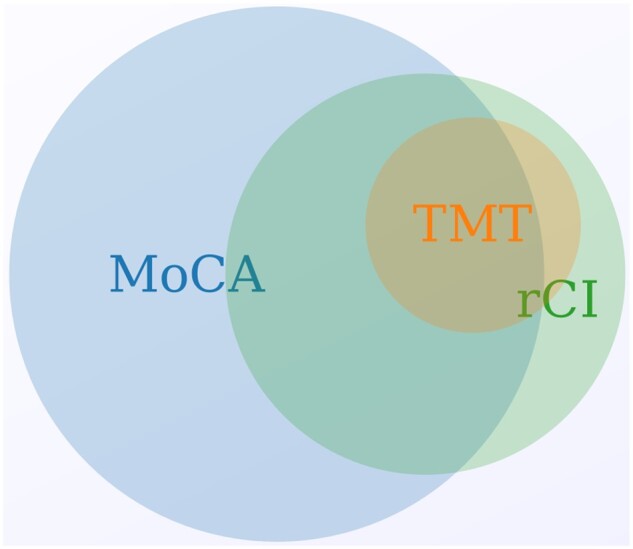
A total of 250 patients in a UK prospective cohort of CKD patients underwent two cognitive assessments: Montreal Cognitive Assessment test and Trail Making Test. Cognitive impairment was defined using validated population cut-offs (cognitive impairment) and relative cognitive impairment. Relative cognitive impairment was defined by <1 standard deviation below the mean -score on any completed test. Two multivariable logistical regression models identified variables associated with cognitive impairment and realtive cognitive impairment.
About 44 and 24.8% of patients suffered cognitive impairment and relative cognitive impairment, respectively. Depression, previous stroke and older age were significantly associated with cognitive impairment. Older age was significantly associated with relative cognitive impairment (P ≤ 0.05) and higher proteinuria and the use of psychodynamic medications were also significantly associated with relative cognitive impairment (P = 0.05). Delta estimated glomerular filtration rate (eGFR) in patients with cognitive impairment and relative cognitive impairment compared with those having normal cognition was similar (-0.77 versus -1.35 mL/min/1.73 m/year, P = 0.34 for cognitive impairment and -1.12 versus -1.02 mL/min/1.73 m/year, P = 0.89 for relative cognitive impairment).
Risk factors for cognitive impairment in CKD include previous stroke, depression or anxiety, higher proteinuria and prescription of psychodynamic medications. Patients with a faster eGFR decline do not represent a group of patients at increased risk of cognitive impairment.
慢性肾脏病(CKD)中的认知障碍很常见且未得到充分认识[1,2]。确定认知障碍的危险因素以及CKD进展速度是否是一个重要的考虑因素,可能有助于肾病学家识别认知障碍。血管疾病被认为是CKD认知障碍的基础,通过将已证实患有血管疾病的CKD患者区分开来,我们或许还能发现与CKD患者认知障碍的其他重要关联。
在英国一个CKD患者前瞻性队列中,共有250名患者接受了两项认知评估:蒙特利尔认知评估测试和连线测验。使用经过验证的人群临界值(认知障碍)和相对认知障碍来定义认知障碍。相对认知障碍定义为在任何完成的测试中得分低于平均分1个标准差以下。两个多变量逻辑回归模型确定了与认知障碍和相对认知障碍相关的变量。
分别约有44%和24.8%的患者患有认知障碍和相对认知障碍。抑郁、既往中风和高龄与认知障碍显著相关。高龄与相对认知障碍显著相关(P≤0.05),更高的蛋白尿和使用精神动力药物也与相对认知障碍显著相关(P = 0.05)。与认知正常的患者相比,患有认知障碍和相对认知障碍的患者的估计肾小球滤过率(eGFR)变化相似(认知障碍患者为-0.77 vs -1.35 mL/min/1.73 m²/年,P = 0.34;相对认知障碍患者为-1.12 vs -1.02 mL/min/1.73 m²/年,P = 0.89)。
CKD认知障碍的危险因素包括既往中风、抑郁或焦虑、更高的蛋白尿以及精神动力药物的处方。eGFR下降较快的患者并不代表认知障碍风险增加的患者群体。