Cominal Juçara Gastaldi, Cacemiro Maira da Costa, Berzoti-Coelho Maria Gabriela, Pereira Illy Enne Gomes, Frantz Fabiani Gai, Souto Elizabeth Xisto, Covas Dimas Tadeu, de Figueiredo-Pontes Lorena Lobo, Oliveira Maria Carolina, Malmegrim Kelen Cristina Ribeiro, de Castro Fabíola Attié
Department of Clinical Analyses, Toxicology and Food Science, School of Pharmaceutical Sciences of Ribeirão Preto, University of São Paulo, Ribeirão Preto, Brazil.
Center for Cell-Based Therapy, Regional Blood Center of Ribeirão Preto Medical School, University of São Paulo, Ribeirão Preto, Brazil.
Front Oncol. 2021 May 18;11:665037. doi: 10.3389/fonc.2021.665037. eCollection 2021.
Essential thrombocythemia (ET), polycythemia vera (PV), and primary myelofibrosis (PMF) are clonal hematological diseases classified as Philadelphia chromosome-negative myeloproliferative neoplasms (MPN). MPN pathogenesis is associated with the presence of somatic driver mutations, bone marrow (BM) niche alterations, and tumor inflammatory status. The relevance of soluble mediators in the pathogenesis of MPN led us to analyze the levels of cytokines, chemokines, and growth factors related to inflammation, angiogenesis and hematopoiesis regulation in the BM niche of MPN patients.
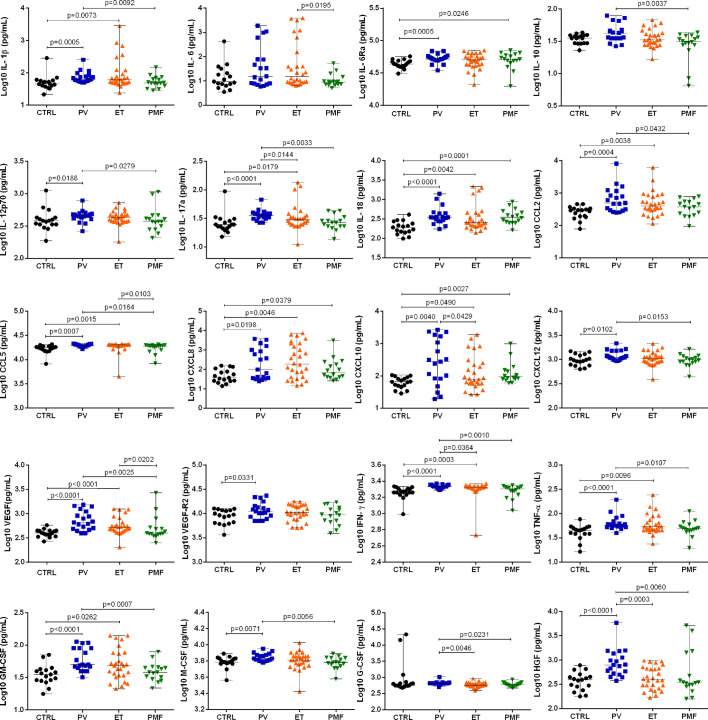
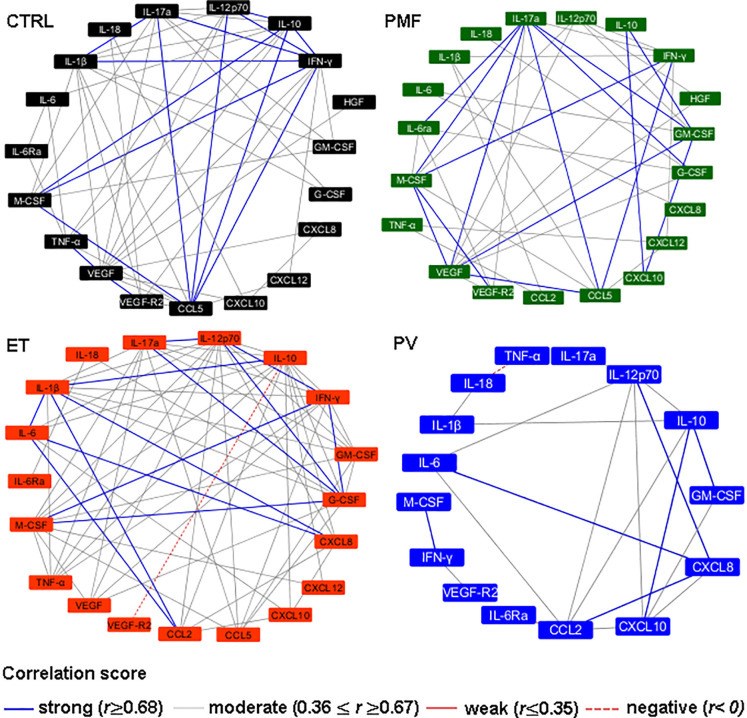
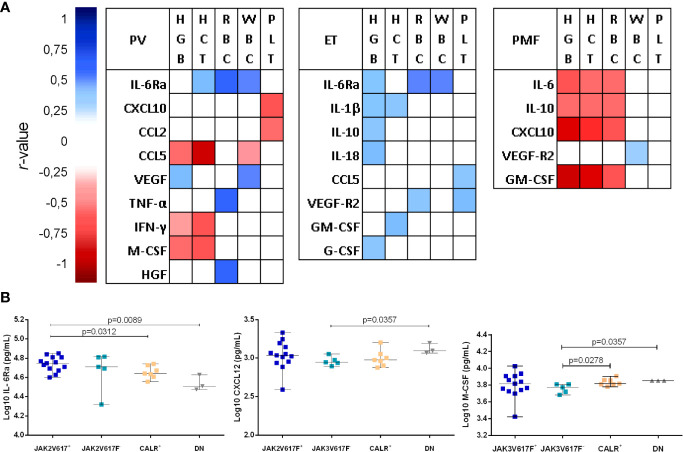
Soluble mediator levels in BM plasma samples from 17 healthy subjects, 28 ET, 19 PV, and 16 PMF patients were determined using a multiplex assay. Soluble mediator signatures were created from categorical analyses of high mediator producers. Soluble mediator connections and the correlation between plasma levels and clinic-laboratory parameters were also analyzed.
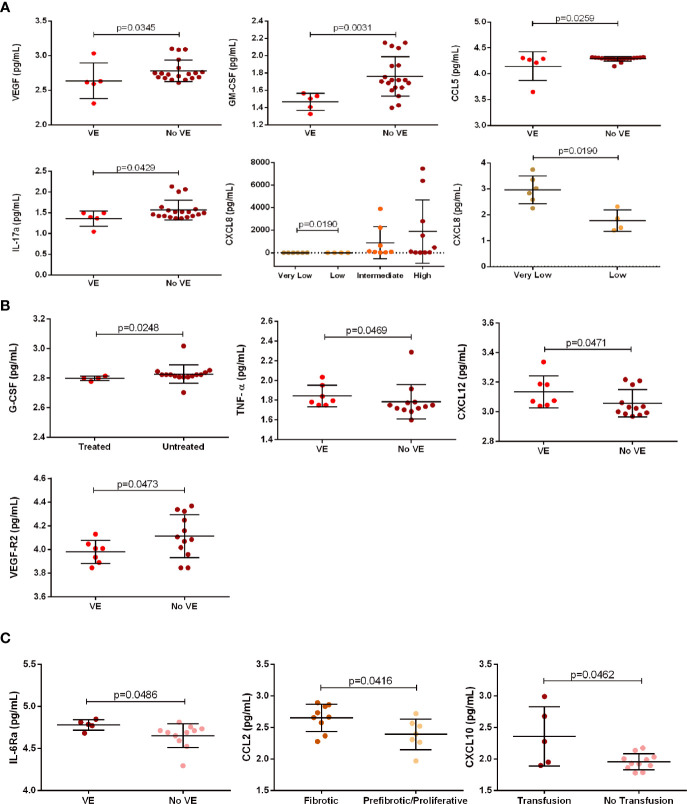
The soluble mediator signatures of the BM niche of PV patients revealed a highly inflammatory and pro-angiogenic milieu, with increased levels of chemokines (CCL2, CCL5, CXCL8, CXCL12, CXCL10), and growth factors (GM-CSF M-CSF, HGF, IFN-γ, IL-1β, IL-6Ra, IL-12, IL-17, IL-18, TNF-α, VEGF, and VEGF-R2). ET and PMF patients presented intermediate inflammatory and pro-angiogenic profiles. Deregulation of soluble mediators was associated with some clinic-laboratory parameters of MPN patients, including vascular events, treatment , risk stratification of disease, hemoglobin concentration, hematocrit, and red blood cell count.
Each MPN subtype exhibits a distinct soluble mediator signature. Deregulated production of BM soluble mediators may contribute to MPN pathogenesis and BM niche modification, provides pro-tumor stimuli, and is a potential target for future therapies.
原发性血小板增多症(ET)、真性红细胞增多症(PV)和原发性骨髓纤维化(PMF)是归类为费城染色体阴性骨髓增殖性肿瘤(MPN)的克隆性血液系统疾病。MPN的发病机制与体细胞驱动突变的存在、骨髓(BM)微环境改变以及肿瘤炎症状态有关。可溶性介质在MPN发病机制中的相关性促使我们分析MPN患者BM微环境中与炎症、血管生成和造血调节相关的细胞因子、趋化因子和生长因子水平。
使用多重检测法测定17名健康受试者、28名ET患者、19名PV患者和16名PMF患者的BM血浆样本中的可溶性介质水平。通过对高介质产生者的分类分析创建可溶性介质特征。还分析了可溶性介质连接以及血浆水平与临床实验室参数之间的相关性。
PV患者BM微环境的可溶性介质特征显示出高度炎症和促血管生成的环境,趋化因子(CCL2、CCL5、CXCL8、CXCL12、CXCL10)和生长因子(GM-CSF、M-CSF、HGF、IFN-γ、IL-1β、IL-6Ra、IL-12、IL-17、IL-18、TNF-α、VEGF和VEGF-R2)水平升高。ET和PMF患者呈现出中等程度的炎症和促血管生成特征。可溶性介质的失调与MPN患者的一些临床实验室参数相关,包括血管事件、治疗、疾病风险分层、血红蛋白浓度、血细胞比容和红细胞计数。
每种MPN亚型都表现出独特的可溶性介质特征。BM可溶性介质的失调产生可能有助于MPN的发病机制和BM微环境改变,提供促肿瘤刺激,并且是未来治疗的潜在靶点。