Department of Earth Sciences, Sapienza University of Rome, Piazzale Aldo Moro 5, 00185, Rome, Italy.
Department of Geosciences, University of Padua, Via Gradenigo 6, 35131, Padua, Italy.
Environ Sci Pollut Res Int. 2021 Jul;28(26):35286-35296. doi: 10.1007/s11356-021-14558-2. Epub 2021 Jun 3.
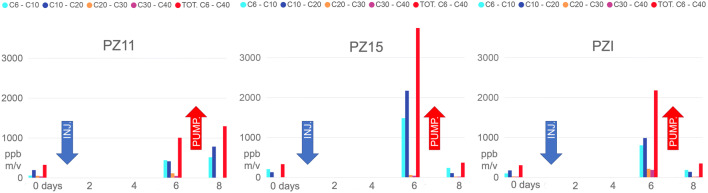
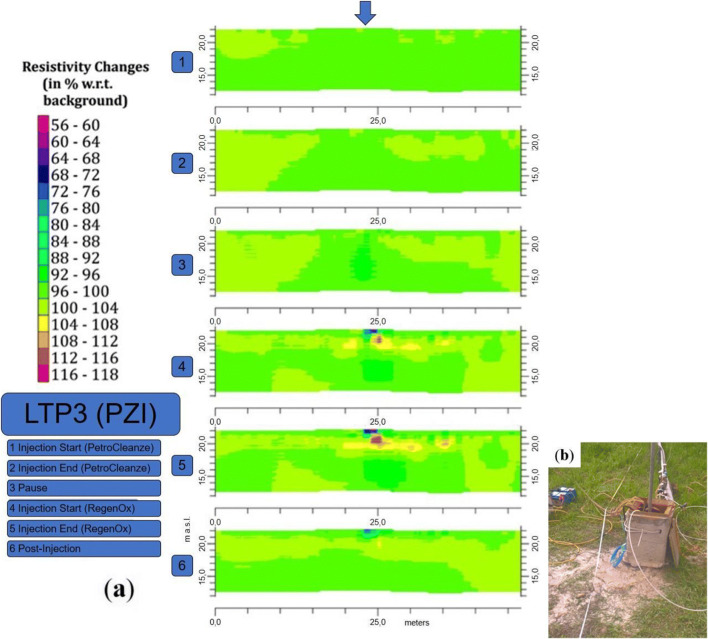
The remediation of petroleum-contaminated soil and groundwater is a challenging task. The petroleum hydrocarbons have a long persistence in both the vadose zone and in the aquifer and potentially represent secondary and residual sources of contamination. This is particularly evident in the presence of residual free-phase. Pump-and-treat is the most common hydrocarbon decontamination strategy. Besides, it acts primarily on the water dissolved phase and reduces concentrations of contaminants to an asymptotic trend. This study presents a case of enhanced light non-aqueous phase liquid (LNAPL) remediation monitored using noninvasive techniques. A pilot-scale field experiment was conducted through the injection of reagents into the subsoil to stimulate the desorption and the oxidation of residual hydrocarbons. Geophysical and groundwater monitoring during pilot testing controlled the effectiveness of the intervention, both in terms of product diffusion capacity and in terms of effective reduction of pollutant concentrations. In particular, non-invasive monitoring of the reagent migration and its capability to reach the target areas is a major add-on to the remediation technique. Most of the organic contaminants were decomposed, mobilized, and subsequently removed using physical recovery techniques. A considerable mass of contaminant was recovered resulting in the reduction of concentrations in the intervention areas.
受石油污染的土壤和地下水的修复是一项具有挑战性的任务。石油烃在包气带和含水层中具有较长的持久性,并且可能代表二次和残余污染源。在存在残余游离相的情况下尤其如此。泵吸和处理是最常见的烃类污染去除策略。此外,它主要作用于水溶解相,并将污染物浓度降低到渐近趋势。本研究介绍了使用非侵入性技术监测强化轻质非水相液体 (LNAPL) 修复的案例。通过向土壤中注入试剂,进行了小规模现场试验,以刺激残余烃类的解吸和氧化。在试点测试期间进行的地球物理和地下水监测控制了干预措施的有效性,无论是在产品扩散能力方面,还是在有效降低污染物浓度方面。特别是,对试剂迁移及其到达目标区域的能力进行非侵入性监测是修复技术的主要附加功能。大部分有机污染物被分解、迁移,并随后使用物理回收技术去除。大量污染物被回收,从而降低了干预区域的浓度。