Eye Center, Renmin Hospital of Wuhan University, Wuhan, 430060, China.
School of Public Health, Fudan University, Shanghai, 200433, China.
BMC Public Health. 2021 Jun 4;21(1):1065. doi: 10.1186/s12889-021-11097-w.
Population-based screening was essential for glaucoma management. Although various studies have investigated the cost-effectiveness of glaucoma screening, policymakers facing with uncontrollably growing total health expenses were deeply concerned about the potential financial consequences of glaucoma screening. This present study was aimed to explore the impact of glaucoma screening with artificial intelligence (AI) automated diagnosis from a budgetary standpoint in Changjiang county, China.
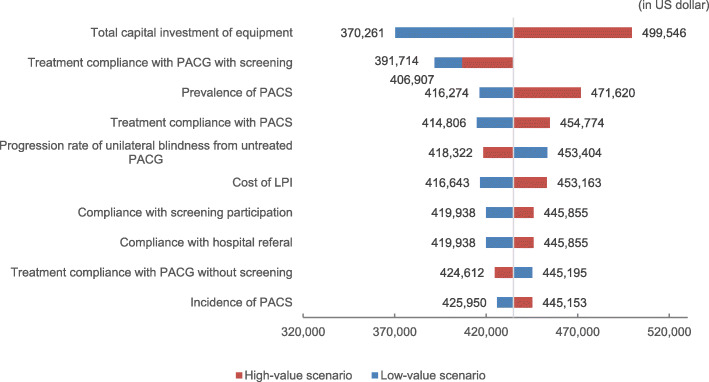
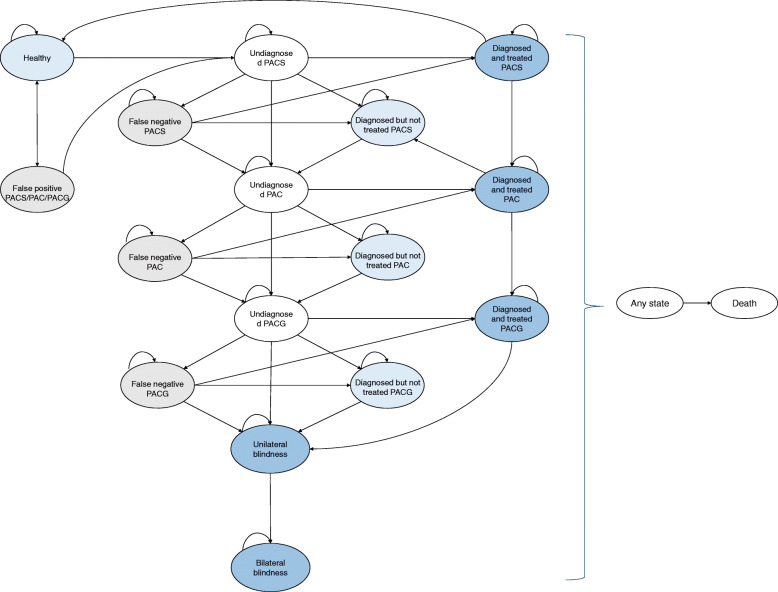
A Markov model based on health care system's perspective was adapted from previously published studies to predict disease progression and healthcare costs. A cohort of 19,395 individuals aged 65 and above were simulated over a 15-year timeframe. Fur illustrative purpose, we only considered primary angle-closure glaucoma (PACG) in this study. Prevalence, disease progression risks between stages, compliance rates were obtained from publish studies. We did a meta-analysis to estimate diagnostic performance of AI automated diagnosis system from fundus image. Screening costs were provided by the Changjiang screening programme, whereas treatment costs were derived from electronic medical records from two county hospitals. Main outcomes included the number of PACG patients and health care costs. Cost-offset analysis was employed to compare projected health outcomes and medical care costs under the screening with what they would have been without screening. One-way sensitivity analysis was conducted to quantify uncertainties around model results.
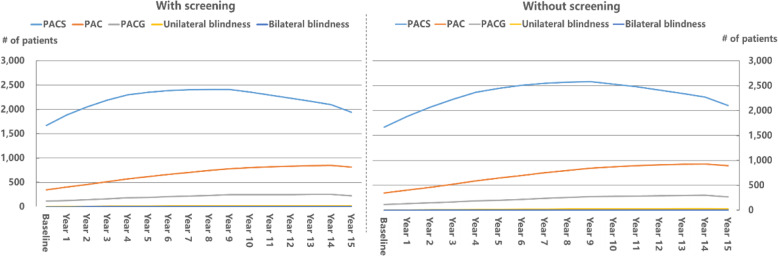
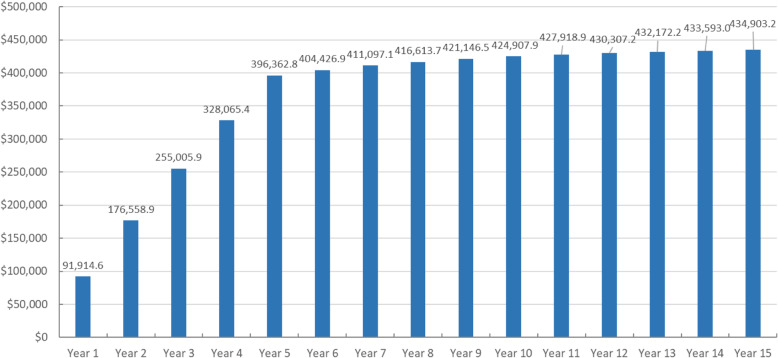
Among people aged 65 and above in Changjiang county, it was predicted that there were 1940 PACG patients under the AI-assisted screening scenario, compared with 2104 patients without screening in 15 years' time. Specifically, the screening would reduce patients with primary angle closure suspect by 7.7%, primary angle closure by 8.8%, PACG by 16.7%, and visual blindness by 33.3%. Due to early diagnosis and treatment under the screening, healthcare costs surged dramatically to $107,761.4 dollar in the first year and then were constantly declining over time, while without screening costs grew from $14,759.8 in the second year until peaking at $17,900.9 in the 9th year. However, cost-offset analysis revealed that additional healthcare costs resulted from the screening could not be offset by decreased disease progression. The 5-, 10-, and 15-year accumulated incremental costs of screening versus no screening were estimated to be $396,362.8, $424,907.9, and $434,903.2, respectively. As a result, the incremental cost per PACG of any stages prevented was $1464.3.
This study represented the first attempt to address decision-maker's budgetary concerns when adopting glaucoma screening by developing a Markov prediction model to project health outcomes and costs. Population screening combined with AI automated diagnosis for PACG in China were able to reduce disease progression risks. However, the excess costs of screening could never be offset by reduction in disease progression. Further studies examining the cost-effectiveness or cost-utility of AI-assisted glaucoma screening were needed.
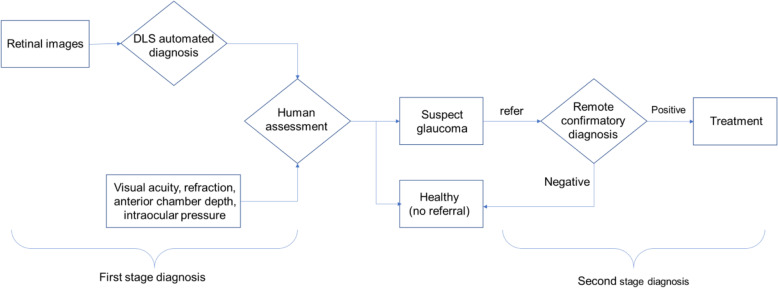
人群筛查对于青光眼管理至关重要。尽管已有多项研究探讨了青光眼筛查的成本效益,但面临医疗保健总费用不断增长的决策者们仍对青光眼筛查可能带来的财务后果深感担忧。本研究旨在从预算角度探讨中国长江县人工智能(AI)自动诊断青光眼筛查的影响。
从先前发表的研究中改编了一个基于医疗保健系统视角的马尔可夫模型,以预测疾病进展和医疗保健成本。模拟了一个年龄在 65 岁及以上的 19395 人的队列,时间跨度为 15 年。为了说明问题,本研究仅考虑了原发性闭角型青光眼(PACG)。患病率、各阶段疾病进展风险、依从率均来自已发表的研究。我们进行了荟萃分析,以从眼底图像估计 AI 自动诊断系统的诊断性能。筛查成本由长江筛查项目提供,而治疗成本则来自两家县级医院的电子病历。主要结局包括 PACG 患者数量和医疗保健费用。采用成本抵消分析比较了筛查组和非筛查组的预期健康结果和医疗费用。进行了单因素敏感性分析,以量化模型结果的不确定性。
在长江县 65 岁及以上的人群中,预计在 AI 辅助筛查方案下,15 年内将有 1940 例 PACG 患者,而无筛查组则有 2104 例。具体而言,筛查将使原发性闭角型青光眼疑似患者减少 7.7%,原发性闭角型青光眼减少 8.8%,PACG 减少 16.7%,视力丧失减少 33.3%。由于筛查下的早期诊断和治疗,医疗保健费用在第一年飙升至 107761.4 美元,然后随着时间的推移持续下降,而无筛查费用则从第二年的 14759.8 美元增加到第九年的 17900.9 美元。然而,成本抵消分析显示,筛查带来的额外医疗费用无法被疾病进展的减少所抵消。与不筛查相比,筛查的 5 年、10 年和 15 年累计增量成本预计分别为 396362.8、424907.9 和 434903.2 美元。因此,任何阶段可预防的 PACG 的增量成本为 1464.3 美元。
本研究首次尝试通过开发马尔可夫预测模型来预测健康结果和成本,以解决决策者在采用青光眼筛查时的预算问题。中国的人群筛查结合 AI 自动诊断原发性闭角型青光眼,可以降低疾病进展风险。然而,筛查带来的额外成本永远无法被疾病进展的减少所抵消。需要进一步研究 AI 辅助青光眼筛查的成本效益或成本效用。