Department of Medical Education, Tokyo Women's Medical University, 8-1, Kawada-cho, Shinjuku-ku, Tokyo, 162-8666, Japan.
Department of Orthopaedic Surgery, Tokyo Women's Medical University, 8-1, Kawada-cho, Shinjuku-ku, Tokyo, 162-8666, Japan.
BMC Med Educ. 2021 Jun 5;21(1):322. doi: 10.1186/s12909-021-02742-4.
The traditional curriculum for medical students in Japan does not include sufficient opportunities for students to develop their skills for musculoskeletal (MSK) examination and clinical reasoning and diagnosis. Therefore, an effective programme is required to help medical students and residents improve their clinical skills in MSK. This paper aims to assess the clinical skills of medical students who have participated in a peer role-playing simulation programme using a mini clinical evaluation exercise (mini-CEX).
Participants were 90 female medical students who were completing their first orthopaedic clinical clerkship. They were divided into two groups. The simulation group participated in a role-play focussed on MSK cases as low-fidelity simulation, a structured debriefing with the course supervisor, and a self-reflection on Day 1 (n = 64). The control group did not participate in the role-play due to randomised clerkship schedules (n = 26). On Day 2 of the intervention, we observed and assessed all participants' performances during MSK outpatient encounters using the mini-CEX. We compared the mini-CEX score between the simulation group and the control group; the Wilcoxon rank-sum test was used for statistical analysis.
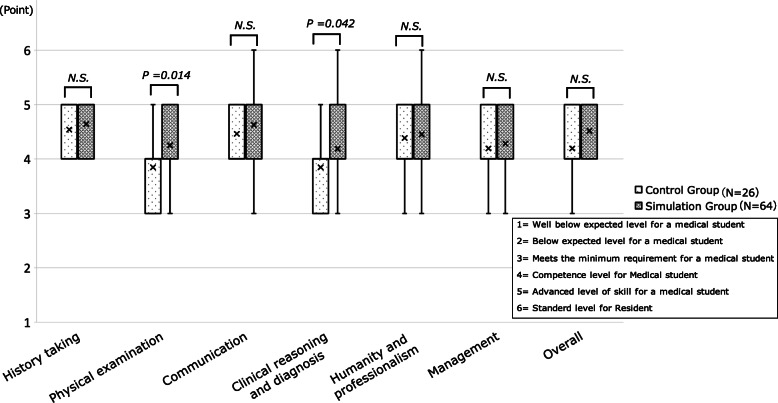
The mini-CEX scores for physical examination, clinical reasoning and diagnosis, and overall clinical competency were significantly higher in the simulation group than in the control group (p < .05, physical examination: p = .014, clinical reasoning: p = .042, overall: p = .016). These findings suggest that medical students who partake in a peer role-playing simulation programme could experience improved clinical skills for physical examination, clinical reasoning and diagnosis, and overall clinical competency in real-life MSK outpatient encounters.
Through a mini-CEX assessment, our findings indicate that medical students who participated in our peer role-playing simulation programme have improved clinical skills. Peer role-playing as a low-fidelity simulation and practical educational opportunity will enable educators to polish the competency of medical students in musculoskeletal physical examinations and clinical reasoning and diagnosis in a clinical setting.
日本医学生的传统课程并未为学生提供足够的机会来发展其肌肉骨骼 (MSK) 检查以及临床推理和诊断技能。因此,需要一个有效的方案来帮助医学生和住院医师提高他们在 MSK 方面的临床技能。本文旨在通过迷你临床演练评估 (mini-CEX) 评估参加同伴角色扮演模拟项目的医学生的临床技能。
参与者为 90 名正在完成第一个骨科临床实习的女医学生。他们被分为两组。模拟组参加了以 MSK 病例为重点的角色扮演,即低保真模拟、与课程主管进行的结构化讨论以及第一天的自我反思 (n = 64)。由于随机安排的实习时间表,对照组未参加角色扮演 (n = 26)。在干预的第二天,我们使用 mini-CEX 观察并评估了所有参与者在 MSK 门诊就诊期间的表现。我们比较了模拟组和对照组的 mini-CEX 评分;使用 Wilcoxon 秩和检验进行统计分析。
模拟组的体格检查、临床推理和诊断以及整体临床能力的 mini-CEX 评分明显高于对照组 (p <.05,体格检查:p =.014,临床推理:p =.042,整体:p =.016)。这些发现表明,参加同伴角色扮演模拟项目的医学生在现实生活中的 MSK 门诊就诊中可能会体验到体格检查、临床推理和诊断以及整体临床能力的提高。
通过 mini-CEX 评估,我们的发现表明,参加我们的同伴角色扮演模拟项目的医学生的临床技能有所提高。同伴角色扮演作为一种低保真模拟和实践教育机会,将使教育者能够在临床环境中磨练医学生在肌肉骨骼体格检查和临床推理与诊断方面的能力。