Department of Optometry, Radiography and Lighting Design, Faculty of Health and Social Sciences, University of South-Eastern Norway, University of South-Eastern Norway, Post office box 235, 3603, Kongsberg, Norway.
BMC Health Serv Res. 2021 Jun 5;21(1):554. doi: 10.1186/s12913-021-06591-1.
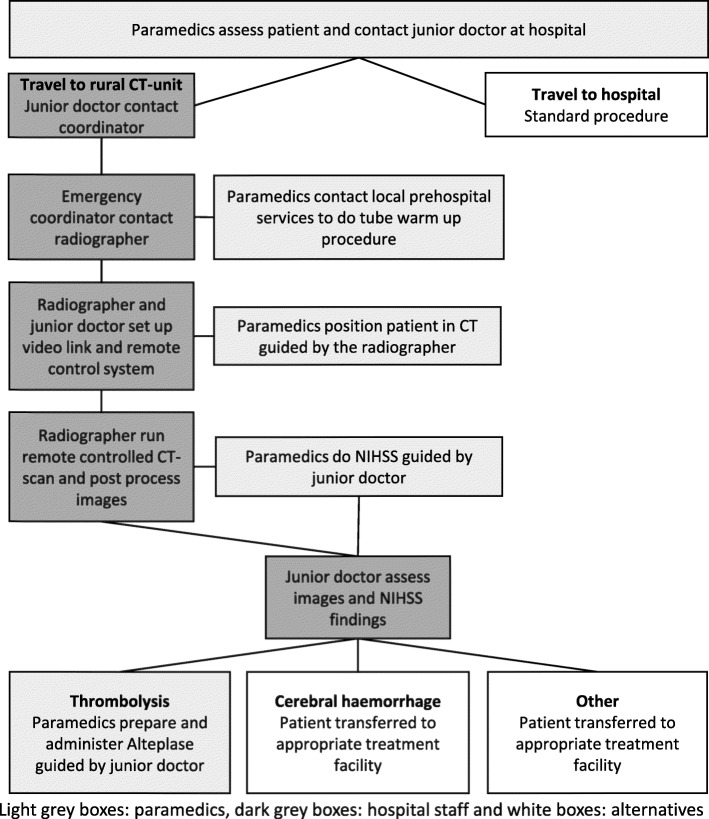
In the case of ischemic stroke, access to a Computed Tomography (CT) scanner and the start of thrombolytic therapy immediately is imperative. Transport to the nearest hospital from the remote, rural area of Hallingdal in Norway entails a 2-3 h drive. The local medical centre in this area has a CT-scanner operated by radiographers during office hours. Out-of-hours stroke evaluation and treatment has been the focus of a research project. Paramedics position the patient in the CT-scanner. A radiographer at the participating hospital runs a remote-controlled scan and a junior doctor instructs a paramedic in the performance of a neurological examination. The aim of this study was to explore how radiographers, paramedics and junior doctors experience conducting telemedicine-based stroke evaluation and treatment.
Six semi-structured interviews were conducted with radiographers, paramedics and junior doctors; with remote control, CT examination and stroke management as central issues. Core issues in the interview guide were: communication; cooperation; competence; service quality and training. The study employed thematic content analysis in analysing the data inductively.
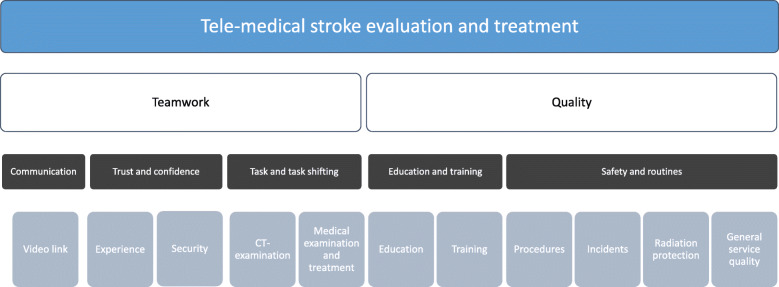
The analysis gave an overview of the patient flow and communication routines in this service. Further findings were divided into two main themes, "Teamwork" and "Quality". The theme "Teamwork" included three categories "Communication", "Trust and confidence", and "Task and task shifting". The theme "Quality" included two categories "Education and training" and "Safety and routines". The respondents considered the service to be of high quality and that the team functioned at a high level as a result of regular training sessions. However, communication and image reading routines could be improved.
The telemedicine-based, remote controlled, stroke evaluation and treatment was experienced, by the participants, to be well organised and of high quality. Communication and image reading appear to be the salient challenges. Regular training sessions and follow-up, as well as an evaluation of incidents by the project manager, proved to be of great importance in retaining and securing the continued running of the service and ensuring high-quality treatment. Further research is indicated in the comparison of this telemedicine service with stroke treatment given in a mainstream hospital.
在缺血性中风的情况下,立即获得计算机断层扫描(CT)扫描仪并开始溶栓治疗至关重要。从挪威哈灵达尔偏远的农村地区到最近的医院需要 2-3 小时的车程。该地区的当地医疗中心在办公时间内由放射技师操作 CT 扫描仪。非工作时间的中风评估和治疗一直是一个研究项目的重点。护理人员将患者置于 CT 扫描仪中。参与医院的放射技师远程控制扫描,初级医生指导护理人员进行神经检查。本研究旨在探讨放射技师、护理人员和初级医生在远程医疗基础上进行中风评估和治疗的体验。
对放射技师、护理人员和初级医生进行了 6 次半结构化访谈;以远程控制、CT 检查和中风管理为中心问题。访谈指南中的核心问题包括:沟通;合作;能力;服务质量和培训。该研究采用主题内容分析对数据进行归纳分析。
该分析概述了该服务中的患者流程和沟通惯例。进一步的发现分为两个主要主题,“团队合作”和“质量”。主题“团队合作”包括三个类别“沟通”、“信任和信心”和“任务和任务转移”。主题“质量”包括两个类别“教育和培训”和“安全和常规”。受访者认为该服务质量很高,并且由于定期培训课程,团队运作水平很高。但是,沟通和图像阅读常规可以改进。
基于远程医疗的远程控制中风评估和治疗被参与者认为组织良好且质量很高。沟通和图像阅读似乎是突出的挑战。定期培训课程和跟进,以及项目经理对事件的评估,对于保留和确保服务的持续运行以及确保高质量治疗非常重要。需要进一步研究将这种远程医疗服务与主流医院提供的中风治疗进行比较。