First Affiliated Hospital of Anhui Medical University, Department of Otorhinolaryngology Head and Neck Surgery, Hefei, Anhui, China.
First Affiliated Hospital of Anhui Medical University, Department of Otorhinolaryngology Head and Neck Surgery, Hefei, Anhui, China.
Braz J Otorhinolaryngol. 2022 Nov-Dec;88 Suppl 1(Suppl 1):S147-S155. doi: 10.1016/j.bjorl.2021.05.006. Epub 2021 May 29.
Allergic rhinitis is a form of IgE mediated inflammation of the nasal mucosa in response to specific allergens, resulting in typical symptoms.
This study was designed with the primary goal of comparing the clinical efficacy of posterior nasal neurectomy with or without pharyngeal neurectomy for the treatment of moderate-to-severe perennial allergic rhinitis. Secondary study aims included a comparison of the severity of comorbidities, including chronic cough and asthma, between patients in these two surgical treatment groups.
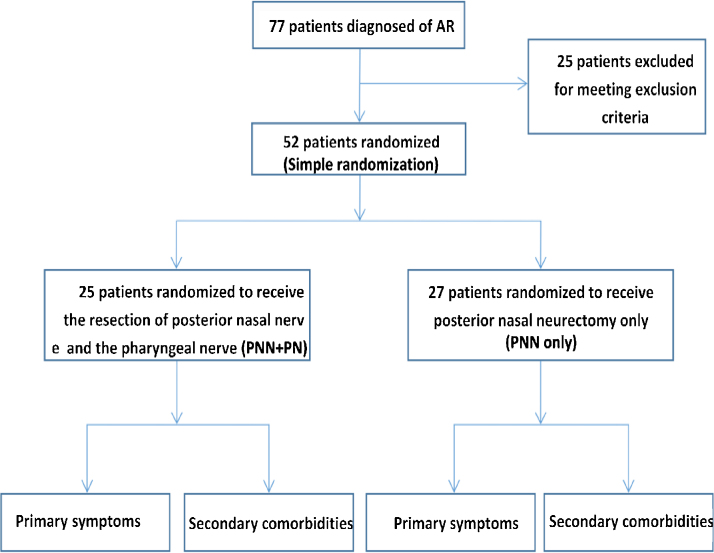
A total of 52 patients were enrolled in this randomized controlled trial and were assigned to either the control group (posterior nasal neurectomy) or the experimental group (posterior nasal neurectomy + pharyngeal neurectomy). The visual analog scale and rhinoconjunctivitis quality of life questionnaire were used to compare the differences in patient symptoms between baseline and 6-, 12-, and 24-months post-treatment. In addition, patient cough and asthma symptoms were monitored during follow-up via visual analog scale and asthma control test respectively.
No significant differences in preoperative scores were evident between groups (p > 0.05). At 6-months post-treatment, there were significant differences in visual analog scale, rhinoconjunctivitis quality of life questionnaire, and asthma control test scores relative to baseline values in experimental group and control group patients (p < 0.05), and this remained true upon 12- and 24-month follow-up. No significant differences in visual analog scale, rhinoconjunctivitis quality of life questionnaire, or asthma control test scores were observed between the two treatment groups at any postoperative follow-up time point (p > 0.05), while coughing severity was found to be significantly reduced in the experimental group relative to the control group (p < 0.05).
posterior nasal neurectomy can be safely implemented with or without pharyngeal neurectomy in order to effectively treat allergic rhinitis. Combined posterior nasal neurectomy and pharyngeal neurectomy treatment may offer greater value than posterior nasal neurectomy alone for the treatment of allergic rhinitis patients with chronic cough.
变应性鼻炎是一种针对特定过敏原的鼻黏膜 IgE 介导炎症,导致典型症状。
本研究旨在比较后鼻神经切断术联合或不联合咽神经切断术治疗中重度常年性变应性鼻炎的临床疗效。次要研究目的包括比较这两种手术治疗组患者的合并症严重程度,包括慢性咳嗽和哮喘。
这项随机对照试验共纳入 52 名患者,分为对照组(后鼻神经切断术)和实验组(后鼻神经切断术+咽神经切断术)。使用视觉模拟量表和鼻结膜炎生活质量问卷比较患者治疗前后 6 个月、12 个月和 24 个月的症状差异。此外,通过视觉模拟量表和哮喘控制测试分别监测患者的咳嗽和哮喘症状。
两组患者术前评分无显著差异(p>0.05)。治疗后 6 个月,实验组和对照组患者的视觉模拟量表、鼻结膜炎生活质量问卷和哮喘控制测试评分均较基线值有显著差异(p<0.05),12 个月和 24 个月随访时仍如此。两组患者在任何术后随访时间点的视觉模拟量表、鼻结膜炎生活质量问卷或哮喘控制测试评分均无显著差异(p>0.05),但实验组的咳嗽严重程度明显低于对照组(p<0.05)。
后鼻神经切断术可安全联合或不联合咽神经切断术治疗变应性鼻炎。对于伴有慢性咳嗽的变应性鼻炎患者,后鼻神经切断术联合咽神经切断术的治疗效果可能优于单纯后鼻神经切断术。